Utah is the only state with five separate national parks packed into one relatively compact region, a cluster so celebrated that tourism officials branded it “the Mighty 5” decades ago. Zion, Bryce Canyon, Capitol Reef, Canyonlands, and Arches sit close enough together that a single well-planned road trip can realistically hit all five, yet each one looks and feels genuinely different: red slot canyons, orange hoodoos, a 100-mile geological fold, four separated backcountry districts, and the densest concentration of natural stone arches on Earth.
Here’s the practical guide for planning a Utah parks trip: where they’re located relative to each other, what each one costs, the numbers that define them, and how their very different histories all led to the same red-rock corner of the American Southwest.
Utah’s Five National Parks Overview
| Park | Location | Established | Vehicle Entrance Fee | Signature Feature |
| Zion | Southwestern Utah, near Springdale | 1919 | $35 (7 days) | Zion Canyon, Narrows, Angels Landing |
| Bryce Canyon | Southwestern Utah, Paunsaugunt Plateau | 1928 | $35 (7 days) | Largest hoodoo concentration on Earth |
| Capitol Reef | South-central Utah, along Highway 24 | 1937 (monument); 1971 (park) | Free corridor; $20 for Scenic Drive | Waterpocket Fold, Fruita orchards |
| Canyonlands | Southeastern Utah, near Moab | 1964 | $30 (7 days) | Island in the Sky, the Needles, the Maze |
| Arches | Eastern Utah, near Moab | 1929 (monument); 1971 (park) | $30 (7 days) | Over 2,000 documented natural arches |
Where Utah’s National Parks Are Located
All five parks sit across southern and southeastern Utah, loosely connected by Highway 89 and Interstate 70, forming a rough loop that most visitors drive over a week to ten days. Zion and Bryce Canyon sit closest together in the southwest corner of the state, roughly an hour and a half apart, both within a few hours of Las Vegas or St. George. Capitol Reef sits in the middle of the state along a lonelier stretch of Highway 24, genuinely more remote than its neighbors. Canyonlands and Arches sit right next to each other near Moab in the southeast, close enough that many visitors base themselves in Moab and day-trip into both.
Salt Lake City International Airport offers the widest range of flights for a Utah-focused trip, though Las Vegas’ Harry Reid International often works better for visitors prioritizing Zion and Bryce Canyon first, and Grand Junction, Colorado provides another entry point for those starting with the Moab-area parks.
What Utah’s National Parks Cost to Visit
Entrance fees vary meaningfully across the five parks. Zion and Bryce Canyon both charge $35 per vehicle for a 7-day pass, reflecting their status among the most visited parks in the state. Canyonlands and Arches each charge $30, while Capitol Reef stands apart with a genuinely unusual structure: much of the park, including Highway 24 and the historic Fruita area, is entirely free, with a $20 fee applying only if you drive the Scenic Drive beyond the Fruita Campground.
For anyone visiting all five, the Southeast Utah Group Annual Pass covers Arches, Canyonlands, and the nearby Hovenweep and Natural Bridges National Monuments, while the $80 America the Beautiful Pass covers every fee-charging national park nationwide and typically pays for itself after just two or three park visits on a Mighty 5 road trip. One important 2026 detail: Zion and Bryce Canyon are among the eleven national parks nationwide currently charging non-U.S. residents an additional $100 per-person surcharge, while Arches, Canyonlands, and Capitol Reef are not, so international travelers should budget accordingly depending on which parks are on their itinerary.
Facts That Distinguish Each Park
Zion’s defining feature is Zion Canyon itself, carved by the Virgin River through towering sandstone walls, with hikes like Angels Landing and the Narrows drawing crowds intense enough that Angels Landing now requires a lottery permit. Bryce Canyon, despite its name, isn’t a canyon at all but a series of natural amphitheaters filled with thousands of thin rock spires called hoodoos, the largest concentration found anywhere on Earth, some rising up to 200 feet tall.
Capitol Reef centers on the Waterpocket Fold, a nearly 100-mile uplifted ridge of rock formed by the same tectonic forces that built the Rocky Mountains, alongside the surprising, still-productive orchards of Fruita, a Mormon farming settlement preserved within the park where visitors can pick fruit in season. Canyonlands splits into four distinct districts, Island in the Sky, the Needles, the Maze, and the rivers themselves, none of which connect by road, offering everything from accessible mesa-top overlooks to genuinely remote backcountry requiring four-wheel drive.
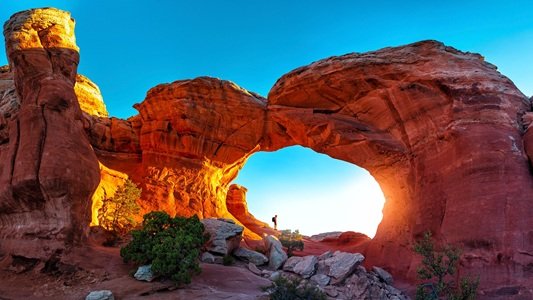
Arches protects more than 2,000 documented natural stone arches within a relatively compact area, formed as an ancient underground salt bed shifted and cracked the sandstone above it over millions of years, creating the fins and openings that erosion later carved into the arches visible today.
The History Behind Utah’s Five National Parks
Each park followed its own distinct path to federal protection, though several share a common thread: early designation as a national monument, followed decades later by full national park status. Zion, protected as Mukuntuweap National Monument in 1909, became a full national park in 1919, one of the earliest in Utah. Bryce Canyon followed a similar arc, designated a monument in 1923 before achieving park status in 1928, following a multi-year process of transferring private and state-held land to the federal government.
Capitol Reef and Arches both trace back to the 1930s, protected as national monuments in 1937 and 1929 respectively, largely thanks to persistent local advocates like Dr. A.L. Inglesby in Capitol Reef’s case and railroad promoter Alexander Ringhoffer for Arches. Both didn’t reach full national park status until 1971, within the same legislative wave. Canyonlands took the most direct path, championed by Bates Wilson’s persistent “Dutch oven diplomacy” campfire diplomacy through the 1950s and early 1960s, resulting in President Lyndon Johnson signing the park into existence in 1964 without ever passing through a preliminary monument phase.
Collectively, these five parks now draw millions of visitors annually, and Utah’s tourism industry has leaned heavily into the “Mighty 5” branding since the early 2010s, a marketing effort credited with substantially boosting visitation, and occasionally overcrowding, at all five parks over the past decade.
Frequently Asked Questions
Q1. How many days should I budget to visit all five Utah national parks?
Most travelers need at least 7 to 10 days to see all five without feeling rushed, given the driving distances involved, particularly the stretch between Capitol Reef and the Moab-area parks. A tighter 5-day trip is possible if you focus on shorter visits to each.
Q2. Which park should I prioritize if I only have time for two or three?
Zion and Bryce Canyon pair naturally together given their proximity and offer dramatically different scenery within a short drive of each other. Arches and Canyonlands make a similarly efficient pairing near Moab if your time or route favors the eastern side of the state.
Q3. Do I need reservations or permits for any of these parks?
Zion’s Angels Landing requires a lottery permit, and several parks require separate reservations for specific hikes or camping. Arches dropped its timed-entry requirement for 2026, but always check each park’s current reservation policy before your trip, since rules shift from year to year.
Q4. Is one pass enough to cover all five parks, or do I need separate tickets?
The $80 America the Beautiful Pass covers standard entrance fees at all five, making it the simplest option for a full Mighty 5 road trip. It does not cover Zion and Bryce Canyon’s international nonresident surcharge, guided tours, or camping fees, which remain separate costs regardless of pass type.