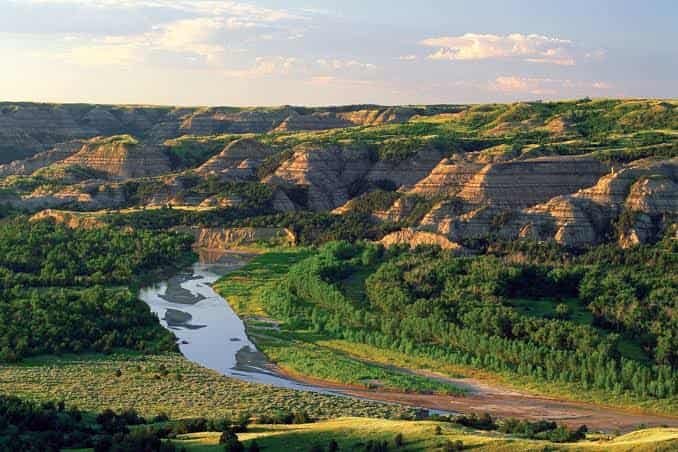
On February 14, 1884, Theodore Roosevelt’s mother and his wife died in the same house, hours apart, on the same day. Devastated, the future president left New York and fled to the badlands of the Dakota Territory, where he threw himself into ranching and hunting bison across a landscape of eroded buttes and winding river valleys. That personal tragedy, and the years he spent recovering here, shaped the conservation philosophy Roosevelt later carried into the White House, where he protected roughly 230 million acres of American public land. Fittingly, this is the only national park named after a single person, honoring the place that arguably made him a conservationist in the first place.
Here’s the practical guide for anyone planning a visit: where the park sits, what it costs, the numbers behind its rugged three-part layout, and the unusual path from wildlife refuge to memorial park to full national park status.
Theodore Roosevelt National Park Overview
| Category | Details |
| Location | Western North Dakota, Billings and McKenzie counties |
| Park units | South Unit (Medora), North Unit (near Watford City), and Elkhorn Ranch Unit |
| Nearest airport | Dickinson-Theodore Roosevelt Regional Airport (DIK) |
| Established | National Memorial Park on April 25, 1947; national park on November 10, 1978 |
| Total area | About 70,446 acres |
| Vehicle entrance fee | $30, valid 1–7 days |
| Motorcycle fee | $25 |
| Per-person fee (foot/bicycle) | $15 |
| Annual Park Pass | $55 |
| America the Beautiful Annual Pass | $80 (all U.S. national parks) |
| Wilderness designation | 29,920 acres, designated in 1978 |
| Bison reintroduced | 1956 |
| Annual visitation | Around 550,000 to 800,000 visitors |
Where Theodore Roosevelt National Park Is Located
Theodore Roosevelt National Park sits in the badlands of western North Dakota, split into three geographically separate units connected loosely by the Little Missouri River and surrounded by the Little Missouri National Grassland. The South Unit, home to park headquarters and the visitor center, sits directly in the town of Medora, right off Interstate 94. The North Unit lies roughly 68 miles away, accessed via Highway 85 about 15 minutes south of Watford City. The remote Elkhorn Ranch Unit, where Roosevelt’s own cabin once stood, sits between the two main units and is reachable only via gravel roads, requiring more deliberate planning to visit.
Dickinson-Theodore Roosevelt Regional Airport offers the closest air access, though many visitors reach the park by car as part of a broader North Dakota or upper Midwest road trip, since the three units are spread out enough that visiting all of them takes real time and driving.
What It Costs to Visit
A standard vehicle pass costs $30, valid for one to seven days depending on purchase. Motorcycles pay $25, and visitors on foot or bicycle pay $15 per person. Frequent visitors can pick up the $55 Annual Park Pass, while anyone visiting multiple national parks throughout the year typically prefers the $80 America the Beautiful Pass.
Entrance fees apply year-round, though how you pay changes with the season. From roughly May through September, fees are collected directly at staffed entrance stations, while during the rest of the year, payment shifts to the visitor centers in each unit. Self-pay stations remain available whenever visitor centers and entrance stations are both closed, and passes can also be purchased online in advance. Notably, the park does not issue timed entry permits, keeping access straightforward regardless of season.
Facts That Make Theodore Roosevelt National Park Unique
This is the only national park in the entire system named directly after an individual person, a distinction tied to how profoundly this specific landscape shaped Roosevelt’s later conservation policies as president. The park’s badlands terrain formed from sediment, ash, and stone laid down during the Paleocene Epoch roughly 55 to 65 million years ago, exposing colorful layered rock formations across all three units, along with a petrified forest section in the South Unit.
Wildlife here reflects a genuine restoration success story. American bison, once eliminated from the region entirely, were reintroduced to the park in 1956, helping revive native grassland ecosystems that had been absent for decades. Alongside bison, the park now supports elk, bighorn sheep, black-tailed prairie dogs, and Nokota feral horses, a breed with genetic ties to horses historically used by the Northern Plains tribes.
The 144-mile Maah Daah Hey Trail connects the park’s separated units, its name drawn from a Hidatsa phrase meaning roughly “an area that has been road-crossed” or “darkness all around,” a linguistic nod to the Indigenous peoples who inhabited this landscape long before Roosevelt or any federal designation arrived.
The History Behind Theodore Roosevelt National Park
Roosevelt first encountered this landscape in 1883, arriving to hunt bison, and returned repeatedly over the following years, investing in cattle ranching operations throughout the region even as his personal life unraveled following the deaths of his mother and wife in 1884. Those years in the Dakota badlands, marked by both grief and frontier self-reliance, are widely credited with deepening Roosevelt’s appreciation for wilderness and shaping the conservation ethic he brought to the presidency starting in 1901.
Federal protection of the land itself followed a genuinely unusual path. Civilian Conservation Corps camps operated in the future park units from 1934 to 1941, building roads and structures still in use today. The area became the Roosevelt Recreation Demonstration Area in 1935, then transferred to the U.S. Fish and Wildlife Service in 1946 as the Theodore Roosevelt National Wildlife Refuge. After a five-year advocacy campaign led by North Dakota Representative William Lemke, President Harry Truman established the South Unit as Theodore Roosevelt National Memorial Park on April 25, 1947, the only national memorial park ever created in the entire National Park System. The North Unit followed by act of Congress in June 1948.
Full national park status arrived on November 10, 1978, when President Jimmy Carter signed legislation elevating the site from memorial park to full national park, simultaneously adjusting boundaries and designating 29,920 acres as official wilderness under the 1964 Wilderness Act, recognizing the site’s ecological significance alongside its historical connection to Roosevelt himself.
Frequently Asked Questions
Q1. Can I visit all three units, South, North, and Elkhorn Ranch, in a single day?
It’s genuinely difficult given the distances involved. The North and South Units sit roughly 68 miles apart, and the Elkhorn Ranch Unit requires gravel road access in between, so most visitors plan at least two days to properly experience all three sections.
Q2. Do I need a permit to visit Roosevelt’s Elkhorn Ranch cabin site?
No permit is required, but the Elkhorn Ranch Unit is accessed via unmarked gravel roads that can be difficult to navigate. Check with park staff at a visitor center for current directions and road conditions before attempting the drive.
Q3. Is the park open in winter, and does the entrance fee still apply?
Yes, the park remains open year-round, though winter access to some roads may be limited by snow. Entrance fees still apply, but payment shifts from staffed entrance stations to the visitor centers during the off-season months.
Q4. What’s the best way to see wildlife like bison and wild horses during my visit?
Scenic drives through both the North and South Units offer the most reliable wildlife viewing, particularly during early morning or evening hours. Bison herds and Nokota horses are commonly spotted directly from park roads without requiring a hike.