Three railway workers stumbled onto something strange in 1883, digging near a mountain pass in what’s now southern Alberta: steaming hot springs bubbling up out of solid rock, tucked into a cave at the base of Sulphur Mountain. That discovery, and the argument over who actually found it first, led directly to Canada’s oldest national park. More than a century later, Banff draws millions of visitors annually to see turquoise glacial lakes, jagged limestone peaks, and wildlife that still wanders freely through townsite streets.
For U.S. travelers planning a trip north, here’s what matters: where Banff sits, what it costs in dollars you’ll actually recognize, the key facts, and the surprisingly practical history behind Canada’s first protected wilderness.
Banff National Park Overview
| Category | Details |
| Location | Alberta, Canadian Rockies, along the B.C. border |
| Nearest towns | Banff, Lake Louise, Canmore |
| Distance from Calgary | About 80 miles (roughly 90 minutes to 2 hours) |
| Nearest airport | Calgary International Airport (YYC) |
| Established | 1885 (as a reserve); 1887 (as Canada’s first national park) |
| Total area | About 2,564 square miles (6,641 km²) |
| Daily adult entry fee (2026) | CAD $12.25 (roughly $9 USD, exchange rates vary) |
| Senior entry fee | CAD $10.75 |
| Family/group pass (up to 7 in one vehicle) | CAD $24.50 |
| Youth (17 and under) | Free |
| Discovery Pass (annual) | Available; pays for itself after 2 visits |
| Free admission window (2026) | June 19 – September 7, via the Canada Strong Pass |
| Currency note | Prices set in Canadian dollars; convert at current exchange rate |
| UNESCO status | Part of the Canadian Rocky Mountain Parks World Heritage Site (1984) |
| Annual visitation | Roughly 4 million visitors |
Where Banff National Park Is Located
Banff sits in southwestern Alberta, straddling the eastern slopes of the Rocky Mountains right up against the border with British Columbia. The park’s eastern entrance is about 80 miles west of Calgary, a drive that typically takes an hour and a half to two hours depending on traffic and weather, and Calgary International Airport is by far the most convenient way for U.S. travelers to arrive.
Inside the park, the town of Banff serves as the main hub for lodging, dining, and outfitters, while Lake Louise, about 45 minutes further west, gives access to some of the park’s most photographed scenery. Just outside the park’s eastern gate sits Canmore, a popular alternative base for travelers who want easy park access without paying premium in-park hotel rates.
Banff connects directly to several other Canadian parks — Yoho to the west, Kootenay to the south, and Jasper to the north via the Icefields Parkway, one of the most scenic mountain drives in North America. Because these parks border one another, many U.S. visitors combine two or three into a single road trip.
What It Costs to Enter Banff
Unlike U.S. national parks, which charge per vehicle, Banff and other Parks Canada sites charge per person, using a day pass system. As of 2026, that runs CAD $12.25 for adults, CAD $10.75 for seniors, and CAD $24.50 for a family or group of up to seven people traveling together in a single vehicle. Visitors 17 and under get in free.
For anyone planning to visit more than once or two within a year, or hitting multiple Parks Canada sites during a longer trip, the annual Discovery Pass typically pays for itself after just a couple of visits, since it covers entry to Banff along with dozens of other national parks and historic sites across Canada.
There’s one detail worth building a trip around if your dates are flexible: from June 19 through September 7, 2026, Banff is offering completely free admission through the federal Canada Strong Pass program, with no purchase or pass required at all. The same window also comes with a 25% discount on Parks Canada campgrounds within the park. This free-entry program currently applies only to Banff, not to neighboring parks like Jasper or Yoho, so don’t assume it extends to a multi-park itinerary without checking each park separately.
Keep in mind that all Banff fees are quoted in Canadian dollars, and the effective cost in U.S. dollars will shift with the exchange rate at the time of your trip.
Facts Worth Knowing About Banff
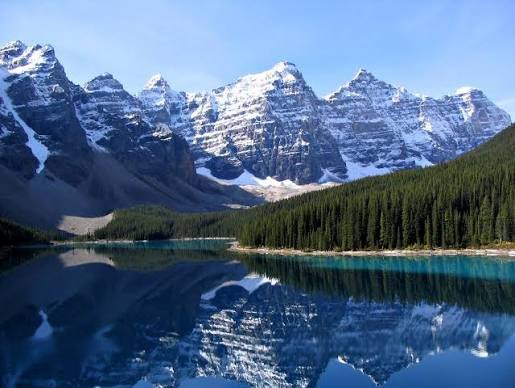
Banff spans roughly 2,564 square miles of mountainous terrain, making it considerably larger than most U.S. national parks on this list, and includes glaciers, ice fields, dense coniferous forest, and some of the most recognizable alpine lakes in the world, including Lake Louise and Moraine Lake.
The park sits within the Canadian Rocky Mountain Parks UNESCO World Heritage Site, a designation shared with several neighboring parks that together protect one continuous stretch of Rocky Mountain wilderness. Wildlife here is abundant and visible — elk, bighorn sheep, and black bears are common sights even near populated areas, while grizzly bears and wolves range through the park’s more remote backcountry.
Archaeological evidence shows humans have used this land for close to 11,000 years, long before railway construction or federal protection entered the picture, and multiple Indigenous nations maintain longstanding ties to the land within present-day Treaty 6, 7, and 8 territories.
The History Behind Banff National Park
Banff’s origin story is tied directly to the Canadian Pacific Railway. In 1883, railway workers laying track through the Bow Valley stumbled onto a cluster of natural hot springs at the base of Sulphur Mountain, now known as the Cave and Basin. Competing claims over who had discovered the springs first, and who had the right to develop them commercially, pushed the Canadian government to intervene.
In 1885, Prime Minister John A. Macdonald set aside a modest 10-square-mile reserve around the springs to prevent private exploitation. Two years later, the Rocky Mountains Park Act expanded that reserve to 260 square miles and formally established it as Canada’s first national park, and the third national park created anywhere in North America, following Yellowstone and Michigan’s short-lived Mackinac National Park.
The park’s boundaries shifted several more times over the following decades. In 1930, the National Parks Act fixed the park at roughly its current size and renamed it Banff National Park, after the Canadian Pacific Railway station that had itself been named for the Banffshire region of Scotland. Small adjustments in 1933 and 1949 settled the park at its present 2,564 square miles.
Tourism was baked into Banff’s identity from the start. The Canadian Pacific Railway built the grand Banff Springs Hotel in 1888, deliberately positioning the park as a luxury destination for wealthy travelers, a legacy that still shapes the town’s character today.
Frequently Asked Questions
Q1. Do I need a park pass if I’m just driving through Banff without stopping?
No. Parks Canada only requires a pass if you’re stopping within the park boundaries, including for photos or short hikes. Driving straight through on the Trans-Canada Highway without stopping doesn’t require one, though most visitors do stop and should plan accordingly.
Q2. Is the free admission period in 2026 guaranteed to happen again next year?
Not confirmed. The Canada Strong Pass free-entry window is currently set for June 19 through September 7, 2026, and Parks Canada hasn’t announced whether the program will continue into future years, so don’t count on it repeating.
Q3. Can one park pass be used at multiple Canadian national parks?
A daily pass is generally valid at several parks operating under the same regional pass system, including Banff, Jasper, Kootenay, and Yoho, but always confirm current rules at the specific parks you’re visiting, since coverage has changed over the years.
Q4. What’s the best way to see both Banff and Jasper in one trip?
Most travelers drive the Icefields Parkway connecting the two parks, a roughly 3 to 4 hour scenic drive one-way. Plan for at least a full day if you want to stop at glacier viewpoints and waterfalls along the route rather than driving straight through.