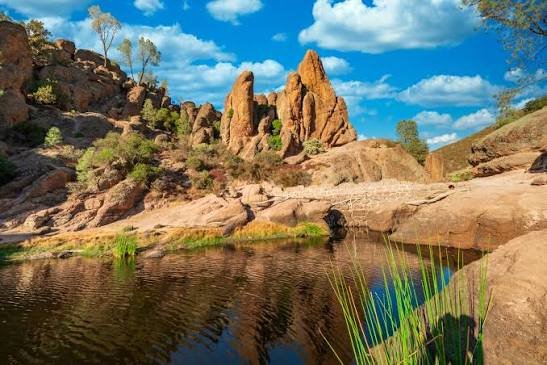
The jagged rock spires that give Pinnacles National Park its name didn’t form anywhere near where they now stand. They’re the eroded remains of a volcano that erupted more than 23 million years ago, roughly 195 miles south of its current location near Lancaster, California. Movement along the San Andreas Fault slowly carried half the volcano northward over millions of years, leaving these rugged formations sitting far from their original home, a rare geological journey most visitors never realize they’re walking through.
Here’s the practical guide for anyone planning a trip: where the park sits, what it costs, the numbers behind its unusual volcanic history, and how a persistent local advocate turned a threatened rock formation into one of California’s newest national parks.
Pinnacles National Park Overview
| Category | Details |
| Location | Gabilan Mountains, central California |
| Counties | San Benito and Monterey |
| Nearest city | Soledad, CA (about 5 miles from the west entrance) |
| Nearest airport | San Jose International (SJC), roughly 80 miles away |
| Established | January 16, 1908 (national monument); January 10, 2013 (national park) |
| Total area | About 26,600 acres |
| Vehicle entrance fee | $30, valid 7 consecutive days |
| Motorcycle fee | $25 |
| Per-person fee (foot/bicycle) | $15 |
| Pinnacles Annual Pass | $55 |
| America the Beautiful Annual Pass | $80 (all U.S. national parks) |
| Payment method | Cashless — credit/debit card recommended |
| East and West entrances | Not connected by any road within the park |
| Wingspan of resident California condors | Up to 9.5 feet |
| Annual visitation | Around 275,000 to 300,000 visitors |
Where Pinnacles National Park Is Located
Pinnacles sits in the Gabilan Mountains of central California, east of the Salinas Valley, roughly 80 miles southeast of San Jose. The park splits into two distinct sides, an East Entrance near the town of Paicines and a West Entrance closer to Soledad, and critically, no road within the park connects them. Getting from one side to the other means driving around the outside of the park entirely, a detail that surprises plenty of first-time visitors who assume they can simply cross through.
Because of that split layout, most visitors pick one entrance based on their planned activities and stick with it for the day. The East Entrance tends to offer more visitor infrastructure, including the campground and a larger visitor center, while the West Entrance provides quicker access to certain trailheads and tends to draw a quieter crowd.
San Jose International Airport is the most convenient arrival point for most travelers, with roughly an hour and a half drive to reach either entrance depending on route and traffic through the Salinas Valley.
What It Costs to Visit
A standard vehicle pass costs $30, covering everyone inside for seven consecutive days. Motorcycles pay $25, and visitors on foot or bicycle pay $15 per person.
Frequent visitors typically pick up the $55 Pinnacles Annual Pass, while anyone planning trips to multiple national parks throughout the year tends to prefer the $80 America the Beautiful Pass, covering admission to every federal recreation site nationwide.
Entrance stations here discourage cash payment, so visitors are strongly encouraged to pay by credit card or purchase a pass online in advance through Recreation.gov before arriving. Because the park operates on relatively tight staffing, entrance fee revenue plays a significant role in funding trail improvements, emergency response services, and hazardous tree removal throughout the park.
Facts That Make Pinnacles Geologically Unique
The park’s signature rock spires are the eroded remnants of the ancient Neenach Volcano, which erupted more than 23 million years ago near what is now Lancaster, California. Movement along the San Andreas Fault gradually transported this portion of the volcanic field roughly 195 miles north to its present location, a slow-motion geological migration that continues today as the fault remains active.
Beyond the spires themselves, Pinnacles is known for its talus caves, formed not through the usual process of water erosion but by massive boulders wedging themselves into narrow canyons, creating dark passageways that house at least 13 species of bats. These caves periodically close to protect bat populations during sensitive breeding and hibernation periods, so checking current cave status before a visit is worthwhile if exploring them is a priority.
The park also plays a genuinely significant role in California condor conservation, serving as a release site for condors hatched in captivity as part of a broader recovery effort following the species’ near-extinction in the 1980s. With a wingspan reaching up to 9.5 feet, California condors remain the largest flying birds in North America, and spotting one soaring above the High Peaks Trail ranks among the park’s most memorable wildlife encounters.
The History Behind Pinnacles National Park
Indigenous peoples, primarily the Chalon and Mutsun groups of the Ohlone, inhabited this region for well over 2,000 years before European contact, leaving behind stone artifacts still found within the park today. Spanish missionary activity reached the area in the late 1700s, with a mission established in nearby Soledad in 1791, reshaping the region’s demographics and land use in the following century.
Modern protection efforts trace back to a local homesteader named Schuyler Hain, who arrived in the area in the late 1800s, began leading tours through the rock formations, and spent years advocating for their preservation against the threat of quarrying and development. His persistence reached President Theodore Roosevelt, an active conservationist who, on January 16, 1908, designated the area Pinnacles National Monument under the newly passed Antiquities Act, protecting an initial 2,500 acres.
The monument expanded steadily over the following decades, with the Civilian Conservation Corps playing a major role in the 1930s, building trails carved directly into sheer cliff faces, constructing the Bear Gulch Reservoir dam, and erecting the park’s historic stone visitor center, much of which remains in use today. Advocacy for full national park status gained momentum in the early 2000s, with supporters arguing that the site’s unique geology, condor conservation role, and recreational value warranted greater recognition. That effort succeeded on January 10, 2013, when President Barack Obama signed legislation redesignating the site Pinnacles National Park, making it California’s ninth national park and, at the time, the newest addition to the entire National Park System.
Frequently Asked Questions
Q1. Can I drive between the East and West entrances if I want to see both sides in one day?
No, there’s no road connecting the two sides within the park itself. Traveling between entrances requires driving around the park’s exterior, which can take well over an hour depending on your route, so most visitors plan to focus on just one side per day.
Q2. Are the talus caves always open to visitors?
Not always. Bear Gulch Cave and Balconies Cave periodically close to protect resident bat populations, particularly during breeding and hibernation seasons. Check the park’s current cave status page before your trip if visiting the caves is a priority.
Q3. What’s the best time of year to visit given how hot it gets?
Spring and fall offer the most comfortable hiking conditions. Summer temperatures regularly exceed 100°F with no water sources along most trails, so visitors attempting summer hikes need to carry significantly more water than they might expect.
Q4. How likely am I to actually see a California condor during my visit?
Sightings are possible but not guaranteed, since condors range widely across a large territory beyond the park’s boundaries. The High Peaks Trail and areas near the visitor centers offer some of the better chances, especially during midday thermals when condors tend to soar.