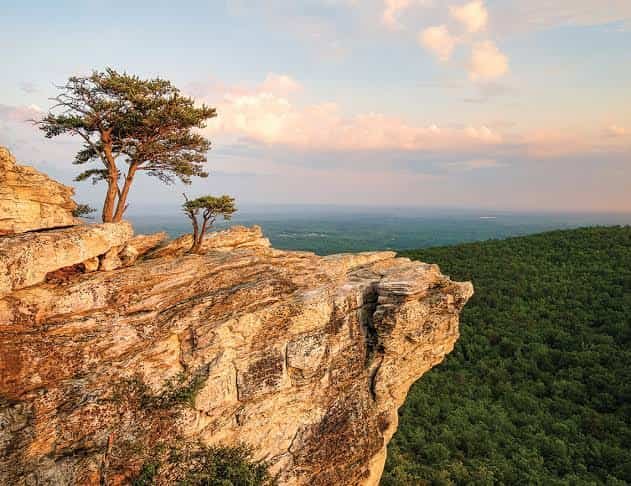
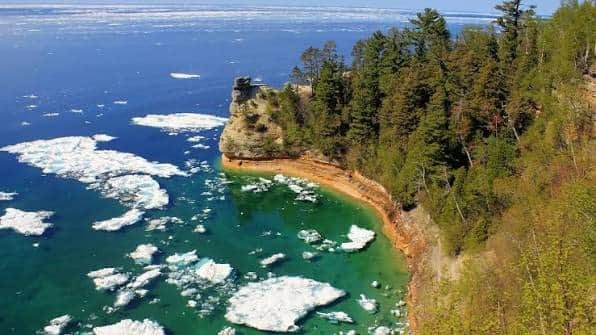
The Midwest doesn’t have the towering peaks or slot canyons of the American West, but it holds a genuinely varied set of national parks: a roadless wolf-and-moose island in Lake Superior, a lake-filled wilderness on the Canadian border, sand dunes within sight of the Chicago skyline, an industrial river reclaimed from pollution, the tallest monument in the country, and eroded badlands packed with ancient fossils. Seven parks span the region broadly defined, and unlike their western counterparts, most charge little or nothing to enter.
Here’s the practical guide to all seven: where they sit, what they cost, the numbers that define them, and how such different landscapes all earned federal protection across the heartland.
Midwest National Parks Overview
| Park | Location | Established | Entrance Fee | Signature Feature |
| Isle Royale | Lake Superior, Michigan | 1940 | $7 per person, per day | Roadless island, longest predator-prey study on Earth |
| Voyageurs | Northern Minnesota, Canadian border | 1975 | Free | Interconnected lakes, houseboat access only to interior |
| Indiana Dunes | Northwest Indiana, Lake Michigan | 2019 (park) | $25 per vehicle | Over 1,100 plant species near Chicago |
| Cuyahoga Valley | Northeast Ohio, between Cleveland and Akron | 2000 (park) | Free | Reclaimed industrial river valley |
| Gateway Arch | Downtown St. Louis, Missouri | 2018 (park) | Free grounds; tram ticket ~$15 | Tallest monument in the U.S. |
| Badlands | Southwestern South Dakota | 1978 (park) | $30 per vehicle | Eroded buttes, rich Oligocene fossil beds |
| Wind Cave | Black Hills, South Dakota | 1903 | Free (cave tours ticketed) | Barometric “breathing” cave |
Where the Midwest’s National Parks Are Located
These seven parks scatter across a wide swath of the upper Midwest and Great Plains. Isle Royale sits isolated in Lake Superior, reachable only by ferry or seaplane from Michigan or Minnesota. Voyageurs sits along the Minnesota-Canada border near International Falls, while Indiana Dunes hugs the Lake Michigan shoreline less than 40 miles from Chicago. Cuyahoga Valley sits wedged between Cleveland and Akron in Ohio, and Gateway Arch anchors downtown St. Louis, Missouri. Further west, Badlands and Wind Cave sit in southwestern South Dakota, both within a few hours’ drive of Rapid City and commonly paired with Mount Rushmore on a Black Hills itinerary.
Because these parks spread across such a wide region, no single road trip realistically covers all seven. Most travelers focus on a cluster: the Great Lakes parks (Isle Royale, Voyageurs, Indiana Dunes, Cuyahoga Valley) or the Great Plains pair (Badlands and Wind Cave) alongside South Dakota’s other Black Hills attractions.
What the Midwest’s National Parks Cost to Visit
Fee structures vary widely across the region. Voyageurs, Cuyahoga Valley, Gateway Arch’s grounds, and Wind Cave’s surface area all charge no entrance fee whatsoever. Isle Royale charges $7 per person per day, a unique structure reflecting its lack of roads. Indiana Dunes charges $25 per vehicle, and Badlands charges $30 per vehicle, among the higher rates in this regional grouping.
For anyone visiting several of these parks, or combining them with parks elsewhere in the country, the $80 America the Beautiful Annual Pass covers every fee-charging park on this list and typically pays for itself after just two or three visits. None of the seven Midwest parks currently charge the additional $100 international visitor surcharge applied at select high-traffic western parks.
Facts That Distinguish the Midwest’s National Parks
Isle Royale hosts the longest-running predator-prey study in the world, tracking wolves and moose since 1958, on an island with no roads and no bears, raccoons, or possums. Voyageurs is roughly 40% water, named for French-Canadian fur traders who once paddled its interconnected lakes by canoe. Indiana Dunes protects over 1,100 plant species, including prickly pear cactus growing alongside Great Lakes wetlands, within sight of steel mills and a huge metropolitan population.
Cuyahoga Valley exists because its river once caught fire, helping spark the modern environmental movement, and the park still contains no backcountry camping or designated wilderness. Gateway Arch, at just 91 acres, is the smallest national park in the entire system, built around a 630-foot stainless steel monument rather than any natural landscape. Badlands holds one of the richest fossil beds on Earth, including ancient three-toed horses and saber-toothed cats, while Wind Cave protects roughly 95% of the world’s known boxwork cave formations beneath a prairie surface famous for the barometric “wind” that gives the park its name.
The History Behind the Midwest’s National Parks
Several of these parks share a theme of reclamation and unlikely survival rather than pristine wilderness preservation. Cuyahoga Valley emerged directly from 1970s environmental advocacy following the infamous 1969 river fire. Indiana Dunes fought off decades of steel industry encroachment before finally achieving national park status in 2019, following a campaign that traced back to pioneering ecologist Henry Cowles in the early 1900s.
Isle Royale and Voyageurs both trace their protection to early 20th-century advocacy, established in 1940 and 1975 respectively after decades of logging and resource extraction pressure. Gateway Arch grew out of a 1930s effort to commemorate westward expansion, culminating in Eero Saarinen’s 1947 competition-winning arch design. Wind Cave, meanwhile, holds the distinction of being one of the oldest parks in the entire system, established in 1903 after a contested ownership dispute over the cave’s discovery, while Badlands took nearly a decade to move from monument to full park status, finally arriving in 1978.
Frequently Asked Questions
Q1. Which Midwest national park is easiest to visit without much planning?
Cuyahoga Valley and Gateway Arch both require no reservations for basic entry and sit close to major cities, making them the most spontaneous options on this list compared to the more remote Isle Royale or Voyageurs.
Q2. Can I combine Badlands and Wind Cave into a single South Dakota trip?
Yes, they’re commonly paired with Mount Rushmore, Custer State Park, and the Crazy Horse Memorial into one Black Hills itinerary, since all sit within a few hours of each other in southwestern South Dakota.
Q3. Why do Isle Royale and Voyageurs require boats rather than cars?
Both parks were deliberately protected as roadless or largely water-based wilderness; Isle Royale is an island with no bridge or road connection, and much of Voyageurs’ interior sits on a peninsula reachable only by water or, in winter, by snowmobile or ski.
Q4. Is it worth visiting Indiana Dunes if I’m mainly interested in wilderness scenery rather than an industrial Midwest setting?
Yes, despite its surrounding industry, the park protects over 1,100 plant species and genuinely diverse habitats, from prairie to wetland to dune, making it a legitimate biodiversity destination rather than just a novelty stop near Chicago.