West Virginia holds exactly one national park, and it’s also one of the newest in the entire system: New River Gorge, home to a bridge that’s the longest steel arch in the Western Hemisphere, some of the best whitewater rafting in the country, and a river geologists believe is one of the oldest on Earth, despite its misleading name. It didn’t earn full national park status until December 2020, making it West Virginia’s first and only park to carry the designation.
Here’s the practical guide to West Virginia’s national park: where it sits, what it costs, the numbers behind its ancient river and dramatic gorge, and the path from a protected National River to full national park status.
New River Gorge National Park Overview
| Category | Details |
| Location | Southern West Virginia, Fayette and Summers counties |
| Nearest city | Fayetteville, WV |
| Nearest airport | Yeager Airport, Charleston, WV, about 60 miles away |
| Established | National River in 1978; national park and preserve December 27, 2020 |
| Total area | About 72,808 acres |
| Entrance fee | None — free to visit year-round |
| America the Beautiful Pass | Not needed, though useful for other parks nationwide |
| Bridge span | 3,030 feet, longest steel arch in the Western Hemisphere |
| Established climbing routes | Over 1,600 |
| Protected river length | 53 miles of the New River |
| Annual visitation | Over 1.5 million visitors |
Where New River Gorge National Park Is Located
New River Gorge National Park sits in southern West Virginia’s Appalachian Mountains, spanning Fayette and Summers counties and stretching 53 miles from just downstream of Hinton to Hawks Nest State Park near Ansted. Fayetteville serves as the nearest town of note, and Yeager Airport in Charleston, roughly 60 miles northwest, offers the closest commercial air access.
Interstate 64 provides access to the park’s southern reaches, while Highway 19 reaches the western and northern sections, including the iconic New River Gorge Bridge. There’s no public transportation within the park, and the narrow, winding two-lane roads built decades ago mean visitors should leave large RVs and trailers at home when navigating the gorge itself.
What It Costs to Visit
New River Gorge National Park charges no entrance fee at all. There’s no gate, no vehicle pass, and no per-person charge required to explore the park’s trails, overlooks, or river access points.
Because the park has no entrance fee, America the Beautiful passes have no direct function here, though they remain useful for any other fee-charging parks on a broader trip. The main costs visitors typically budget for are guided whitewater rafting trips, which run through private outfitters based in and around Fayetteville, along with any camping or lodging arrangements, since the park itself has limited infrastructure given how recently it gained full national park status.
Facts That Make New River Gorge Unique
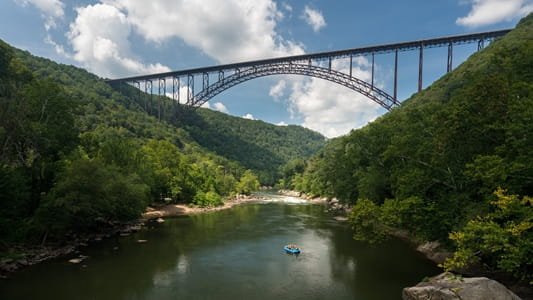
Despite its name, the New River is believed to be one of the oldest rivers on Earth, and one of only two rivers in the United States that flows northward. The New River Gorge Bridge, completed in 1977, spans 3,030 feet and holds the distinction of being the longest steel arch bridge in the Western Hemisphere and the third-highest bridge in the United States. Every October, the bridge closes to vehicle traffic for one day, known as Bridge Day, when pedestrians and BASE jumpers can cross and jump from the span in one of the region’s most anticipated annual events.
The park ranks among the most popular climbing destinations in the country, with more than 1,600 established routes across its sandstone walls, and the gorge itself offers some of the best whitewater rafting in the eastern United States, particularly along the stretch from the Cunard put-in to the Fayette Station take-out. Ten named mountains rise within the park, the highest being Swell Mountain at 3,291 feet.
The History Behind New River Gorge National Park
Human history along the New River stretches back centuries, with the area first documented by European explorers in 1671. More recent history centers heavily on the coal mining industry, which left behind a vast network of roads, old railway tracks, and bridges still visible throughout the park today, along with former mining communities whose remnants stand as a tangible record of the region’s industrial past.
President Jimmy Carter signed legislation establishing the New River Gorge National River on November 10, 1978, protecting the corridor under a designation focused on river conservation and recreation. Advocacy for full national park status built over subsequent decades, driven in part by economic studies showing the significant boost in visitor spending that comes with the “national park” designation itself. That effort succeeded when Senator Shelley Moore Capito authored the legislation that President Trump signed into law on December 27, 2020, redesignating the site New River Gorge National Park and Preserve, making it the 63rd national park and 20th national preserve in the country, and West Virginia’s first national park. Not all state residents supported the change at the time, with some concerned about how the new designation might affect longstanding hunting and fishing traditions in the area, though the legislation specifically protected those existing uses within the preserve section.
Frequently Asked Questions
Q1. Why does the park have both a “national park” and “preserve” designation?
The split structure allows different rules in different zones; the “national park” portion generally applies more standard park protections, while the “preserve” section explicitly protects longstanding hunting and fishing traditions that predate the 2020 redesignation, addressing concerns some residents raised at the time.
Q2. Is it difficult to find parking during peak summer season?
Yes, since the park is still relatively new to full national park status and hasn’t built out extensive visitor infrastructure yet, popular trailheads like Endless Wall can have limited parking that fills quickly, especially on weekends.
Q3. Do I need a permit to go whitewater rafting on the New River?
Independent rafting doesn’t require a park permit, but the more serious rapids sections are typically run with licensed commercial outfitters based in Fayetteville, especially for visitors without whitewater experience.
Q4. What’s Bridge Day, and can I attend without any special preparation?
Bridge Day is an annual October event when the New River Gorge Bridge closes to vehicles for pedestrian access and BASE jumping demonstrations. It draws large crowds, so arriving early and expecting significant traffic and parking congestion is essential if you plan to attend.