Over three days in July 1863, more than 50,000 soldiers were killed, wounded, captured, or went missing on the fields surrounding a small Pennsylvania farm town, making Gettysburg the bloodiest single battle of the entire Civil War. Four months later, President Abraham Lincoln stood at the dedication of a new soldiers’ cemetery on that same battlefield and delivered a two-minute speech that redefined American democracy itself. Today, visitors can walk that ground for free, drive 40 miles of park roads past more than 1,400 monuments and 400 cannons, and stand at the exact spot where Lincoln spoke.
Here’s the practical guide for anyone planning a visit: where the park sits, what it actually costs (mostly nothing, with a few worthwhile exceptions), the numbers behind its staggering monument collection, and the fight to preserve this battlefield that began almost as soon as the actual fighting ended.
Gettysburg National Military Park Overview
| Category | Details |
| Location | Adams County, south-central Pennsylvania |
| Nearest city | Gettysburg, PA (within the park) |
| Distance from major cities | About 50 miles from Baltimore; roughly 80 miles from Washington, D.C. |
| Nearest airport | Harrisburg International Airport (MDT), about 45 miles away |
| Established | Federal protection 1895; National Park Service administration since 1933 |
| Total area | About 6,000+ acres |
| Battlefield entrance fee | None — free to visit year-round |
| Museum, film & Cyclorama ticket | $20.75 adult / $19.75 senior & veteran / $15.75 youth (6–12); free for active military and under 6 |
| America the Beautiful Pass | Not sold here and does not cover museum/film/Cyclorama fees |
| Monuments and markers | Over 1,400 monuments, plus roughly 400 preserved cannons |
| Park roads | Over 40 miles for scenic touring |
| Annual visitation | Around 730,000 to 1.8 million visitors |
Where Gettysburg National Military Park Is Located
Gettysburg National Military Park sits in Adams County, south-central Pennsylvania, roughly 50 miles northwest of Baltimore and about 80 miles from Washington, D.C., making it an easy day trip or weekend visit for much of the mid-Atlantic region. Harrisburg International Airport offers the closest commercial air access, though many visitors reach the park by car given its proximity to major East Coast cities.
The battlefield itself surrounds the town of Gettysburg, with key terrain features including Little Round Top, Cemetery Ridge, and Seminary Ridge woven throughout the surrounding countryside. The Museum and Visitor Center, privately operated by the nonprofit Gettysburg Foundation in partnership with the National Park Service, serves as the natural starting point for most visits, offering park maps, ranger consultations, and access to ticketed exhibits.
What It Costs to Visit
Here’s the essential detail: the Gettysburg battlefield itself is completely free to visit, open daily from about 30 minutes before sunrise to 30 minutes after sunset, weather permitting. No entrance pass is required anywhere on the battlefield, and the Museum and Visitor Center building itself, including the bookstore and Refreshment Saloon, is also free to enter.
What does carry a cost is the ticketed experience inside the visitor center: the museum, the film “A New Birth of Freedom” narrated by Morgan Freeman, and the historic Cyclorama painting. A combined ticket for all three runs $20.75 for adults, $19.75 for seniors 65 and older and veterans, and $15.75 for youth ages 6 to 12, with active military and children under 6 admitted free. One detail worth flagging for pass holders: Gettysburg doesn’t sell America the Beautiful Annual or Senior Passes, and those passes don’t cover the museum, film, or Cyclorama fees even if you hold one from another park.
Beyond the standard visitor center offerings, Licensed Battlefield Guides, certified through the National Park Service, offer private guided tours of the battlefield, bookable through the Gettysburg Foundation either in advance or on a first-come, first-served basis at the visitor center.
Facts That Make Gettysburg Historically Significant
The Battle of Gettysburg, fought July 1 through 3, 1863, is widely regarded as the turning point of the Civil War, often called the “High Water Mark of the Confederacy” for marking the furthest point of General Robert E. Lee’s second invasion of the North. Casualties on both sides exceeded 51,000, roughly 23,000 Union and 28,000 Confederate, making it the single bloodiest battle fought on American soil.
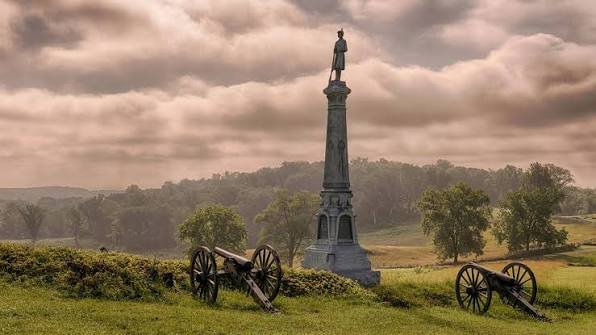
Today, the park’s monument density is genuinely remarkable: more than 1,400 individual monuments and markers dot the landscape alongside roughly 400 preserved cannons, most placed by veteran organizations and state governments in the decades following the battle to mark specific troop positions and honor individual regiments. The adjacent Soldiers’ National Cemetery holds more than 7,000 interments, including over 3,500 burials from the Civil War itself, and remains the site where Lincoln delivered the Gettysburg Address on November 19, 1863.
Visitors can explore the battlefield along more than 40 miles of park roads, whether by private vehicle, guided bus tour, bicycle, or on foot, making it one of the more thoroughly preserved and interpreted battlefields anywhere in the National Park System.
The History Behind Gettysburg National Military Park
Preservation efforts began almost immediately after the guns fell silent. In October 1863, just months after the battle, the state-sponsored Gettysburg Battlefield Memorial Association began exhuming and reburying 3,354 Union soldiers in a permanent Soldiers’ National Cemetery at the edge of the battlefield. It was at that cemetery’s dedication ceremony, on November 19, 1863, that Lincoln delivered his brief but enduring address, redefining the war’s purpose in terms of American democracy itself.
The Memorial Association continued acquiring and preserving battlefield land through the following decades, including monument tracts and larger parcels purchased starting in June 1893. On February 11, 1895, Congress officially established Gettysburg National Military Park, transferring administration to the U.S. War Department, partly to forestall commercial railroad development that threatened to cut directly through the historic battlefield. A three-member commission of Union and Confederate veterans, alongside an Army engineer, oversaw preservation and monument placement for decades afterward, including a notable 1917 federal eminent domain action that removed the Gettysburg Electric Railway’s right-of-way from the battlefield grounds.
Administration transferred from the War Department to the newly reorganized National Park Service in 1933, part of a broader nationwide consolidation of federal parklands that brought historic battlefields like Gettysburg into the same system managing scenic wilderness parks. The park’s protected acreage has grown substantially since then, from roughly 540 acres in 1888 to over 6,000 acres today, reflecting a century of continued land acquisition aimed at preserving the historic battlefield largely as it appeared in 1863.
Frequently Asked Questions
Q1. Do I need to buy a ticket just to drive or walk the battlefield?
No. The battlefield itself is completely free to visit, with no entrance pass required. Tickets are only necessary for the museum, film, and Cyclorama painting inside the Museum and Visitor Center.
Q2. Does my America the Beautiful Pass cover any part of a Gettysburg visit?
It doesn’t need to for the battlefield itself, since that’s free regardless of any pass. However, Gettysburg does not sell America the Beautiful passes on-site, and existing passes from other parks do not cover the museum, film, or Cyclorama admission fees.
Q3. Is it worth hiring a Licensed Battlefield Guide, or can I just do the self-guided driving tour?
Both are valid options. The self-guided NPS driving tour is free and well-marked, but a Licensed Battlefield Guide offers a two-hour, in-depth car or bus tour with expert narration, a worthwhile upgrade for visitors wanting deeper historical context beyond the standard route.
Q4. How much time should I budget to see the battlefield and visitor center properly?
Most visitors need at least half a day for a meaningful visit, combining the museum and film with a driving tour of key sites like Little Round Top and Cemetery Ridge. A full day allows time for a guided tour and a visit to the Soldiers’ National Cemetery as well.