When Captain George Vancouver sailed past this stretch of Alaskan coastline in 1794, he charted little more than a small indentation in a wall of solid ice, a glacier so massive it filled the entire bay. Just over a century later, that same ice had retreated more than 65 miles inland, one of the fastest and most dramatic glacial retreats ever documented on Earth. Today, cruise ships carry nearly 700,000 passengers a year into waters that were buried under thousands of feet of ice within living memory of the Huna Tlingit people who still call this place home.
Here’s the practical guide for anyone planning a visit: where the park sits, what it costs (free, with an unusual funding twist), the numbers behind its record-setting glacial retreat, and the century-long relationship between the National Park Service and the Tlingit clans who were here first.
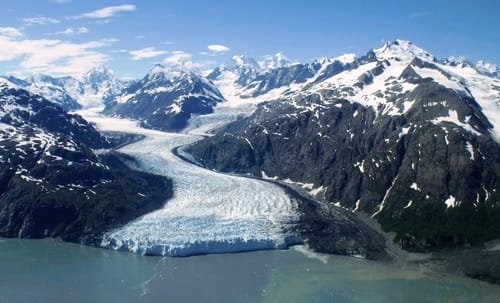
Glacier Bay National Park Overview
| Category | Details |
| Location | Southeastern Alaska, about 65 miles west of Juneau |
| Nearest town | Gustavus, AK |
| Nearest airport | Gustavus Airport, or Juneau International (JNU) with a connecting flight |
| Established | National monument February 26, 1925; national park and preserve December 2, 1980 |
| Total area | About 3.28 million acres (park and preserve combined) |
| Entrance fee | None — free to visit year-round |
| Primary funding source | Cruise ship passenger fees, not entrance fees |
| Daily vessel limits (summer) | 2 cruise ships, 3 tour vessels, 6 charter vessels, 25 private vessels |
| Glaciers within the park | Roughly 1,045, covering about 27% of park land |
| UNESCO status | World Heritage Site (1992), Biosphere Reserve (1986) |
| 2024 visitation | Over 691,000 cruise ship passengers, a record-breaking year |
Where Glacier Bay National Park Is Located
Glacier Bay National Park sits in southeastern Alaska, roughly 65 miles west of Juneau, accessible only by boat or small plane since no road system connects it to the rest of the state. The small town of Gustavus, just outside the park boundary, has its own airport served by Alaska Airlines in summer and small charter planes year-round, along with scheduled Alaska Marine Highway ferry service from Juneau.
The park’s visitor center and lodge sit at Bartlett Cove, near the entrance to the bay itself, which stretches roughly 65 miles from Icy Strait deep into the mountains, ranging between 3 and 18 miles wide along its length. Most visitors experience the park either via cruise ship, which accounts for the overwhelming majority of annual visitation, or through smaller tour and charter vessels departing from Bartlett Cove.
What It Costs to Visit
Glacier Bay National Park charges no entrance fee at all, one of the more financially accessible national parks in the entire system, at least on paper. There’s no vehicle pass, per-person charge, or gate of any kind for anyone reaching the park independently.
What makes Glacier Bay genuinely unusual is how it’s funded instead. Rather than relying on entrance fees like most fee-charging parks, the majority of its operating budget comes from cruise ship passenger fees, since the park limits daily vessel traffic during summer months to just two cruise ships, three tour vessels, six charter vessels, and 25 private vessels at any given time. A portion of those cruise fees flows directly back into park operations, while the rest follows a more traditional distribution model shared across the wider National Park System.
For independent travelers, the primary cost of a Glacier Bay visit comes down to transportation, flights or ferry tickets to Gustavus, plus any guided tours, kayak rentals, or lodging booked once you arrive, none of which fall under NPS entrance fees at all.
Facts That Make Glacier Bay Extraordinary
The park protects roughly 1,045 glaciers, covering about 27% of its total land area, a concentration of ice that’s made Glacier Bay one of the most important sites on Earth for studying tidewater glacier dynamics and plant succession following glacial retreat. When Captain Cook first sailed past in 1778, the Grand Pacific Glacier reportedly filled the entire bay with a towering ice face; by the time naturalist John Muir explored the area by canoe in 1879, the ice had already retreated roughly 30 miles inland. Today, ships travel some 64 miles into fjords that simply didn’t exist as open water a little over a century ago.
Beyond the glaciers, the park protects more than 700 miles of shoreline available for kayaking and camping, alongside just four established hiking trails totaling roughly 15.5 miles, reflecting how much of Glacier Bay’s landscape is genuinely meant to be experienced by water rather than on foot. Wildlife here includes humpback whales, orcas, Steller sea lions, and coastal brown bears, drawn to the nutrient-rich marine environment created by the retreating glaciers.
The History Behind Glacier Bay National Park
The Huna Tlingit have inhabited this region for a thousand years or more, with recovered artifacts dating settlements back to at least 1250, though Tlingit oral history places their presence here considerably earlier. Their traditional homeland, once a broad, grass-covered valley with salmon-filled streams, was buried under advancing ice roughly 300 years ago, forcing their ancestors to relocate before the ice began its dramatic retreat in the centuries that followed.
Ecologist William Skinner Cooper visited beginning in 1916, drawn by the rare scientific opportunity the retreating glaciers presented for studying plant succession in real time, and his advocacy helped convince President Calvin Coolidge to designate the area Glacier Bay National Monument on February 26, 1925. That designation, unfortunately, came with a painful consequence for the Huna Tlingit, since subsequent land management banned their traditional hunting and fishing practices within what had been their homeland for centuries, a restriction that took generations of advocacy to begin reversing.
The monument expanded twice, first through a 1978 proclamation under President Carter, then again in 1980 when the Alaska National Interest Lands Conservation Act redesignated the site Glacier Bay National Park and Preserve, part of the same sweeping legislation that created several other Alaskan parks in a single stroke. UNESCO recognized the site’s global significance, designating it a Biosphere Reserve in 1986 and part of a binational World Heritage Site in 1992, shared with neighboring Wrangell-St. Elias and two Canadian parks across the border.
The relationship between the National Park Service and the Huna Tlingit has continued evolving in recent decades. A formal co-management agreement in 1994 began restoring Tlingit presence and rights within the park, and in 2016, the Xunaa Shuká Hít, or Huna Tribal House, opened at Bartlett Cove, a hand-carved cedar structure honoring the clan houses that once lined the same shoreline, now serving as a living space for cultural preservation and visitor education alike.
Frequently Asked Questions
Q1. Do I need to book a cruise to see Glacier Bay, or can I visit independently?
No, independent visits are entirely possible, though most annual visitation comes from cruise ships. Flying or taking the ferry to Gustavus, then booking a day tour boat or arranging kayak access from Bartlett Cove, is a genuine alternative for travelers who’d rather not cruise.
Q2. Why does the park limit the number of vessels allowed in each day?
Vessel limits protect the park’s marine wildlife, particularly whales and other species sensitive to boat traffic and noise, while also preserving the wilderness experience for visitors. The cap includes strict daily maximums for cruise ships, tour boats, charters, and private vessels alike.
Q3. Is it possible to hike extensively in Glacier Bay, or is it mostly a boat-based park?
It’s overwhelmingly boat-based. The park has only about 15.5 miles of established hiking trails total, and most exploration happens via boat tours or kayak along its more than 700 miles of shoreline rather than on foot.
Q4. What’s the best time of year to see calving glaciers and the most wildlife activity?
Late May through early September offers the most reliable weather and wildlife activity, coinciding with peak cruise season and the highest likelihood of witnessing active glacier calving alongside whale and sea lion sightings.