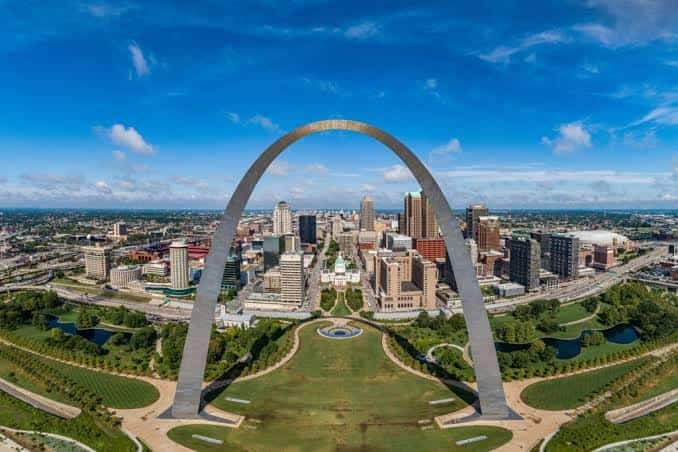
There’s no wilderness, no camping, and no hiking trail longer than a city block at Gateway Arch National Park, the smallest and most urban unit in the entire National Park System. What it does have is the tallest monument in the United States: a 630-foot stainless steel catenary curve rising directly out of downtown St. Louis, visible from miles away and reachable by tram in about a minute. This is a park you can genuinely see in an afternoon, tucked into a working American city rather than isolated in a remote wilderness.
Here’s the practical guide for anyone planning a visit: where the park sits, what it costs, the numbers behind its record-setting monument, and the design competition that turned a Finnish-American architect’s sweeping arch into the “Gateway to the West.”
Gateway Arch National Park Overview
| Category | Details |
| Location | Downtown St. Louis, Missouri, on the Mississippi River |
| Nearest airport | St. Louis Lambert International Airport (STL), about 15 miles away |
| Established | Jefferson National Expansion Memorial in 1935; national park on February 22, 2018 |
| Total area | About 91 acres |
| Park grounds and museum | Free — no entrance fee to walk the grounds or visit the museum |
| Tram to the top | Starting around $15 for adults, $11 for children 3–15 |
| Entrance fee within ticket | $3 built into each adult tram or movie ticket |
| America the Beautiful Pass | Waives the $3 fee, up to 4 discounted tickets per passholder |
| Arch height | 630 feet — tallest monument in the United States |
| Construction completed | October 28, 1965 |
| Annual visitation | Over 1.1 million visitors |
Where Gateway Arch National Park Is Located
Gateway Arch National Park sits directly in downtown St. Louis, Missouri, on the west bank of the Mississippi River, making it the only genuinely urban national park in the entire system. St. Louis Lambert International Airport sits roughly 15 miles northwest, and the park itself is easily reached via Interstate 70, 44, or 64, with parking available in nearby downtown garages.
Public transit works well here too: the St. Louis MetroLink light rail has a stop at Laclede’s Landing within walking distance of the park, and Amtrak’s Gateway Station sits about a mile away. Because the park occupies such a central downtown location, it’s genuinely walkable from most nearby hotels and other St. Louis attractions, a rarity among national parks.
What It Costs to Visit
Walking the park grounds and visiting the museum beneath the Arch cost nothing at all; there’s no entrance fee for simply exploring the site, and the Old Courthouse across the street is also free to enter without any ticket required.
The cost comes in if you want to ride the tram to the top of the Arch itself. Adult tickets start around $15, with children ages 3 to 15 starting around $11, and children 2 and under riding free. Built into every adult and child tram or documentary movie ticket is a $3 National Park Service entrance fee. Anyone holding an America the Beautiful Pass gets that $3 portion waived, effectively discounting the ticket price, and each passholder can purchase up to four discounted tickets using their pass.
Tram rides operate on a timed entry system year-round, and tickets sell out regularly, especially during summer weekends and holiday periods, so booking in advance through the official ticketing site is strongly recommended rather than showing up and hoping for same-day availability. All visitors also pass through airport-style security to enter the visitor center, a detail worth factoring into your arrival time, since it can add up to 30 minutes to your visit.
Facts That Make Gateway Arch Unique
At 630 feet tall, the Gateway Arch stands as the tallest monument anywhere in the United States, an elegant stainless steel catenary curve that’s become one of the most recognizable pieces of architecture in the country. The tram ride to the top takes roughly 45 to 60 minutes round trip including the pre-boarding experience, though time actually spent at the observation area near the summit is limited to under 10 minutes given the space constraints inside the arch’s peak.
Unlike virtually every other national park in the system, Gateway Arch offers no camping, no extensive trail network, and no wilderness backcountry; its entire footprint covers just 91 acres, making it the smallest national park unit by land area. The park’s Riverboats operate seasonally from March through November, offering Mississippi River cruises as an additional paid experience alongside the tram and museum.
The History Behind Gateway Arch National Park
St. Louis itself traces back to 1764, founded as a French fur trading post by Pierre Laclede and Auguste Chouteau. Over the following century, the city grew into the primary departure point for westward American expansion, earning its enduring nickname as the “Gateway to the West,” a role that eventually inspired the monument built here.
In 1935, President Franklin D. Roosevelt authorized the creation of the Jefferson National Expansion Memorial, intended to commemorate Thomas Jefferson’s vision of westward growth and the pioneers who carried it out. A national design competition held in 1947 drew 172 entries, and the winning design came from Finnish-American architect Eero Saarinen, whose bold, sweeping catenary arch concept beat out dozens of competing visions. Construction of the 630-foot stainless steel structure began in 1963, and workers completed the arch on October 28, 1965, when the final keystone section was lowered into place at the top, instantly transforming the St. Louis skyline.
The site continued operating as the Jefferson National Expansion Memorial for decades afterward, encompassing the Arch, the Museum of Westward Expansion, and the historic Old Courthouse. On February 22, 2018, Congress redesignated the site Gateway Arch National Park, elevating its status within the National Park System and giving the monument the full “national park” title it holds today.
Frequently Asked Questions
Q1. Do I need a reservation to visit the park, or only for the tram ride to the top?
Only the tram ride requires a timed entry ticket. Walking the grounds, visiting the free museum, and touring the Old Courthouse all require no reservation, but the tram experience sells out regularly and should be booked in advance.
Q2. What should I expect going through security to enter the visitor center?
Expect an airport-style screening process, including prohibited items like weapons, pepper spray, and knives with fixed blades. Budget up to 30 extra minutes for this step, especially during busy periods, so you don’t miss your scheduled tram time.
Q3. Is there anywhere to camp or stay overnight within the park itself?
No, Gateway Arch National Park has no camping facilities of any kind, consistent with its status as a compact urban park. Visitors stay at nearby downtown St. Louis hotels, many within easy walking distance of the Arch grounds.
Q4. Does the America the Beautiful Pass make the tram ride completely free?
No, it only waives the $3 National Park Service entrance fee built into each ticket, not the full ticket price for the tram ride, documentary movie, or riverboat cruise. Passholders still pay the remaining base ticket cost, just at a slightly discounted rate.