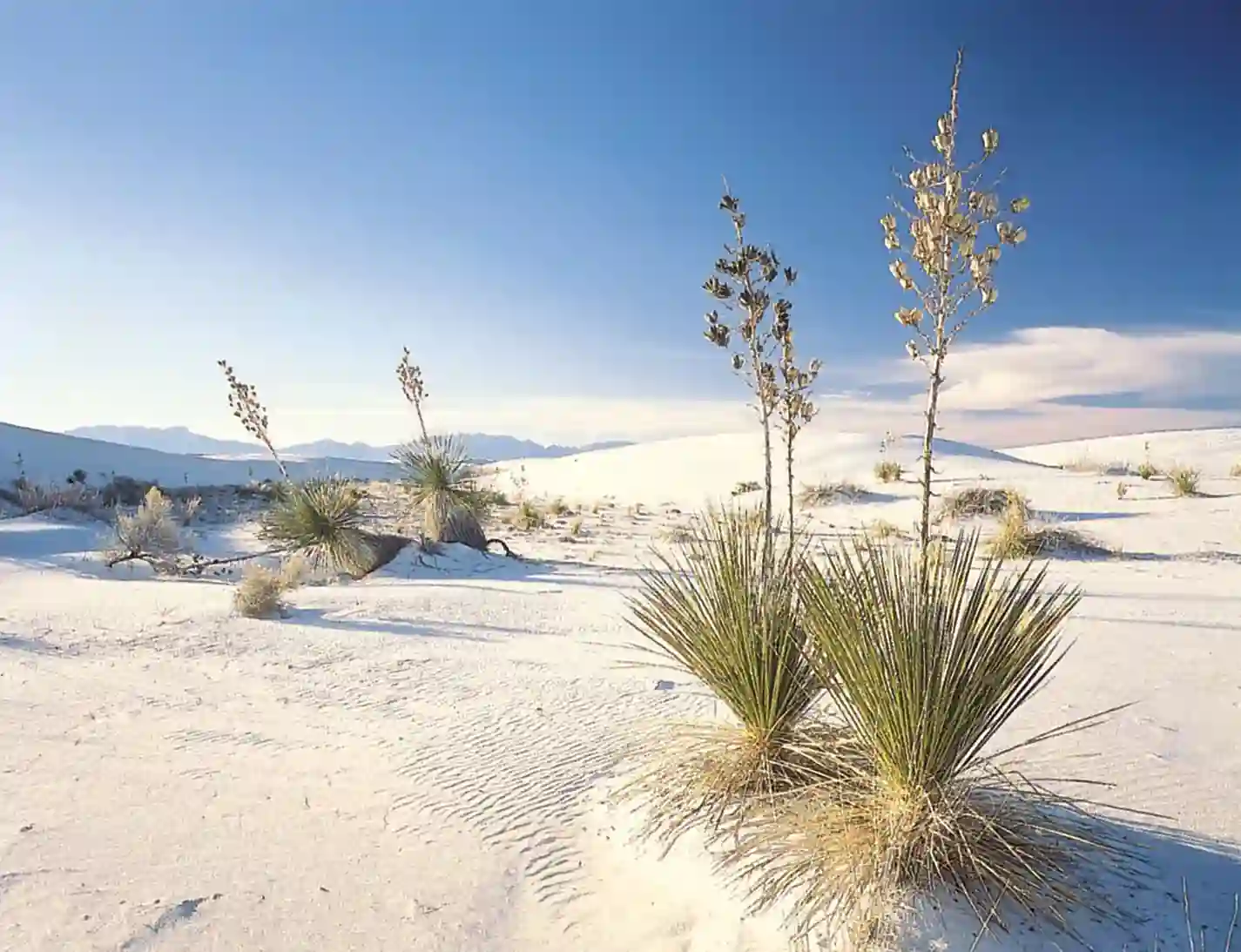
Barefoot, in the middle of summer, on a desert dunefield — most people would expect scorched feet within minutes. At White Sands, the sand stays cool enough to walk comfortably even in the height of a New Mexico afternoon, because these aren’t ordinary quartz dunes. They’re pure gypsum, a mineral that reflects sunlight instead of absorbing it, creating a stretch of the Tularosa Basin that looks, from certain angles, more like snow than desert.
Here’s the practical guide for anyone planning a visit: where the park sits, what it costs, the details that make it genuinely unlike anywhere else in the National Park System, and the unusual history of a park that’s spent most of its existence surrounded by an active military missile range.
White Sands National Park Overview
| Category | Details |
| Location | Tularosa Basin, south-central New Mexico |
| Nearest towns | Alamogordo (15 miles), Las Cruces (52 miles) |
| Nearest airport | El Paso International (ELP), roughly 90 minutes away |
| Established | January 18, 1933 (as a national monument); December 20, 2019 (as a national park) |
| Total area | About 146,000 acres (roughly 229 square miles) |
| Vehicle entrance fee | $25, valid 7 consecutive days |
| Motorcycle fee | $20 |
| Per-person fee (foot/bicycle) | $15 |
| White Sands Annual Pass | $45 |
| America the Beautiful Annual Pass | $80 (all U.S. national parks) |
| Gypsum dunefield size | World’s largest, about 275 square miles total (park protects the southern portion) |
| Tallest dunes | Up to 60 feet high |
| Main scenic road | Dunes Drive, 8 miles |
| Missile range closures | Possible with as little as 24 hours’ notice |
| Annual visitation | Around 600,000 visitors, the most-visited NPS site in New Mexico |
Where White Sands National Park Is Located
White Sands sits in the Tularosa Basin of south-central New Mexico, roughly 15 miles southwest of Alamogordo and about 52 miles northeast of Las Cruces, right along U.S. Highway 70. The basin itself is enclosed by mountain ranges on both sides, the San Andres Mountains to the west and the Sacramento Mountains to the east, a closed geological structure that traps mineral-rich runoff and feeds the gypsum dunefield over thousands of years.
El Paso International Airport is the most practical arrival point for most visitors, with roughly an hour and a half drive to reach the park. The visitor center, built during the 1930s in Pueblo Revival style using adobe and gypsum plaster, sits near the park’s main entrance and now holds a spot on the National Register of Historic Places in its own right.
What makes the park’s location unusual is what surrounds it: White Sands has been completely encircled by the White Sands Missile Range and Holloman Air Force Base since the early 1940s, a military presence that has, somewhat ironically, helped keep development away from the dunes for over 80 years.
What It Costs to Visit
A standard vehicle pass costs $25, covering everyone inside for seven consecutive days, one of the more affordable entrance fees among major national parks. Motorcycles pay $20, and visitors arriving on foot or bicycle pay $15 per person, with children 15 and under admitted free.
Frequent visitors typically pick up the $45 White Sands Annual Pass, while anyone planning trips to multiple national parks during the year tends to prefer the $80 America the Beautiful Pass, which covers admission to every federal recreation site nationwide.
One detail specific to this park’s unusual neighbors: because White Sands sits adjacent to an active missile testing range, Dunes Drive and even sections of nearby U.S. Highway 70 can close temporarily, sometimes for up to three hours, during scheduled missile or rocket tests. These closures can be announced with as little as 24 hours’ notice, so it’s worth checking the park’s current alerts before making the drive, especially if you’re traveling a significant distance to get there.
Facts That Make White Sands Unique
The dunefield here is the largest gypsum dunefield on Earth, formed as rainfall and snowmelt carried dissolved gypsum down from the surrounding mountains into the enclosed basin, where it eventually crystallized and broke down into fine white sand carried by northeast winds into the dunes visitors see today. Unlike typical desert sand made of silica, gypsum doesn’t retain heat the way quartz does, which is why the dunes stay comfortably cool underfoot even during peak summer heat.
In the park’s southwest corner sits Lake Lucero, a usually dry playa encrusted with selenite crystals formed as gypsum-laden water evaporates, effectively the source material feeding the dunefield’s ongoing growth. The dunes themselves reach up to 60 feet high in places, and the dunefield’s massive scale and pale coloring make it visible even from orbit.
One of the more remarkable recent discoveries here involves ancient human history rather than geology. In the 2000s, a National Park Service biologist documented thousands of fossilized footprints, nicknamed the “Ghost Tracks,” embedded in the basin’s ancient lakebed sediments, evidence suggesting people walked this landscape more than 20,000 years ago alongside now-extinct megafauna, among the oldest confirmed evidence of human presence in North America.
The History Behind White Sands National Park
Early interest in protecting the dunes dates back to 1898, when a group from El Paso pushed for national park status, though their proposal included hunting provisions that didn’t align with conservation goals and went nowhere. Senator Albert B. Fall made another attempt between 1912 and 1922, but the National Park Service considered his proposed boundaries too scattered, and the effort stalled again.
Real momentum came from Tom Charles, an Alamogordo businessman who spent years lobbying for protection and helped secure improved road access to the dunes during the 1920s. Advised that a national monument designation would be more achievable than full park status, Charles pushed forward on that basis, and on January 18, 1933, in the final days of his presidency, Herbert Hoover signed the proclamation establishing White Sands National Monument.
The park’s relationship with the military began less than a decade later. In 1941, the surrounding area became the White Sands Missile Range, and the site later gained additional historical weight as the location of the Trinity test, the first detonation of an atomic bomb, conducted nearby during World War II. That military presence has persisted for over 80 years, coexisting uneasily but continuously with the park’s conservation mission.
Full national park status finally arrived far more recently than most people expect. On December 20, 2019, Congress redesignated the site as White Sands National Park through the National Defense Authorization Act, making it one of the newest full national parks in the entire system.
Frequently Asked Questions
Q1. Will missile testing actually affect my visit if I plan a trip?
Possibly, though closures are typically brief. Dunes Drive can close for up to three hours during scheduled tests, sometimes announced with only 24 hours’ notice. Check the park’s official alerts page shortly before your trip, especially if you’re traveling a long distance specifically for this park.
Q2. Can I sled down the dunes, and do I need to bring my own equipment?
Yes, sledding on the gypsum dunes is a popular activity. You can bring your own plastic snow saucer or purchase one at the park’s gift shop, since regular sleds with runners don’t work well on sand.
Q3. Is the Ghost Tracks fossil site open for visitors to see?
Generally no. The fossilized footprint sites are extremely fragile and largely restricted to protect them from damage, though the park occasionally offers limited, ranger-led access to specific areas. Check current visitor center offerings if this is a priority for your trip.
Q4. What’s the best time of day to visit given the heat and lack of shade?
Early morning or the two hours before sunset offer the most comfortable temperatures and the best lighting for photos, since the dunefield has almost no natural shade. Midday summer visits can be genuinely uncomfortable without sun protection and plenty of water.