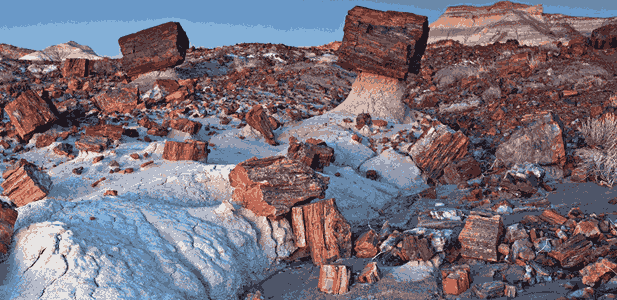
By the late 1800s, entrepreneurs had a plan for the ancient logs scattered across this stretch of northeastern Arizona: crush them into industrial abrasives. These weren’t ordinary fallen trees. They were fossilized wood, some pieces roughly 225 million years old, turned to solid quartz and jasper crystal over eons, and souvenir hunters and commercial collectors were hauling them away at an alarming rate before public outcry finally forced federal protection. Today, that same petrified wood remains one of the world’s largest and most colorful concentrations found anywhere, embedded within a landscape that also holds a stretch of historic Route 66 and centuries of ancient pueblo ruins.
Here’s the practical guide for anyone planning a visit: where the park sits, what it costs, the numbers behind its ancient fossilized forest, and the theft-driven conservation fight that led to one of the first monuments designated under the Antiquities Act.
Petrified Forest National Park Overview
| Category | Details |
| Location | Navajo and Apache counties, northeastern Arizona |
| Nearest city | Holbrook, AZ |
| Nearest airport | Phoenix Sky Harbor International (PHX), about 3.5 hours away |
| Established | National monument December 8, 1906; national park December 9, 1962 |
| Total area | About 221,390 acres |
| Vehicle entrance fee | $25, valid 7 consecutive days |
| Motorcycle fee | $20 |
| Per-person fee (foot/bicycle) | $15 |
| Annual Park Pass | $45 |
| America the Beautiful Annual Pass | $80 (all U.S. national parks) |
| Fossilized wood age | About 211–225 million years old (Triassic Period) |
| Wilderness designation | Over 50,000 acres, designated in 1970 |
| Main park road | 28 miles, connecting north and south entrances |
| Annual visitation | Around 315,000 to 650,000 visitors |
Where Petrified Forest National Park Is Located
Petrified Forest sits in northeastern Arizona, straddling Navajo and Apache counties, with easy access right off Interstate 40 between the towns of Winslow and Holbrook. The park has two entrances connected by a single 28-mile road running through the middle: the north entrance, near the Painted Desert Visitor Center, and the south entrance, close to the Rainbow Forest Museum and its paleontology exhibits.
Phoenix Sky Harbor International Airport is the most practical arrival point for most visitors, with roughly a three-and-a-half hour drive northeast to reach the park. Because the park sits directly along I-40, it functions as an easy stopover for road-trippers crossing Arizona rather than requiring a dedicated detour, and the entire drive through the park can reasonably be done in under a day.
The park’s northern reaches extend into the Painted Desert, a roughly 1,500-square-mile badlands region known for its layered, colorful rock formations, while the park itself is primarily short-grass prairie and semi-arid grassland rather than the cactus-dotted Sonoran Desert scenery many visitors expect from Arizona.
What It Costs to Visit
A standard vehicle pass costs $25, covering everyone inside for seven consecutive days. Motorcycles pay $20, and visitors on foot or bicycle pay $15 per person. Frequent visitors can pick up the $45 Annual Park Pass, while anyone planning trips to multiple national parks during the year typically prefers the $80 America the Beautiful Pass, which covers admission to every federal recreation site nationwide.
Entrance fees apply at both the north and south entrance stations, and the funds directly support infrastructure maintenance, educational programming, wildlife monitoring, and ongoing archaeological preservation efforts throughout the park.
Facts That Make Petrified Forest Extraordinary
The park’s fossilized trees date back roughly 211 to 225 million years to the Triassic Period, predating dinosaurs’ peak diversity and offering scientists a genuine window into an entirely different geological era of Earth’s history. Ancient rivers buried these fallen trees in sediment and volcanic ash, and over millions of years, silica-rich groundwater gradually replaced the organic wood tissue with quartz crystals, producing the vivid, colorful mineral patterns visible in the logs today.
More than 400 plant species survive within the park’s boundaries, dominated by grasses like bunchgrass, blue grama, and sacaton, supporting a genuinely diverse wildlife community despite the harsh, dry, windy climate that swings from summer highs near 100°F to well-below-freezing winter lows.
Beyond the petrified wood itself, the park preserves a restored ancient pueblo at Puerco Pueblo, extensive petroglyphs carved by earlier inhabitants, and a protected, still-visible section of historic Route 66, a detail that ties the park’s ancient geological story directly to a more recent chapter of 20th-century American road travel.
The History Behind Petrified Forest National Park
Documentation of the region’s remarkable fossilized logs dates back to the 1850s, when U.S. Army surveyors and railroad scouts first recorded the great stone trees scattered across the desert floor. By the late 1800s, souvenir hunters and commercial collectors were removing petrified wood at a rate serious enough to alarm conservationists, and some entrepreneurs seriously proposed crushing the ancient logs for use as industrial abrasives, a fate that would have permanently destroyed an irreplaceable scientific resource.
Public outcry over this theft and destruction built momentum for federal action, and on December 8, 1906, President Theodore Roosevelt signed the proclamation establishing Petrified Forest National Monument, one of the first monuments designated under the newly enacted Antiquities Act. The monument expanded modestly in 1932, adding roughly 2,500 acres of the Painted Desert to its protected boundaries.
Full national park status arrived decades later, on December 9, 1962, elevating the site’s protections significantly. In 1970, Congress designated over 50,000 acres within the park as official wilderness, split between units at the park’s north and south ends. The park’s boundaries expanded again dramatically in 2004, when legislation more than doubled its authorized acreage, giving Petrified Forest roughly its current size and securing additional Painted Desert terrain for permanent protection.
Frequently Asked Questions
Q1. Is it illegal to take even a small piece of petrified wood as a souvenir?
Yes, absolutely. Removing any petrified wood from the park is illegal and actively enforced, a direct legacy of the theft that nearly destroyed this resource before federal protection began. Licensed rock shops in nearby towns like Holbrook sell legally sourced petrified wood if you want a genuine souvenir.
Q2. Can I see the entire park in a single day if I’m driving through on I-40?
Yes, easily. The 28-mile main park road connecting both entrances typically takes about 2 to 3 hours to drive with stops at key overlooks and short trails, making it very feasible as a same-day stopover during a longer road trip.
Q3. Is the historic Route 66 section still drivable, or is it just a marker?
It’s primarily a preserved, marked section rather than a fully drivable historic route today, though its location within the park connects visitors to a physical remnant of the original highway alignment that once crossed this same stretch of Arizona.
Q4. What’s the best time of year to visit given the extreme temperature swings?
Spring and fall offer the most comfortable conditions, avoiding both summer highs near 100°F and winter’s sub-freezing overnight temperatures. Wind is a near-constant factor here regardless of season, so dressing in layers is a smart strategy year-round.