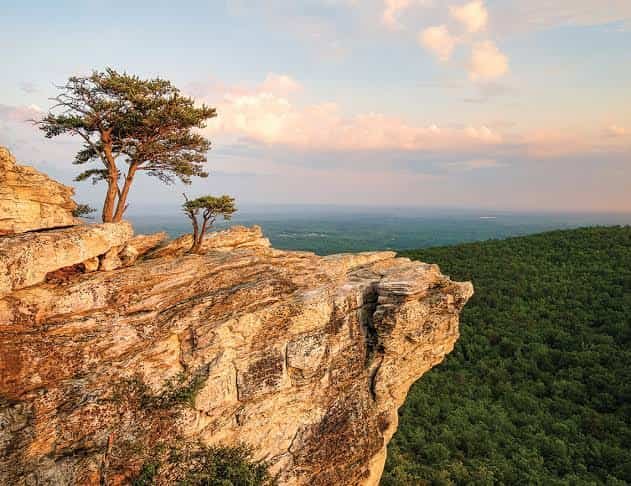
South Dakota holds two national parks, both born from the same 1929-to-1939 stretch of American conservation history, yet protecting completely different landscapes. Badlands preserves a dramatic, eroded moonscape holding one of the richest fossil beds on Earth, while Wind Cave, just a couple hours south, protects a cave system so strange that a rancher’s hat once got blown clean off his head by air rushing out of a small hole in the prairie.
Here’s the practical guide to both: where they sit, what they cost, the numbers that define them, and the different paths each took toward federal protection.
South Dakota’s National Parks Overview
| Park | Location | Established | Entrance Fee | Signature Feature |
| Badlands | Southwestern SD, near Rapid City | 1939 (monument); 1978 (park) | $30 per vehicle | Eroded buttes, rich Oligocene fossil beds |
| Wind Cave | Black Hills, southwestern SD | January 9, 1903 | Free (cave tours ticketed separately) | Barometric “breathing” cave, rare boxwork formations |
Where South Dakota’s National Parks Are Located
Badlands National Park sits in southwestern South Dakota, roughly an hour east of Rapid City, easily reached off Interstate 90. Wind Cave sits further southwest in the Black Hills, about 10 to 11 miles north of Hot Springs, South Dakota, close enough to Custer State Park, Mount Rushmore, and the Crazy Horse Memorial that most visitors treat the region as one combined Black Hills itinerary rather than a single-park trip.
Rapid City Regional Airport serves both parks reasonably well, sitting closer to Badlands but still a manageable drive to Wind Cave, roughly an hour and a half further south.
What South Dakota’s National Parks Cost to Visit
Badlands charges $30 per vehicle, with the $80 America the Beautiful Annual Pass covering entrance and typically paying for itself after two to three park visits. Wind Cave National Park itself charges no entrance fee at all, since the surface prairie and visitor center are free to explore; the cost comes in only if you want to actually go underground, since cave tours require a separate ticket purchased at the visitor center or through Recreation.gov.
Given the proximity of both parks to Mount Rushmore, Custer State Park, and Crazy Horse Memorial, many visitors budget for a combined Black Hills trip covering multiple fee structures across federal, state, and private attractions in the same week.
Facts That Distinguish South Dakota’s Two Parks
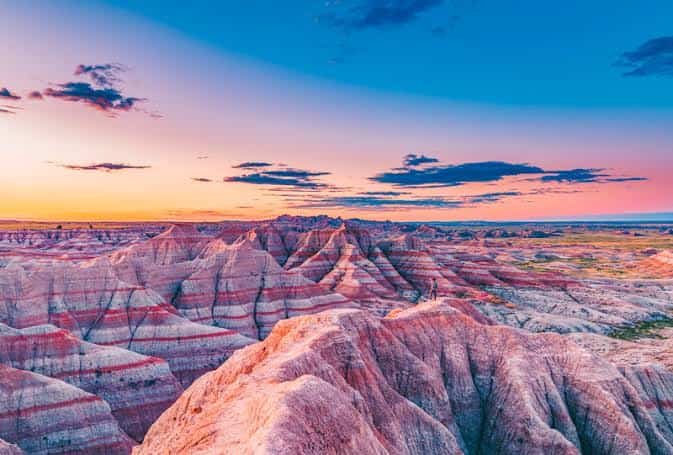
Badlands protects roughly 244,000 acres of sharply eroded buttes, pinnacles, and spires, along with the largest protected mixed-grass prairie in the United States. Its layered rock formations, deposited between 23 and 75 million years ago when a shallow inland sea covered the region, hold one of the richest Oligocene fossil beds on Earth, including remains of ancient three-toed horses, saber-toothed cats, and rhinos. The park’s Stronghold Unit is co-managed with the Oglala Sioux Tribe and includes sites of the 1890s Ghost Dance ceremonies, adding deep cultural significance alongside its geological value.
Wind Cave takes its name from air rushing in and out of its small natural entrance due to barometric pressure changes, sometimes measured at wind speeds up to 70 miles per hour. Below ground, the cave holds more than 160 miles of mapped passages and roughly 95% of the world’s known boxwork formations, a rare, delicate calcite structure found almost nowhere else. Above ground, the park protects one of the largest remaining intact mixed-grass prairie ecosystems in North America, supporting bison, elk, and pronghorn.
The History Behind South Dakota’s National Parks
Wind Cave has the older history of the two by decades. Rancher Tom Bingham stumbled onto the cave’s small entrance in 1881, famously having his hat blown off by the escaping air, and the McDonald family conducted extensive early exploration and guided tours through the 1890s before their ownership claim was rejected by the federal government. President Theodore Roosevelt signed legislation establishing Wind Cave National Park on January 9, 1903, making it one of the earliest parks in the entire system and the first anywhere in the world created specifically to protect a cave.
Badlands followed a longer path. Concerned about private collectors pilfering the area’s abundant fossils, Congress authorized Badlands National Monument in 1929, though it wasn’t formally established until January 25, 1939. In the late 1960s, Congress added more than 130,000 acres of Oglala Sioux tribal land, formerly used as a U.S. Army gunnery range during World War II, into a joint-management arrangement. On November 10, 1978, Congress redesignated the site Badlands National Park, giving it full park status nearly four decades after its initial monument protection.
Frequently Asked Questions
Q1. Can I visit both Badlands and Wind Cave in the same trip?
Yes, they’re commonly combined with Mount Rushmore, Custer State Park, and the Crazy Horse Memorial into a single Black Hills road trip, since all sit within a few hours of each other in southwestern South Dakota.
Q2. Do I need to book a Wind Cave tour in advance?
Yes, it’s recommended, since guided tours are the only way to experience the cave and popular options like the Natural Entrance and Garden of Eden tours can fill up, especially during peak spring field-trip season and summer.
Q3. Am I allowed to collect fossils I find at Badlands?
No. Collecting fossils, plants, or rocks of any kind is illegal within the park; anything found must be reported to a ranger and left in place, consistent with federal law protecting paleontological resources.
Q4. What’s the best time of year to visit Badlands to avoid extreme heat?
Spring (April–May) and fall (September–October) offer the mildest temperatures. Summer visits are still popular but can bring temperatures exceeding 100°F, so plan hikes for early morning or late afternoon during that season.