Hawaii holds two national parks, and both center on the same raw geological force: active volcanism. Haleakalā protects a dormant volcano on Maui famous for sunrise views from its summit crater, while Hawaiʻi Volcanoes on the Big Island remains one of the most consistently active volcanic landscapes on Earth, occasionally erupting in real time while visitors watch from designated overlooks. Both parks were originally managed as a single combined unit before splitting apart decades later.
Here’s the practical guide to both: where they sit, what they cost, the numbers behind their volcanic records, and the shared history that once linked them under one park designation.
Hawaii’s National Parks Overview
| Park | Location | Established | Entrance Fee | Signature Feature |
| Haleakalā | Maui, Summit and Kīpahulu districts | 1916 (as part of Hawaii NP); 1961 (separate park) | $30 per vehicle (3 days, both districts) | 10,023-foot summit, sunrise viewing |
| Hawaiʻi Volcanoes | Big Island (Hawaiʻi), near Hilo | 1916 (as part of Hawaii NP); 1961 (separate park) | $30 per vehicle (7 days) | Kīlauea, one of the world’s most active volcanoes |
Where Hawaii’s National Parks Are Located
Haleakalā National Park sits on the island of Maui, split into two districts that don’t connect by road: the high-elevation Summit District near Pukalani, and the coastal Kīpahulu District near Hāna, typically visited as part of the Road to Hāna drive. Kahului Airport serves as the main arrival point, with the Summit District roughly an hour’s drive away and Kīpahulu requiring a considerably longer trip along the winding coastal highway.
Hawaiʻi Volcanoes National Park sits on the Big Island, roughly 30 miles from Hilo, the closest city of significant size. Hilo International Airport offers direct access, with a straightforward drive to the park entrance along Highway 11. Because the two parks sit on different islands, visiting both requires a separate inter-island flight rather than a single continuous road trip.
What Hawaii’s National Parks Cost to Visit
Haleakalā charges $30 for a vehicle pass valid three days, covering both the Summit and Kīpahulu Districts, with $25 for motorcycles and $15 per person for those on foot or bicycle. The detail that catches nearly every visitor off guard: watching sunrise from the summit requires a separate $1 per-vehicle reservation on top of the standard entrance fee, required for any vehicle entering the Summit District between 3 and 7 a.m., and these reservations release 60 days in advance and often sell out.
Hawaiʻi Volcanoes charges $30 per vehicle for a seven-day pass, $25 for motorcycles, and $15 per person, with entrance stations accepting cards only. Neither park currently charges the additional $100 international visitor surcharge applied at select mainland parks. Frequent visitors to either park can pick up a $55 Hawaiʻi Tri-Park Annual Pass, which covers both parks together, while the $80 America the Beautiful Pass works nationwide for travelers combining Hawaii with mainland park visits.
Facts That Distinguish Hawaii’s Two Parks
Haleakalā’s summit depression, often called a crater, is technically an erosional valley formed by the merger of two separate valleys rather than true volcanic collapse, stretching roughly 7.5 miles long and up to 3,000 feet deep. The park holds more endangered species than any other national park in the country, including the Haleakalā silversword, found nowhere else on Earth, and the nēnē, Hawaii’s state bird, once extinct on Maui before an unusual 1950s reintroduction effort, reportedly involving Boy Scouts carrying geese into the backcountry packed inside old whiskey boxes.
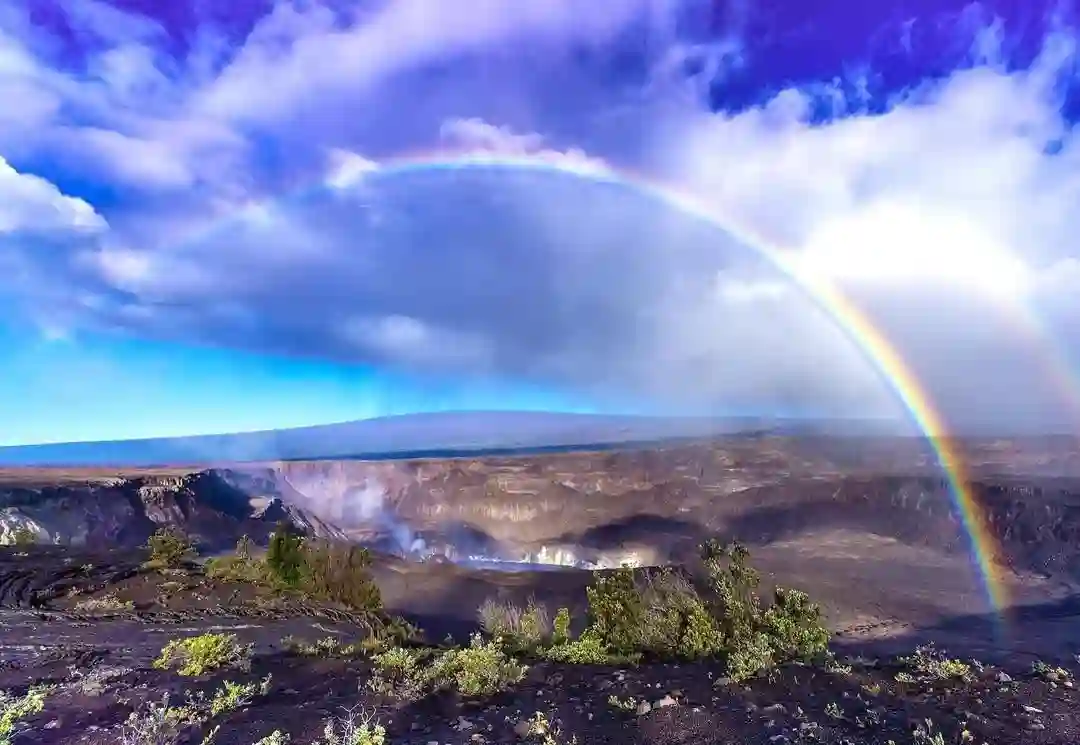
Hawaiʻi Volcanoes protects Kīlauea, one of the most active volcanoes on Earth, alongside Mauna Loa, the largest volcano on the planet by volume. The park’s landscape is still actively being built, sometimes visibly so; a major 2018 eruption caused a significant summit collapse that reshaped much of the crater, and the park continues experiencing episodic eruption activity in the years since, meaning the scenery visitors see can look meaningfully different from photos taken just a few years earlier.
The History Behind Hawaii’s National Parks
Both parks share the same origin story. In 1916, Congress created Hawaii National Park, an unusual multi-island designation combining Haleakalā on Maui with Kīlauea and Mauna Loa on the Big Island under a single park, a practical arrangement given how limited federal staffing was in the territory at the time. A formal dedication ceremony was held at the Kīlauea summit in 1921, where a Hawaiian minister blessed the occasion and offered thanks to Pele, the Hawaiian goddess of volcanoes, blending the site’s scientific significance with its deep cultural roots from the start.
The combined arrangement lasted 45 years. In 1961, Congress split Haleakalā into its own separate national park, distinct from what became Hawaiʻi Volcanoes National Park on the Big Island. Haleakalā’s boundaries later expanded to include the Kīpahulu Valley in 1951 and the pools of ʻOheʻo Gulch in 1969, when the Nature Conservancy purchased and transferred roughly 10,000 acres of coastal ecosystem to the National Park Service. Hawaiʻi Volcanoes, meanwhile, earned UNESCO recognition as a Biosphere Reserve in 1980 and a full World Heritage Site in 1987.
Frequently Asked Questions
Q1. Do I need a separate reservation to watch sunrise at Haleakalā’s summit?
Yes, a $1 per-vehicle reservation is required for entry between 3 and 7 a.m., separate from the standard entrance fee. These release 60 days in advance and routinely sell out, so book as early as that window allows.
Q2. Can I visit both Hawaii national parks on the same trip?
Yes, but it requires an inter-island flight between Maui and the Big Island, since the two parks sit on entirely separate islands with no direct ferry or driving route connecting them.
Q3. Is it safe to visit Hawaiʻi Volcanoes if Kīlauea is actively erupting?
The park manages designated viewing areas specifically to allow safe eruption viewing when conditions permit, though active episodes can bring heavier traffic and temporary closures. Check the USGS Hawaiian Volcano Observatory’s status updates before your trip and always follow posted ranger guidance.
Q4. How cold does it get at Haleakalā’s summit, and what should I pack?
Temperatures at 10,023 feet typically run 30 to 40 degrees colder than sea level, often near or below freezing before sunrise even during summer. Bring warm layers, a windbreaker, hat, and gloves regardless of how warm it is down at the coast.