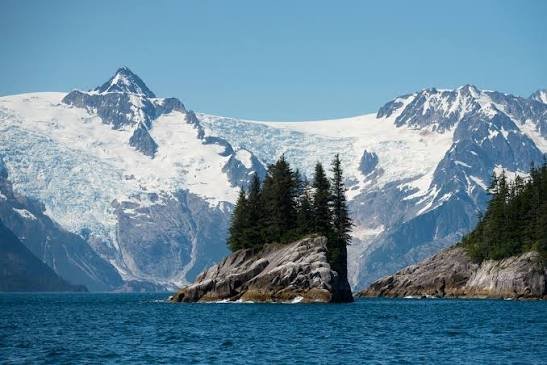
More than half of Kenai Fjords National Park is buried under ice, a single massive icefield feeding nearly 40 separate glaciers that spill down toward the sea. Yet unlike most of Alaska’s remote national parks, which demand a bush plane and a serious travel budget just to reach, Kenai Fjords sits a short drive from a working port town, charges no entrance fee, and lets visitors walk right up to an active glacier without ever boarding a boat or a plane.
Here’s the practical guide for anyone planning a visit: where the park sits, what it costs (nothing, aside from the tours), the numbers behind its massive icefield, and the recent volcanic and tectonic history that literally reshaped this coastline within living memory.
Kenai Fjords National Park Overview
| Category | Details |
| Location | Southeastern Kenai Peninsula, south-central Alaska |
| Nearest city | Seward, AK (park headquarters) |
| Distance from Anchorage | About 126 miles |
| Nearest airport | Ted Stevens Anchorage International (ANC) |
| Established | National monument December 1, 1978; national park December 2, 1980 |
| Total area | About 607,000–670,000 acres |
| Entrance fee | None — free to visit |
| Typical boat tour cost | Averages around $100+ per person |
| Harding Icefield size | About 700 square miles — largest icefield entirely within the U.S. |
| Glaciers fed by the icefield | Nearly 40 |
| Road-accessible area | Only Exit Glacier |
| Coastline | Over 545 miles, explorable by kayak |
| Annual visitation | Roughly 115,000 to 412,000 visitors (varies significantly by year) |
Where Kenai Fjords National Park Is Located
Kenai Fjords National Park sits on the southeastern edge of the Kenai Peninsula in south-central Alaska, roughly 126 miles south of Anchorage along the Seward Highway. The town of Seward, adjacent to the park, serves as both its headquarters and its practical gateway, offering full services and functioning as the departure point for every boat tour into the fjords themselves.
Ted Stevens Anchorage International Airport is the natural arrival point for most visitors, followed by a scenic roughly two-and-a-half-hour drive south to Seward. The park is genuinely split into two distinct experiences that don’t connect to each other: Exit Glacier, the only section reachable by road, sits a short drive from Seward, while the dramatic fjords, tidewater glaciers, and marine wildlife along the coast are accessible exclusively by boat or kayak departing from town.
What It Costs to Visit
Kenai Fjords National Park charges no entrance fee at all. There’s no gate, no vehicle pass, and no per-person charge simply to enter the park or explore its trails.
Where the actual spending happens is transportation and guided experiences, since most of the park’s signature scenery, calving tidewater glaciers, whale sightings, and remote fjords, requires a boat tour operated by private concessionaires based in Seward. These tours vary widely in length and price, with a typical guided boat tour averaging around $100 or more per person, and longer full-day cruises into more remote fjords like the Northwestern Fjord running considerably higher. Because there’s no entrance fee to waive, America the Beautiful passes have no functional use at Kenai Fjords, though they remain useful for other Alaska national parks that do charge admission, and the pass can still be worth carrying if your itinerary includes fee-charging sites elsewhere.
Exit Glacier itself remains free to visit year-round, though the road and nature center there close during winter months, typically reopening again in spring.
Facts That Make Kenai Fjords Extraordinary
The Harding Icefield anchors the entire park, covering roughly 700 square miles and standing as the largest icefield located entirely within U.S. borders. Nearly 40 glaciers flow outward from this icefield, carving the dramatic U-shaped valleys that fill with seawater to form the fjords giving the park its name. More than half the park’s total area sits buried under snow and ice at any given time.
Exit Glacier remains the park’s most accessible feature, reachable via short trails ranging from half a mile to about a mile and a half one-way on the valley floor, while the considerably more demanding Harding Icefield Trail climbs roughly 3,000 feet of elevation over about 8.2 miles round trip, rewarding hikers with a sweeping view of the icefield stretching to the horizon. Beyond Exit Glacier, the park protects more than 545 miles of rugged coastline, explorable by kayak for visitors seeking a slower, quieter approach than a motorized boat tour.
Wildlife here is genuinely abundant along the coast, with humpback whales, orcas, sea otters, sea lions, harbor seals, and a wide variety of seabirds all commonly spotted on boat tours through Resurrection Bay and the surrounding fjords.
The History Behind Kenai Fjords National Park
The Sugpiaq, also known as Alutiiq, people have maintained cultural and ancestral ties to this stretch of coastline for centuries, relying on the region’s rich marine resources as a maritime society long before European contact. Russian fur traders and later European explorers arrived in subsequent centuries, leaving their own historical footprint on the region before it eventually became part of the United States through the Alaska Purchase.
Federal protection began relatively recently. On December 1, 1978, President Jimmy Carter designated the area Kenai Fjords National Monument, one of fifteen new Alaskan national monuments created that day using presidential authority under the Antiquities Act, a move made partly in response to a stalled congressional effort to protect large tracts of Alaskan wilderness. Two years later, on December 2, 1980, Congress passed the Alaska National Interest Lands Conservation Act, redesignating the site Kenai Fjords National Park alongside several other Alaskan monuments elevated to full park status that same day.
The park’s landscape has continued changing dramatically since its creation, shaped by ongoing glacial retreat that’s visibly altered features like Exit Glacier within just the past few decades, along with the region’s underlying seismic activity, since this stretch of coastline sits along one of the most tectonically active zones in North America.
Frequently Asked Questions
Q1. Do I need to book a boat tour in advance, or can I show up in Seward and buy tickets same-day?
Advance booking is strongly recommended, especially during peak summer months from June through August, since popular tours can sell out. Same-day tickets occasionally remain available for less popular departure times, but don’t count on it during high season.
Q2. Can I visit Kenai Fjords without taking a boat tour at all?
Yes. Exit Glacier is the only section of the park reachable by road, and you can hike its trails, view the glacier up close, and even attempt the Harding Icefield Trail entirely without a boat. You’ll miss the fjords and marine wildlife, but a meaningful visit is still possible on land alone.
Q3. What’s the best time of year to visit for the most reliable weather and wildlife viewing?
Late May through early September offers the most consistent conditions, with June through August representing peak whale and marine wildlife activity. Winter access is limited, since the Exit Glacier road and boat tours both close seasonally.
Q4. Is Kenai Fjords a good option for visitors who get seasick easily?
Land-based tours to Exit Glacier, including guided walks and even dog-sled experiences near the Iditarod’s Mile 0 marker, offer a solid alternative for those who’d rather avoid boat travel altogether while still experiencing the park’s glacial scenery.