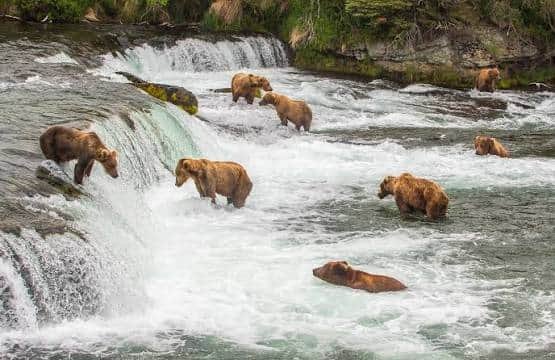
Every October, millions of people online vote for their favorite brown bear in a bracket-style tournament called Fat Bear Week, celebrating the heaviest, most successfully fattened bears at Katmai’s Brooks Falls before winter hibernation. It’s become an internet phenomenon, but the bears themselves are entirely real: Katmai protects roughly 2,200 brown bears, the largest concentration found anywhere on Earth, drawn to a single waterfall where salmon leap directly into their open jaws every summer. Oddly enough, none of that was the original reason this park exists.
Here’s the practical guide for anyone planning a visit: where the park sits, what it costs (nothing, though getting there certainly isn’t free), the numbers behind its record-setting bear population, and the volcanic catastrophe that actually created this park back in 1918.
Katmai National Park Overview
| Category | Details |
| Location | Alaska Peninsula, southwestern Alaska |
| Nearest town | King Salmon, AK |
| Access | Float plane or boat only — no roads connect to the park |
| Established | National monument September 24, 1918; national park and preserve December 2, 1980 |
| Total area | About 4.1–4.2 million acres |
| Entrance fee | None — no fee for day trips |
| Camping (Brooks Camp) | $10 entrance fee plus $5 per person, per night |
| Estimated round-trip cost from Anchorage | Roughly $450 flight to King Salmon + ~$180 air taxi to Brooks Camp |
| Guided day tours (2026) | Around $995–$1,295 per person from Homer |
| Brown bear population | About 2,200 — the world’s largest protected concentration |
| Highest point | Mount Denison, 7,606 feet |
| Brooks Falls Platform capacity | Limited to 40 people, one-hour time limit in peak season |
Where Katmai National Park Is Located
Katmai National Park sits on the Alaska Peninsula in southwestern Alaska, a genuinely remote wilderness with no roads connecting it to the rest of the state. Most visitors fly from Anchorage to the village of King Salmon, just west of the park boundary, then transfer to a small float plane air taxi for the final leg to Brooks Camp, the park’s main visitor hub on the shore of Naknek Lake.
There’s no other way in; the entire park is accessible only by float plane or boat, a defining feature that keeps visitor numbers naturally limited and the wilderness experience genuinely wild. Some visitors instead approach from the park’s eastern coastline along Shelikof Strait, flying directly from Homer or Kodiak for day trips to spot bears feeding on tidal flats rather than routing through King Salmon and Brooks Camp at all.
What It Costs to Visit
Katmai charges no entrance fee for day trips, a genuine rarity that surprises many first-time visitors. Where the real cost comes in is transportation and guided experiences, since reaching this remote park requires flights and boat transfers rather than a simple drive.
Budget roughly $450 round-trip for a flight from Anchorage to King Salmon, plus another $180 or so round-trip for the air taxi connecting King Salmon to Brooks Camp. Many visitors instead book an all-inclusive guided day tour, which for 2026 runs roughly $995 to $1,295 per person from Homer, covering transportation and guided bear viewing in a single package. Camping at Brooks Camp Campground carries a $10 entrance fee plus $5 per person, per night, and reservations for 2026 release in three separate blocks: January 7 for May and June dates, February 7 for July and August, and March 7 for September and October, all opening at 8 a.m. Alaska Time.
Before heading out to the bear-viewing platforms, every visitor is required to attend a 20-minute orientation session at Brooks Camp, sometimes nicknamed the “Brooks Camp School of Bear Etiquette,” covering safety protocols for sharing the landscape with wild brown bears at close range.
Facts That Make Katmai Extraordinary
Katmai protects the world’s largest protected population of brown bears, roughly 2,200 individuals concentrated around its salmon-rich rivers and lakes. The park’s most famous feature, Brooks Falls, draws bears each summer as 200,000 to 400,000 sockeye salmon attempt to jump the falls, creating the iconic image of bears positioned at the lip of the waterfall catching leaping fish mid-air. Late June through late July typically offers the highest concentration of bears at the falls, with a second strong viewing window in late August through September as bears return to feed on spawned-out salmon before winter hibernation.
Because the Falls Platform holds only 40 people at a time, visitors during peak summer season are limited to one hour at a stretch, ensuring everyone gets a turn without overcrowding the viewing area. Elevation across the park’s volcanic terrain ranges from sea level at the Pacific coast up to 7,606 feet at Mount Denison, part of a landscape still shaped by the massive eruption that originally justified the park’s protection.
The History Behind Katmai National Park
The Sugpiaq people called this region home for roughly 9,000 years before a catastrophic event changed everything in 1912. Novarupta Volcano erupted with a force scientists estimate released ten times more energy than the 1980 Mount St. Helens eruption and displaced twice as much material as the 1883 Krakatoa eruption, ranking it among the most powerful volcanic events on Earth in the past 3,400 years. The eruption forced the resettlement of nearby Sugpiaq communities and transformed the once-green landscape into a barren, ash-covered wasteland.
Four years later, in 1916, explorer Robert Griggs climbed Katmai Pass and looked out over a valley still fuming with thousands of steam vents, which he named the Valley of Ten Thousand Smokes. Griggs led the effort that convinced the federal government to protect the area, and on September 24, 1918, Katmai became a national monument, specifically to preserve this volcanically devastated landscape rather than for any wildlife concerns.
Interest gradually shifted over the following decades as visitors discovered the park’s extraordinary concentration of brown bears feeding along its rivers, eventually eclipsing the volcanic valley as the park’s primary draw. On December 2, 1980, the Alaska National Interest Lands Conservation Act expanded the site to roughly 4.1 to 4.2 million acres and redesignated it Katmai National Park and Preserve, cementing both its volcanic history and its now-famous role as a bear sanctuary under one protected boundary.
Frequently Asked Questions
Q1. How far in advance should I book if I want to camp at Brooks Camp during peak bear season?
Very far ahead. July and August reservations release on February 7 at 8 a.m. Alaska Time and tend to fill quickly given limited campground capacity, so mark that release date and be ready to book immediately if you want summer dates.
Q2. Is it safe to be that close to wild brown bears at Brooks Falls?
Yes, when following required protocols. Every visitor must attend a mandatory bear safety orientation before accessing the viewing platforms, and the National Park Service maintains strict distance and behavior guidelines that have kept the area remarkably safe for decades.
Q3. What’s the difference between visiting via Brooks Camp versus a coastal day trip from Homer or Kodiak?
Brooks Camp offers the classic waterfall bear-viewing experience and requires routing through King Salmon, while coastal day trips from Homer or Kodiak fly directly to tidal areas where bears forage for clams, often as an all-inclusive guided package without needing separate flight bookings.
Q4. When is the best time to see the highest concentration of bears at Brooks Falls?
Late June through late July typically offers the most bears at the falls during the first salmon run, while late August through September brings a second wave as bears return to feed before hibernation. Numbers fluctuate day to day based on salmon migration timing.