There are 63 official national parks scattered across the United States, spanning from tropical coral reefs in Florida to Arctic tundra in Alaska, and most people can name maybe a dozen of them. The National Park Service oversees hundreds of other historic sites, monuments, and battlefields too, but the “national park” designation itself is reserved for the system’s most significant natural and scenic landscapes, voted on and approved by Congress rather than assigned informally.
Here’s a practical rundown of every national park in the country, organized by region, along with what each one generally costs, the numbers behind the full system, and how it grew from a single park in 1872 to the sprawling network it is today.
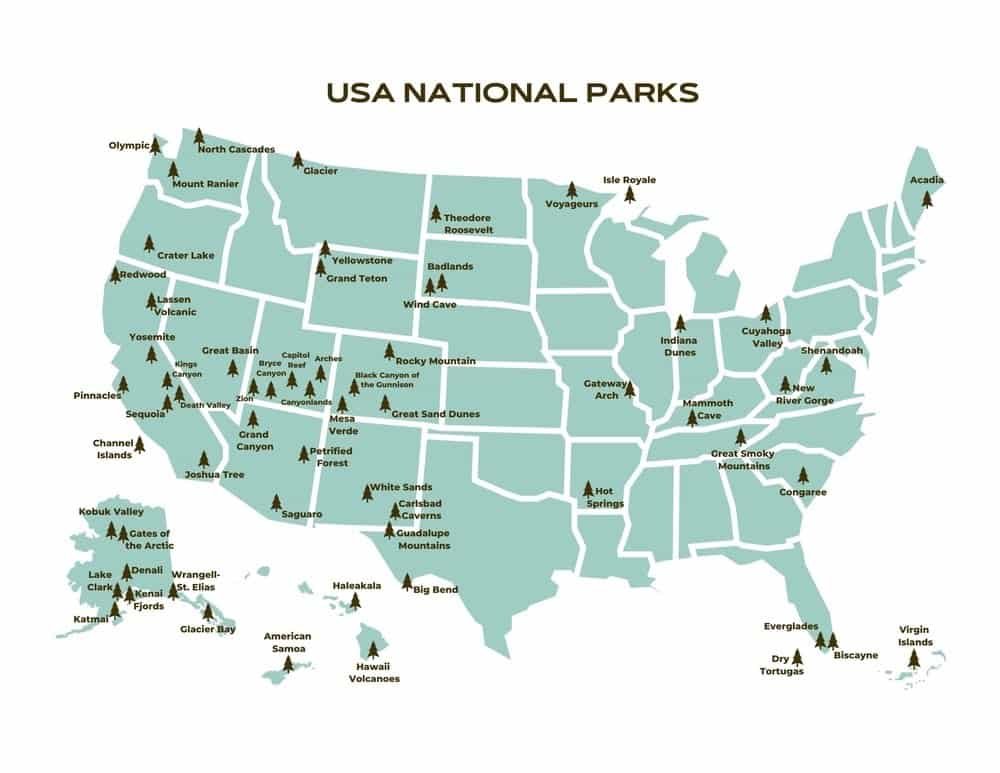
National Parks System Overview
| Category | Details |
| Total national parks | 63 |
| First national park | Yellowstone, established 1872 |
| Newest national park | New River Gorge, West Virginia (2020) |
| States with the most parks | California (9), Alaska (8), Utah (5), Colorado (4) |
| Parks with no entrance fee | Roughly 20+, including Great Smoky Mountains, Congaree, Redwood, Hot Springs |
| Typical vehicle entrance fee (fee-charging parks) | $20–$35, valid 7 days |
| America the Beautiful Annual Pass | $80 (U.S. residents); $250 (non-U.S. residents, as of 2026) |
| International visitor surcharge (2026) | $100 per person at 11 high-traffic parks |
| Total system-wide visitation | Over 300 million visits annually (all NPS units combined) |
| Governing body | National Park Service, U.S. Department of the Interior |
National Parks by Region
West Coast: California alone holds nine national parks, the most of any state: Yosemite, Sequoia, Kings Canyon, Death Valley, Joshua Tree, Redwood, Channel Islands, Pinnacles, and Lassen Volcanic. Oregon and Washington add Crater Lake, Mount Rainier, Olympic, and North Cascades.
Southwest: Utah’s “Mighty 5,” Zion, Bryce Canyon, Capitol Reef, Canyonlands, and Arches, anchor this region alongside Arizona’s Grand Canyon, Petrified Forest, and Saguaro, plus Great Basin in Nevada and Guadalupe Mountains and Big Bend in Texas.
Rocky Mountains: Colorado holds Rocky Mountain, Mesa Verde, Great Sand Dunes, and Black Canyon of the Gunnison. Wyoming contributes Yellowstone and Grand Teton, while Theodore Roosevelt sits in North Dakota.
Midwest and Great Lakes: Isle Royale and Voyageurs represent Michigan and Minnesota respectively, with Indiana Dunes and Cuyahoga Valley (Ohio) rounding out the region alongside Wind Cave and Badlands in South Dakota.
Southeast and East Coast: Great Smoky Mountains straddles Tennessee and North Carolina as the most-visited park in the entire system. Shenandoah (Virginia), Congaree (South Carolina), Everglades, Biscayne, and Dry Tortugas (Florida), Mammoth Cave (Kentucky), Hot Springs (Arkansas), New River Gorge (West Virginia), and Acadia (Maine) cover the rest of the eastern seaboard.
Alaska: Eight parks make up the country’s largest and most remote cluster: Denali, Kenai Fjords, Katmai, Lake Clark, Glacier Bay, Wrangell-St. Elias, Gates of the Arctic, and Kobuk Valley.
Hawaii and Territories: Haleakalā and Hawaiʻi Volcanoes protect Hawaii’s volcanic landscapes, while American Samoa’s National Park of American Samoa protects the system’s only tropical rainforest south of the equator, alongside Virgin Islands National Park in the Caribbean.
Gateway Arch, Missouri: The system’s smallest and only fully urban park sits in downtown St. Louis.
What National Parks Typically Cost
Fee structures vary considerably across the system, and a genuinely useful thing to know before planning any trip: more than 20 national parks charge no entrance fee at all, including Great Smoky Mountains (the most-visited park in the country), Congaree, Redwood, Cuyahoga Valley, Hot Springs, Kenai Fjords, and North Cascades.
Where fees do apply, standard vehicle passes typically run between $20 and $35, valid for seven consecutive days, with reduced rates for motorcycles, pedestrians, and cyclists. Frequent visitors can buy park-specific annual passes, usually $35 to $70, while the $80 America the Beautiful Annual Pass covers entrance at every fee-charging federal recreation site nationwide, a strong value for anyone visiting three or more parks in a single year.
As of January 1, 2026, non-U.S. residents pay $250 for the equivalent annual pass rather than $80, and eleven of the most heavily visited parks, including Yellowstone, Yosemite, Zion, Grand Canyon, and Glacier, charge an additional $100 per-person surcharge for international visitors unless they hold that qualifying non-resident pass.
Facts That Capture the Scale of the National Park System
Alaska alone accounts for roughly 54 million of the National Park System’s total protected acreage, meaning its eight parks, several larger than entire East Coast states, dwarf the land area of the other 55 parks combined. Gates of the Arctic, the largest single national park, covers more than 8.4 million acres and receives fewer annual visitors than Yellowstone sees on a single summer day.
At the other extreme, Gateway Arch in St. Louis covers just 91 acres, making it the smallest national park by a wide margin, while Great Smoky Mountains draws more visitors annually than any other, exceeding 12 million recreational visits some years thanks to its free admission and proximity to a huge share of the eastern U.S. population.
Several parks share joint administration or fee structures with neighbors: Sequoia and Kings Canyon operate under one combined entrance fee, and Haleakalā’s pass covers both its Summit and Kīpahulu districts despite the two not connecting by road.
The History Behind the National Park System
Yellowstone became the world’s first national park in 1872, protected by an act of Congress decades before any federal agency existed to manage it. Additional parks followed sporadically over the next several decades, often championed by individual conservationists, railroad companies eager to drive tourism, or presidents acting through the 1906 Antiquities Act, but management remained inconsistent, sometimes falling to the U.S. Army, until Congress created the National Park Service in 1916 to bring unified oversight to the growing system.
The system expanded significantly through the 20th century, incorporating everything from Everglades’ unique ecosystem-focused designation in 1947 to a wave of Alaskan parks added in 1980 through the Alaska National Interest Lands Conservation Act, which nearly doubled the system’s total protected acreage in a single stroke. More recent additions reflect shifting priorities too: several sites gained full national park status decades after initial protection, including Indiana Dunes (2019), White Sands (2019), and New River Gorge (2020), each elevated from a lesser designation once Congress recognized their broader significance.
Frequently Asked Questions
Q1. How many national parks can I realistically visit if I want to see all 63?
Most dedicated “park baggers” spend years, not months, working through the full list, since roughly a third sit in Alaska or Hawaii and require significant additional travel time and cost beyond a typical road trip. A reasonable multi-year goal for most travelers is 20 to 30 parks within driving or affordable flying distance.
Q2. Is the America the Beautiful Pass worth it if I’m only visiting two or three parks this year?
It typically pays for itself after just two visits to fee-charging parks, given that most standard vehicle fees run $30 to $35. If your trip includes any of the roughly 20 free parks, factor that in, since the pass won’t add value there.
Q3. Which national parks are best for a first-timer who’s never visited any?
Grand Canyon, Yellowstone, Yosemite, and Zion consistently rank as the most iconic and accessible starting points, offering dramatic scenery, solid infrastructure, and relatively easy travel logistics compared to more remote parks in Alaska or the Pacific.
Q4. Do all national parks require advance reservations now?
No. Reservation and timed-entry requirements vary significantly by park and season, and policies change year to year, sometimes even dropping entirely, as Arches did for 2026. Always check the specific park’s current NPS page before finalizing a trip rather than assuming based on a prior visit or another park’s rules.