Somewhere in the Giant Forest stands a tree so massive that measuring its size by height alone misses the point entirely. The General Sherman Tree isn’t the tallest tree on Earth, but by sheer volume of wood, it’s the largest living thing anyone has ever measured — over 52,000 cubic feet of trunk, still growing after roughly 3,500 years. Standing at its base, craning your neck upward, most visitors go quiet for a moment. It’s hard not to.
That’s the pull of Sequoia National Park: not sweeping vistas alone, but individual living organisms old enough to have been standing before recorded history began. Here’s what you need to know before visiting — where it is, what it costs, the key facts, and the century-plus of history behind protecting these groves.
Sequoia National Park Overview
| Category | Details |
| Location | Southern Sierra Nevada, east of Visalia, California |
| County | Tulare County |
| Nearest city | Visalia, CA |
| Nearest airports | Visalia Municipal Airport, Fresno Yosemite International (FAT) |
| Established | September 25, 1890 — America’s second national park |
| Total area | About 404,000 acres (roughly 631 square miles) |
| Vehicle entrance fee | $35, valid 7 consecutive days (also covers Kings Canyon) |
| Motorcycle fee | $30 |
| Per-person fee (foot/bicycle) | $20 |
| Annual Pass (Sequoia & Kings Canyon) | Available for frequent visitors |
| America the Beautiful Annual Pass | $80 (all U.S. national parks) |
| International visitor surcharge (2026) | $100 per person, age 16+ (waived with a qualifying annual pass) |
| Famous landmark | General Sherman Tree, largest tree on Earth by volume |
| Highest point | Mount Whitney, 14,505 feet — tallest peak in the contiguous U.S. |
| Managed jointly with | Kings Canyon National Park (since 1943) |
| Annual visitation | Roughly 1 million visitors |
Where Sequoia National Park Is Located
Sequoia sits in the southern Sierra Nevada, roughly an hour and a half east of Visalia and about three hours north of Los Angeles. The park’s main entrance, at Ash Mountain near Three Rivers, leads onto the Generals Highway, the winding mountain road that connects Sequoia to its administrative twin, Kings Canyon National Park, just to the north. The two parks share a single entrance fee and are managed as one unit, though they retain separate identities and separate landscapes.
Most visitors base themselves in Three Rivers or Visalia, since lodging inside the park itself is limited. If you’re flying in, Fresno Yosemite International offers the most flight options, with a drive of roughly an hour and a half to reach the park boundary.
One detail that catches first-time visitors off guard: the Generals Highway climbs quickly and steeply, gaining thousands of feet in elevation within a fairly short drive. RVs and trailers over a certain length face restrictions on parts of the road, so it’s worth checking current size limits before planning a route through the park in a larger vehicle.
What It Costs to Visit
Entry follows the standard national park fee structure. A vehicle pass costs $35 and covers everyone inside for seven consecutive days — and because Sequoia and Kings Canyon share an entrance fee, that single pass gets you into both parks. Motorcycles pay $30, and visitors on foot or bicycle pay $20 per person.
Frequent visitors can pick up an annual pass covering both parks, while anyone planning trips to multiple national parks during the year tends to prefer the $80 America the Beautiful Pass, which works at every federal recreation site nationwide.
Starting January 1, 2026, Sequoia and Kings Canyon joined several other high-traffic parks in charging non-U.S. residents an additional $100 surcharge per person, on top of the standard vehicle fee. For a group of four international visitors, that adds up to $400 in per-person fees before the vehicle charge is even factored in — a steep jump from the flat rate that used to cover an entire car regardless of who was inside. The workaround is the same as at other affected parks: a $250 non-resident annual pass covers the pass holder plus additional passengers and eliminates the per-person surcharge, which usually makes more financial sense for families or small groups.
Facts That Make Sequoia Unique
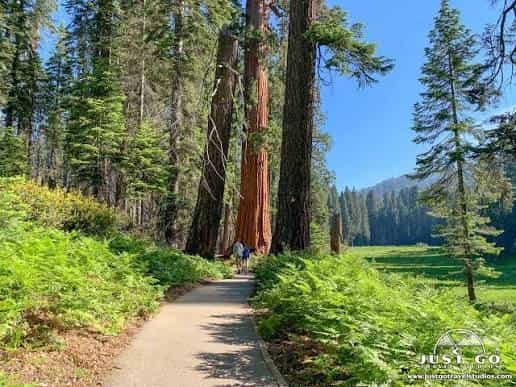
Sequoia protects 35 groves of giant sequoia trees, concentrated mainly along the moist western slopes of the Sierra Nevada between 5,000 and 7,000 feet in elevation. The Giant Forest, the park’s most famous grove, holds five of the ten largest trees on Earth by volume, including the General Sherman Tree itself, which stands roughly 275 feet tall with a trunk more than 36 feet across at its base.
The park also contains Mount Whitney, which at 14,505 feet is the tallest peak in the contiguous United States — meaning Sequoia stretches from ancient sequoia groves at moderate elevation all the way up to alpine terrain most visitors never see from the main roads.
Giant sequoias themselves are botanical outliers: they’re among the oldest living organisms on the planet, with some individual trees estimated at 3,000 to 3,500 years old, and they’re remarkably resistant to fire, insects, and disease thanks to thick, fibrous bark that can exceed two feet in width on mature trees.
The History Behind Sequoia National Park
By the late 1800s, commercial logging had already destroyed significant stands of giant sequoia elsewhere in California, and conservationists grew alarmed at how quickly the remaining groves might disappear. Naturalist John Muir, after witnessing active logging operations near Converse Basin in 1877, became one of the loudest voices pushing for federal protection.
That advocacy paid off quickly, if narrowly. On September 25, 1890, President Benjamin Harrison signed the legislation establishing Sequoia National Park, making it the second national park in the country after Yellowstone, and the first created specifically to protect a living species rather than a geological feature. Just a week later, Congress created the separate General Grant National Park to protect another grove of giant sequoias, including the tree that would later prove to be the second-largest in the world once General Sherman was measured and compared.
General Grant National Park was eventually absorbed into the much larger Kings Canyon National Park in 1940, and in 1943, Kings Canyon and Sequoia were brought together under joint administration, a partnership that continues today even though each retains its own park designation and boundaries.
Much of the road access and visitor infrastructure familiar to modern travelers, including the Generals Highway itself, wasn’t completed until the 1920s, decades after the park’s founding, since building roads into terrain this steep and remote proved to be a slow and expensive undertaking.
Frequently Asked Questions
Q1. Does one entrance fee cover both Sequoia and Kings Canyon?
Yes. Since the parks are administered jointly, a single $35 vehicle pass grants access to both Sequoia and Kings Canyon National Parks for seven consecutive days.
Q2. Are there size restrictions for RVs or trailers on the Generals Highway?
Yes, certain sections have length restrictions due to tight switchbacks and steep grades. Check current NPS guidance before driving a larger vehicle through the park, since restrictions can change seasonally.
Q3. Can I actually walk up to and touch the General Sherman Tree?
You can walk right up to its base via a short paved trail from the main parking area, though a low fence protects the root system from foot traffic damage. Getting an early start helps you avoid the biggest crowds at the viewing area.
Q4. Is Sequoia open year-round, or does snow close sections of the park?
The park stays open year-round, but heavy Sierra snowfall closes some higher-elevation roads and trails in winter, and tire chains are often required for driving the Generals Highway during snowy months.