Somewhere in a remote canyon along the northern California coast stands a tree over 380 feet tall, older than the fall of the Roman Empire, and legally off-limits to visitors. Hyperion, the tallest known living tree on Earth, sits at a location the National Park Service deliberately keeps secret, because previous tourists trampling toward it had already damaged the surrounding old-growth forest. That single tree captures something essential about Redwood National Park: it protects living things so massive and so old that ordinary rules of sightseeing simply don’t apply.
Here’s what to know before visiting: where the park sits, what it actually costs (spoiler: less than you’d expect), the key facts, and the decades-long fight to save a forest that had already lost 90% of its original acreage before protection finally arrived.
Redwood National Park Overview
| Category | Details |
| Location | Del Norte and Humboldt counties, northern California coast |
| Nearest towns | Crescent City, Orick, Trinidad |
| Nearest airport | California Redwood Coast–Humboldt County Airport (ACV) |
| Established | October 2, 1968 (national park); combined with state parks in 1994 |
| Total area | About 139,000 acres (combined federal and state land) |
| National park entrance fee | None — Redwood National Park has no entrance fee |
| State park day-use fees | Apply at specific developed sites (e.g., Gold Bluffs Beach/Fern Canyon) |
| America the Beautiful Pass | Not needed here, but honored for discounts at the adjoining state parks |
| Tallest tree | Hyperion, 381 feet — tallest known living tree on Earth, location undisclosed |
| Old-growth redwood protected | Roughly 45% of all remaining old-growth coast redwood forest |
| Coastline protected | About 40 miles of Pacific shoreline |
| UNESCO status | World Heritage Site (1980), International Biosphere Reserve (1983) |
| Annual visitation | Roughly 480,000 to 500,000 visitors |
Where Redwood National Park Is Located and How It’s Managed
Redwood sits along California’s far northern coast, close to the Oregon border, spanning Del Norte and Humboldt counties. It’s a genuine drive to get there from anywhere major — roughly six to seven hours north of San Francisco, or about six hours south of Portland, Oregon. The nearest commercial airport, California Redwood Coast–Humboldt County Airport, sits closer to the park but still offers limited flight options compared to bigger regional hubs.
What makes Redwood unusual isn’t just its remoteness but its management structure. It isn’t a single national park in the traditional sense; it’s jointly administered by the National Park Service alongside three California State Parks — Jedediah Smith Redwoods, Del Norte Coast Redwoods, and Prairie Creek Redwoods — under the combined name Redwood National and State Parks. That partnership dates back to 1994, when the federal and state units were formally unified under one cooperative management structure, though each retains its own identity and, in some cases, its own fee rules.
Five visitor centers are spread across the combined parks, giving travelers multiple entry points depending on which section they’re headed toward, whether that’s the coastal prairies near Orick or the river canyons near the Smith River further north.
What It Costs to Visit
Here’s the detail that surprises most first-time visitors: Redwood National Park itself has no entrance fee at all. There are no toll booths, no ticket windows, and no entrance stations checking passes anywhere within the federal portion of the park. It’s genuinely free to drive in and explore.
The three California State Parks woven into the same complex, however, do charge day-use fees at specific developed sites. The most notable is the fee required to access Gold Bluffs Beach and Fern Canyon within Prairie Creek Redwoods State Park, along with a handful of other day-use areas across the three state parks. Camping fees also apply at developed campgrounds throughout the complex.
Because there’s no NPS entrance fee here, the federal park doesn’t sell annual or senior passes tied specifically to Redwood, since those products only make sense at fee-charging sites. That said, the America the Beautiful Pass is still honored for discounted or waived day-use fees at the state park sections, so it’s worth having if you’re combining this trip with other national parks that do charge admission.
One access note worth flagging: the road to Gold Bluffs Beach and Fern Canyon requires an online reservation between May 15 and September 15 each year, with no same-day bookings available, so that particular detour needs to be planned in advance rather than decided on a whim.
Facts That Make Redwood Extraordinary
Coast redwoods once covered roughly 2 million acres along California’s coastal fog belt, but commercial logging beginning in the 1850s stripped away more than 90% of that original old-growth forest before meaningful protection took hold. What remains within Redwood National and State Parks today accounts for nearly 45% of all old-growth coast redwood forest left on the planet.
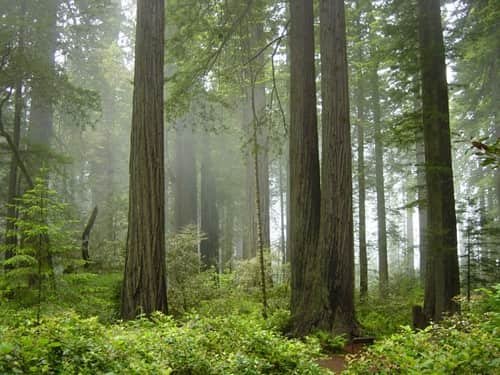
The trees themselves defy easy comprehension. Hyperion, discovered in 2006 by naturalists Chris Atkins and Michael Taylor, currently measures over 381 feet, making it the tallest known living tree anywhere on Earth, though its exact location remains undisclosed to prevent further habitat damage from visitors trying to find it. Several other record-setting trees, including Helios and Icarus, also grow within the park’s boundaries, each exceeding 370 feet. Individual old-growth trees here commonly reach 500 to 700 years old, with some surpassing 2,000 years.
Beyond the trees, the parks protect a genuinely varied landscape, including coastal prairies, oak woodlands, and roughly 40 miles of rugged Pacific shoreline, supporting wildlife like Roosevelt elk, black bears, mountain lions, and river otters.
The History Behind Redwood National Park
Conservation efforts here actually predate the national park by decades. The Save-the-Redwoods League, founded in 1918, helped establish the first protective measures, leading to the creation of Prairie Creek Redwoods State Park in 1923, Del Norte Coast Redwoods in 1925, and Jedediah Smith Redwoods in 1929, all aimed at saving isolated groves from continued logging.
By the 1960s, with roughly 90% of the original old-growth forest already cut down, conservationists pushed hard for federal intervention, facing years of resistance from timber companies that depended on the remaining stands. That effort finally succeeded on October 2, 1968, when President Lyndon B. Johnson signed the legislation establishing Redwood National Park, initially covering a modest 58,000 acres.
The park expanded significantly in the late 1970s, adding land to protect watersheds feeding the forest, before the truly defining change arrived in 1994: Congress and the state of California formally combined the national park with the three surrounding state parks into a single cooperative management unit, creating the roughly 139,000-acre complex that exists today. UNESCO recognized the parks’ global significance with World Heritage Site status in 1980, followed by an International Biosphere Reserve designation in 1983.
Frequently Asked Questions
Q1. If there’s no entrance fee, do I need any pass to visit at all?
No pass is required to enter or drive through Redwood National Park itself. You’ll only need to pay if you’re accessing specific state park day-use areas, like Gold Bluffs Beach and Fern Canyon, which charge a separate fee collected by California State Parks.
Q2. Can I hike to see Hyperion, the world’s tallest tree?
No. Its location is intentionally kept confidential, and attempting to seek it out off-trail can result in serious fines, including penalties up to $5,000 or jail time, due to past damage caused by visitors trampling the surrounding old-growth understory.
Q3. Do I need a reservation to visit Fern Canyon or Gold Bluffs Beach?
Yes, between May 15 and September 15 each year, an online reservation is required to drive the access road to that area, and same-day bookings aren’t available. Plan this specific stop well ahead of your trip during peak season.
Q4. How does Redwood compare to Sequoia National Park if I can only visit one?
Redwood protects the tallest trees on Earth alongside dramatic coastline, but the groves themselves are relatively compact and better suited to shorter walks. Sequoia offers larger, more massive trees by volume and more extensive high-elevation hiking, so the choice often comes down to whether you want coastal scenery or mountain terrain alongside the big trees.s