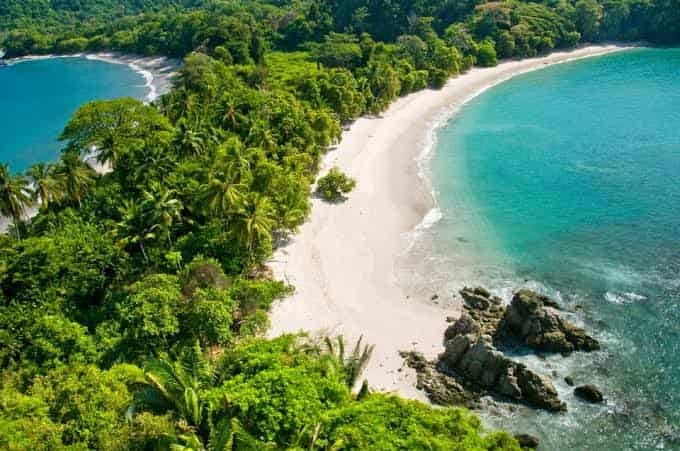
Costa Rica’s smallest national park somehow manages to be its most visited, packing rainforest, coral reef, and four separate monkey species into an area smaller than most American suburbs. Manuel Antonio exists at all because, back in the early 1970s, a foreign landowner tried to block locals from a public beach, and the resulting community pushback ended with the government expropriating the land entirely rather than letting private development win.
Here’s the practical guide for anyone planning a trip from the U.S.: where the park sits, what it costs, how the reservation system works, and the grassroots activism that saved this stretch of Pacific coastline from becoming a private resort.
Manuel Antonio National Park Overview
| Category | Details |
| Location | Central Pacific coast, Puntarenas Province, Costa Rica |
| Nearest town | Quepos (about 7 km / 4 miles north) |
| Distance from San José | About 105 miles (roughly 3–3.5 hour drive) |
| Nearest airport | Quepos/La Managua Airport (XQP), or San José (SJO) with connecting flight |
| Established | November 15, 1972 (Law No. 5100) |
| Total land area | About 1,983 hectares (4,900 acres) — Costa Rica’s smallest national park |
| Adult entrance fee (foreigners) | $18 USD |
| Children (2–12) | $5 USD; under 2 free |
| Booking | Mandatory advance online reservation through SINAC |
| Operating hours | 7 AM–4 PM, closed Tuesdays |
| Guided naturalist tours | $25–$75 per person depending on group size |
| Parking | No official park lot; private lots nearby run about $7/day |
Where Manuel Antonio National Park Is Located
Manuel Antonio sits on Costa Rica’s Central Pacific coast in Puntarenas Province, just south of the town of Quepos and roughly 105 miles from the capital, San José, a drive that typically takes three to three and a half hours depending on road conditions. Most visitors either drive from San José, fly into the small regional airport at Quepos with direct connections from the capital, or take a bus or shuttle service that runs several times daily.
The village community also called Manuel Antonio sits between Quepos and the park entrance itself, functioning as the main hub for hotels, restaurants, and tour operators. Because the park has no official on-site parking, most visitors park in one of several private lots near the entrance gate or arrive via taxi, public bus, or an organized tour that includes transportation.
What It Costs to Visit
Foreign visitors pay $18 USD for adult entry, with children ages 2 to 12 admitted for $5 USD and children under 2 entering free. Costa Rican citizens and residents pay a separately discounted local rate. That fee grants unlimited time inside the park during its operating hours of 7 AM to 4 PM, covering access to all trails, beaches, and wildlife viewing areas, though it’s valid for a single entry only; if you exit the park, re-entry requires a new ticket.
The most important logistical detail: tickets must be purchased online in advance through Costa Rica’s official SINAC booking platform, since the park enforces a daily visitor cap to protect its ecosystem. During peak season, roughly December through April, popular dates can sell out three to four weeks ahead, so booking early is genuinely important rather than a mere suggestion. The park is closed every Tuesday for rest and maintenance, a detail that catches some travelers by surprise when planning a tight itinerary.
Beyond the entrance fee, certified naturalist guides offer 2.5 to 3-hour wildlife tours for $25 to $35 per person in small groups, or $50 to $75 for a private tour, typically including a spotting scope that makes a genuine difference for finding camouflaged sloths and smaller wildlife most visitors would otherwise walk right past.
Facts That Make Manuel Antonio Extraordinary
Despite covering just 1,983 hectares, roughly 4,900 acres, making it the smallest national park in Costa Rica’s system, Manuel Antonio consistently ranks as the country’s most visited, drawing well over 150,000 visitors annually and more than 4.3 million between 2012 and 2022 alone. In 2011, Forbes listed it among the world’s 12 most beautiful national parks, a distinction that’s only increased its popularity in the years since.
The park is one of the few places on Earth where visitors can spot all four of Costa Rica’s monkey species in a single location: squirrel monkeys, white-faced capuchins, mantled howlers, and Central American spider monkeys, alongside both brown-throated three-toed sloths and Hoffmann’s two-toed sloths. Early morning hours, roughly 7 to 10 AM, offer the best wildlife viewing window, since animals are most actively feeding before the day’s heat sets in.
Four beaches sit within the park boundaries, offering swimming, snorkeling, and calm water framed by rainforest right down to the shoreline, while Cathedral Point, a rocky outcropping jutting into the Pacific, provides the park’s most recognizable panoramic viewpoint over both jungle and coastline.
The History Behind Manuel Antonio National Park
This land was originally home to the Indigenous Quepoa people, a subgroup of the Boruca, whose presence gave the nearby town of Quepos its name. Following Spanish contact in the 16th century, the region eventually passed through agricultural use, including a period under the United Fruit Company, before drawing renewed attention in the mid-20th century for its natural beauty.
By the 1960s, foreign property owners had begun restricting local access to the area’s beaches, a move that directly violated Costa Rica’s nationwide law guaranteeing public beach access. When a foreign landowner sold the property to a French buyer who reportedly planned to develop the site into a private tourism facility, local community members and conservationists organized in protest, pushing the government to intervene before development could proceed. That pressure worked: the government expropriated the land, and on November 15, 1972, under Law No. 5100, Manuel Antonio was officially declared a national park, initially covering a modest 682 hectares, though full funding for the land acquisition wasn’t completely secured until 1975.
The park’s protected area expanded to its current 1,983 hectares in 1983, adding both additional rainforest and coastal terrain. What began as a grassroots effort to preserve public beach access and stop unchecked development has since grown into one of Central America’s most celebrated conservation success stories, even as the park’s own popularity now requires careful visitor management to protect the very ecosystem the community originally fought to save.
Frequently Asked Questions
Q1. Can I buy tickets at the gate, or do I need to book online first?
You must book online in advance through the official SINAC platform; walk-up tickets generally aren’t available, especially during busy periods. If you book a guided tour, your guide typically handles the ticket purchase as part of the package.
Q2. What happens if I need to leave the park and come back the same day?
Your entrance fee only covers a single entry. If you exit, you’ll need to purchase a new ticket to re-enter, so plan to bring everything you need, food restrictions aside, for your full visit before heading in.
Q3. Is the park open every day of the week?
No, Manuel Antonio is closed every Tuesday for rest and environmental maintenance. Plan around this closure day if you’re building a tight Costa Rica itinerary, since it’s easy to overlook when comparing it to parks that operate seven days a week.
Q4. Can I bring food into the park for a picnic on the beach?
No, outside food isn’t permitted inside the park, though beverages like water, sodas, and juice are allowed, and a small kiosk inside sells snacks. Plan to eat before entering or budget for the limited food options available on-site.