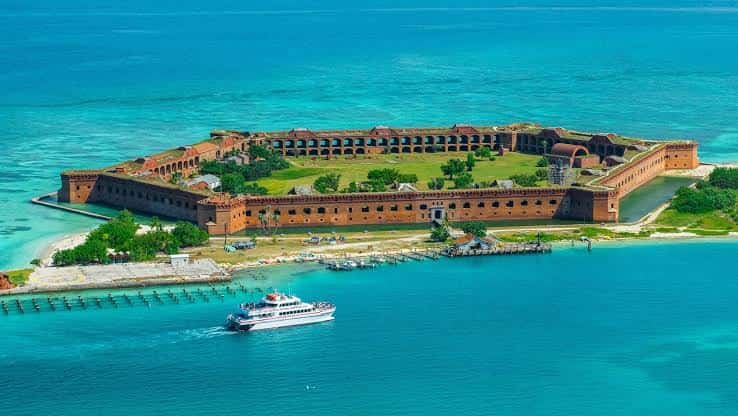
You cannot drive to Dry Tortugas National Park. There’s no bridge, no road, and no way in except by boat, seaplane, or your own private vessel, making it one of the most genuinely remote national parks in the entire system despite sitting just 70 miles off Key West. What waits at the end of that journey is stranger still: a massive 19th-century brick fortress rising out of the sea, built from 16 million bricks on an island barely 16 acres in size, surrounded by a park that’s 99% water.
Here’s the practical guide for anyone planning a visit: where the park sits, what it costs, how you actually get there, and the surprising military and maritime history behind a fort that was never fully completed despite 30 years of construction.
Dry Tortugas National Park Overview
| Category | Details |
| Location | Gulf of Mexico, about 70 miles west of Key West, Florida |
| County | Monroe County |
| Nearest city | Key West, FL |
| Nearest airport | Key West International Airport (EYW) |
| Established | Fort Jefferson National Monument on January 4, 1935; Dry Tortugas National Park on October 26, 1992 |
| Total area | About 64,700 acres — over 99% water |
| Entrance fee | $15 per person, valid 7 consecutive days |
| Ferry ticket (Yankee Freedom) | About $235–$250, includes entrance fee, breakfast/lunch, snorkel gear |
| Seaplane ticket | Roughly $507 (half-day) to $890 (full-day), entrance fee separate |
| Camping fee | $15/night per individual site, $30/night group site |
| Fort Jefferson size | Largest all-masonry fort in the U.S., built from over 16 million bricks |
| Annual visitation | Around 65,000 to 90,000 visitors |
Where Dry Tortugas National Park Is Located
Dry Tortugas sits roughly 70 miles west of Key West in the Gulf of Mexico, at the westernmost and most isolated end of the Florida Keys chain. The park comprises seven small islands, with Garden Key hosting the historic Fort Jefferson and serving as the primary destination for nearly all visitors.
Key West International Airport is the natural jumping-off point for any trip here, since every visitor route to the park, whether by ferry, seaplane, or private boat, departs from Key West. There is no road connection whatsoever, which shapes every aspect of visiting: no day trip happens on a whim, and every visitor commits to either a multi-hour boat crossing or a scenic seaplane flight before setting foot on the islands.
Once you arrive, Garden Key is genuinely small, walkable in a matter of minutes, with the fort itself occupying roughly 11 of the island’s 16 total acres.
What It Costs to Visit
The National Park Service entrance fee is $15 per person, valid for seven consecutive days, and children under 16 are exempt entirely. Most visitors never pay this fee separately, since it’s built directly into ferry and seaplane ticket prices.
The Yankee Freedom ferry, the only ferry service to the park, charges roughly $235 to $250 per adult, which includes the entrance fee, breakfast and lunch, and use of snorkeling gear during the roughly four hours of island time the trip provides. Seaplane options through Key West Seaplane Adventures run considerably higher, from about $507 for a half-day trip to $890 for a full-day excursion, with the entrance fee typically added separately unless you’ve already purchased a pass through Recreation.gov.
If you already hold an America the Beautiful Pass or another qualifying National Park pass, you can show it at check-in for either the ferry or seaplane and have the entrance fee deducted from your transportation cost, though you must present the physical pass at that time or you’ll be charged regardless.
Camping on Garden Key costs $15 per night for an individual site or $30 for the reservable group site, booked through the Recreation.gov app, though only a limited number of camping passengers are permitted on the ferry each day, so booking months ahead is strongly recommended, especially around holidays.
Facts That Make Dry Tortugas Extraordinary
Fort Jefferson stands as the largest all-masonry fort in the United States, constructed from more than 16 million bricks shipped in from the mainland, covering roughly 16 acres of Garden Key. Despite roughly 30 years of construction beginning in 1846, the fort was never actually completed, a detail that surprises many visitors expecting a fully finished structure.
The park itself covers about 64,700 acres, but the seven small islands that make it up account for only around 40 to 97 acres of dry land combined, meaning well over 99% of the park’s total area is open water and coral reef. That marine environment, part of one of the longest coral reef systems in the world, draws visitors for exceptional snorkeling, with clear waters surrounding the fort’s historic moat and offshore reef structures.
One notable current condition: the walkway around Fort Jefferson’s moat, historically popular for a full 360-degree view of the fort and its surrounding waters, has sustained significant damage from Hurricanes Irma, Ian, and subsequent storms, and remains closed as of this writing with reopening anticipated around fall 2026.
The History Behind Dry Tortugas National Park
Spanish explorer Ponce de León first named these islands “Las Tortugas,” or “The Turtles,” in 1513 after the abundant sea turtles found in the surrounding waters. Mariners later added “Dry” to warn sailors that the islands offered no fresh water source, a critical navigational detail in an era before modern charts.
Construction of Fort Jefferson began in 1846, intended to protect the crucial shipping channel connecting the Atlantic Ocean, Gulf of Mexico, and Caribbean Sea. The fort later served as a military prison during and after the Civil War, most famously holding Dr. Samuel Mudd, convicted of conspiracy for setting John Wilkes Booth’s broken leg following Abraham Lincoln’s assassination. In 1898, the USS Maine departed from the Dry Tortugas on its ill-fated voyage to Havana, an event that helped ignite the Spanish-American War.
Concern for the islands’ bird populations led to an early conservation designation in 1908, protecting nesting seabirds from commercial egg collectors. President Franklin Roosevelt designated the site Fort Jefferson National Monument under the Antiquities Act on January 4, 1935, an area that saw sparse visitation for decades despite occasional notable visits, including President Truman and Queen Elizabeth II. The monument expanded in 1983, and Congress formally redesignated the site Dry Tortugas National Park on October 26, 1992, giving it the protections and status it holds today. The park continues to share administrative staff and oversight with nearby Everglades National Park.
Frequently Asked Questions
Q1. Should I take the ferry or the seaplane, and which is actually cheaper?
The ferry is significantly cheaper, running roughly $235 to $250 per adult with about four hours of island time, compared to $507 or more for a seaplane trip. The seaplane offers more scenic value and slightly more flexible timing but comes at a substantial cost premium primarily for the flying experience itself.
Q2. Can I camp overnight on Garden Key, and how far ahead should I book?
Yes, camping is available at a primitive campground a short walk from the dock, but the ferry only carries a limited number of camping passengers each day. Book months in advance through Recreation.gov, especially around winter holidays when demand is highest.
Q3. Is the moat walk around Fort Jefferson currently open?
No, it’s closed as of this writing due to cumulative hurricane damage from Irma, Ian, and more recent storms, with reopening anticipated around fall 2026. Check current park conditions before your trip if walking the full moat loop was part of your plan.
Q4. Do I need my own snorkeling gear, or is it provided?
If you’re traveling via the Yankee Freedom ferry, snorkel gear is included in your ticket price for day-trippers. Seaplane passengers and private boaters should bring their own gear, since it’s not automatically included with those transportation options.