For a couple of weeks each spring, thousands of fireflies inside Congaree National Park stop blinking randomly and start flashing in perfect unison, a genuine natural phenomenon found in only a handful of places on Earth. It’s just one reason this quiet South Carolina park, tucked less than 20 miles from the state capital, protects something increasingly rare: the largest remaining stretch of old-growth bottomland hardwood forest left anywhere in the country.
Here’s the practical guide for planning a visit: where the park sits, what it costs (nothing, as it turns out), the numbers behind its record-setting trees, and the grassroots campaign that saved this forest from the logging that wiped out nearly everything like it.
Congaree National Park Overview
| Category | Details |
| Location | Central South Carolina, near Columbia |
| Nearest city | Columbia, SC (about 18 miles northwest) |
| Nearest airport | Columbia Metropolitan Airport (CAE) |
| Established | National monument 1976; national park November 10, 2003 |
| Total area | About 26,700 acres |
| Entrance fee | None — completely free to visit |
| Firefly event vehicle pass | Free but lottery-based, required only during the annual firefly viewing window |
| Wilderness designation | About 15,000 to 20,000 acres of the park |
| Tallest canopy trees | Regularly exceed 150 feet |
| National champion trees | More of these than any other park in the country |
| Boardwalk Loop Trail | 2.4 to 2.6 miles, ADA accessible |
| Annual visitation | Around 150,000 to 290,000 visitors |
Where Congaree National Park Is Located
Congaree sits in central South Carolina, roughly 18 miles southeast of Columbia, making it one of the more accessible national parks for anyone in the Southeast without requiring a long drive or flight into a remote region. Columbia Metropolitan Airport serves the area directly, and the park’s main entrance and visitor center sit a short drive from the interstate.
The park protects the floodplain where the Congaree and Wateree Rivers converge, and despite its former name, Congaree Swamp National Monument, it’s technically not a swamp at all. A swamp holds water permanently, while Congaree is a floodplain forest, meaning the Congaree River floods through the area intermittently, often ten or more times a year, depositing nutrients and sediment that fuel the forest’s extraordinary growth rather than keeping it permanently submerged.
What It Costs to Visit
Congaree National Park charges no entrance fee at all. There’s no vehicle pass, no per-person charge, and no gate to pass through, making it one of the most financially accessible national parks in the entire system.
The one notable exception involves the park’s famous synchronous firefly event, held for roughly a week each May. Because parking capacity is extremely limited during this brief window, and interest far exceeds available spots, the park issues a set number of vehicle passes, currently around 145 per night, through a free lottery system on Recreation.gov. Winning a spot doesn’t cost anything, but demand is high enough that entry isn’t guaranteed simply by applying.
Given that the park charges no admission, America the Beautiful passes have no functional use here directly, though they remain worth holding if your trip includes other fee-charging parks in the region.
Facts That Make Congaree Ecologically Significant
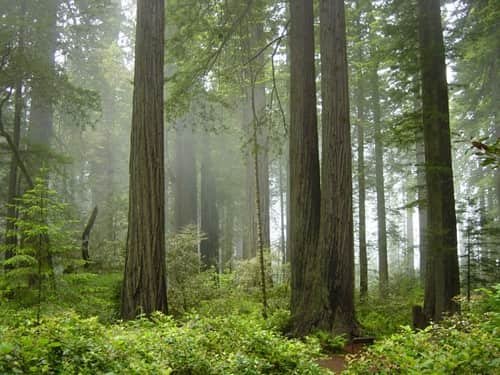
Congaree protects the largest intact tract of old-growth bottomland hardwood forest remaining in the United States, a type of ecosystem that once covered vast stretches of the Southeast before post-Civil War logging operations decimated most of it within a few decades. What survives here does so partly because the terrain’s difficulty and periodic flooding made large-scale logging less economically attractive compared to drier, more accessible forest tracts elsewhere.
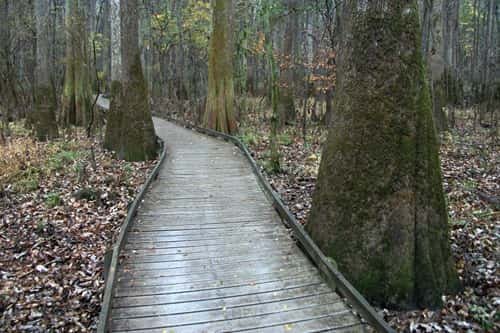
The forest canopy here regularly exceeds 150 feet, forming one of the tallest deciduous forest canopies anywhere in the world, and the park holds more nationally recognized champion trees, meaning the largest known individual specimens of a given species, than any other location in the country. Bald cypress trees draped in Spanish moss, water tupelo, loblolly pine, oak, and maple all share the floodplain, supported by the same periodic flooding that would drown less adapted plant species elsewhere.
Wildlife here is genuinely diverse, including alligators, river otters, and bobcats, along with the synchronous firefly, one of only a small number of firefly species anywhere in the world known to flash in coordinated unison during their brief mating display each spring.
The History Behind Congaree National Park
This land carries deep human history stretching back to the Indigenous Congaree people, whose presence in the floodplain predates any written record. Later, the dense, difficult terrain provided refuge for escaped enslaved people, and the forest’s isolation also made it a useful hideout for bootleggers during Prohibition, along with a documented history involving Revolutionary War-era activity in the surrounding region.
Commercial logging accelerated sharply following the Civil War, and within roughly 50 years, most of the bottomland hardwood forest across the broader Southeast had been cleared. Congaree survived largely because its swampy, flood-prone terrain made large-scale timber extraction genuinely difficult compared to drier forest tracts.
Concern about losing what remained of this forest sparked a grassroots campaign beginning in 1969, led significantly by the Sierra Club, pushing back against private landowners eager to capitalize on rising timber prices. That advocacy paid off on October 18, 1976, when Congress designated the area Congaree Swamp National Monument. The monument gained International Biosphere Reserve status in 1983, and in 1988, nearly two-thirds of its acreage received formal wilderness designation, protecting it permanently from development.
Full national park status arrived much later, on November 10, 2003, when President George W. Bush signed legislation establishing Congaree National Park, replacing the earlier monument designation with stronger statutory protection and formally acknowledging the site’s exceptional ecological significance.
Frequently Asked Questions
Q1. How do I get a chance to see the synchronous fireflies each year?
You’ll need to enter the park’s free vehicle pass lottery through Recreation.gov, typically opening a few weeks before the roughly week-long viewing window each May. Demand significantly exceeds the limited number of passes issued, so apply as early as the lottery allows and have a backup plan if you’re not selected.
Q2. Is the park actually a swamp, or is that name outdated?
It’s outdated and technically inaccurate. Congaree is a floodplain forest, meaning it floods intermittently rather than staying permanently underwater like a true swamp, which is why the park dropped “Swamp” from its name when it became a national park in 2003.
Q3. What’s the easiest trail for someone who wants to see old-growth trees without a long hike?
The Boardwalk Loop Trail, an ADA-accessible elevated path roughly 2.4 to 2.6 miles long, starts right at the Harry Hampton Visitor Center and winds through the heart of the old-growth forest, making it the most accessible option for most visitors.
Q4. Are alligators a real concern when hiking or paddling in the park?
Alligators do live in the park’s waterways, though encounters with hikers on developed trails are uncommon. Exercise normal caution near water, especially while canoeing or kayaking, and never approach or feed any wildlife you encounter.