Ohio holds exactly one national park, and it’s a genuine anomaly in the system: no entrance fee, no backcountry camping, and a landscape that was reclaimed from industrial pollution rather than preserved as untouched wilderness. Cuyahoga Valley sits wedged between Cleveland and Akron, crisscrossed by highways, and its river once famously caught fire, an event that helped spark the modern environmental movement.
Here’s the practical guide to Ohio’s only national park: where it sits, what it costs, the numbers behind its unusual urban setting, and the environmental turnaround that made its creation possible.
Cuyahoga Valley National Park Overview
| Category | Details |
| Location | Northeast Ohio, between Cleveland and Akron |
| Counties | Summit and Cuyahoga |
| Nearest cities | Cleveland and Akron, both within about 30 minutes |
| Nearest airport | Cleveland Hopkins International (CLE) |
| Established | National recreation area 1974; redesignated national park October 11, 2000 |
| Total area | About 33,000 acres |
| Entrance fee | None — the park is completely free to enter |
| Scenic Railroad tickets | Separate cost, typically $18+ for adults |
| Hale Farm & Village admission | Separate cost, roughly $15 for adults |
| Ohio & Erie Canal Towpath Trail | About 20 miles within the park |
| Camping | None — no backcountry or campsites within the park |
| Annual visitation | Around 2.8 to 3 million visitors |
Where Cuyahoga Valley National Park Is Located
Cuyahoga Valley sits directly between Cleveland and Akron in northeast Ohio, following the Cuyahoga River through a 22-mile corridor that most visitors reach easily from either city in roughly 30 minutes. Cleveland Hopkins International Airport is the most convenient arrival point for anyone flying in.
What makes this park’s location genuinely unusual is how urban it is. The park isn’t a remote wilderness destination; it’s crisscrossed by roads and highways, sits within easy driving distance of millions of people, and offers no true backcountry or designated campsites anywhere within its boundaries. The Ohio & Erie Canal Towpath Trail, roughly 20 miles long within the park, connects to a broader regional trail network stretching across more than 40 surrounding communities, making Cuyahoga Valley one of the more accessible national parks in the country for a simple afternoon visit.
What It Costs to Visit
Cuyahoga Valley National Park has no entrance fee whatsoever. There’s no vehicle pass, no per-person charge, and no annual pass specific to the park, since none of that infrastructure exists here. You can drive in, park, and walk any trail entirely free, any day of the year.
Several popular attractions within the park’s boundaries do charge separately. The Cuyahoga Valley Scenic Railroad, which runs vintage train excursions through the valley, typically starts around $18 for adults and $13 for children, with prices climbing higher for special fall foliage runs that tend to sell out weeks in advance. Hale Farm & Village, a living history site within the park, charges separate admission, roughly $15 for adults and $8 for children ages 3 to 12. Because the park itself charges nothing, America the Beautiful passes have no functional use here, though they remain worth having for any other fee-charging parks on a broader trip.
Facts That Make Cuyahoga Valley Different
Cuyahoga Valley stands apart from most national parks in a fundamental way: it wasn’t created to preserve untouched wilderness, but to reclaim and restore an industrial landscape that had been severely degraded by pollution, urban sprawl, and decades of neglect. The park contains no designated wilderness, no backcountry zones, and no campgrounds, a rarity in the National Park System.
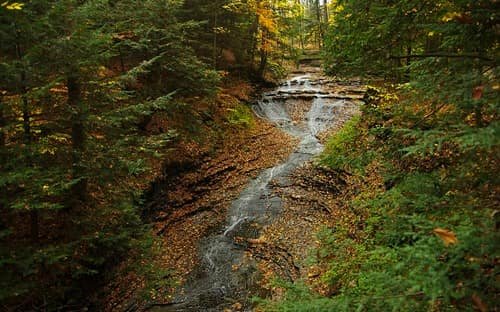
Within its boundaries, the park protects nearly 1,490 identified wetlands covering roughly 1,900 acres, along with a 22-mile river corridor and surrounding floodplain. Brandywine Falls, a 60-foot waterfall accessible via a short boardwalk trail, ranks as one of the park’s signature natural features, running hardest during spring snowmelt. The park’s unusual patchwork geography, woven through 15 municipalities rather than existing as one solid block, reflects the piecemeal way land was assembled here over decades.
The History Behind Cuyahoga Valley National Park
This land has supported human life for over 10,000 years, beginning with Paleo-Indian peoples and later serving as home to the ancestors of the Lenape, now known as the Delaware Nation. By the late 1800s, residents of nearby cities had already discovered the valley as an escape from urban life, even as industrial pollution steadily worsened, culminating in the infamous 1969 river fire, an event that became a symbol of America’s environmental reckoning and helped spur the creation of the EPA and the Clean Water Act.
Local advocates, led significantly by Congressman John Seiberling, pushed for federal protection throughout the early 1970s. President Gerald Ford signed legislation creating the Cuyahoga Valley National Recreation Area on December 27, 1974, protecting roughly 32,000 acres along the river corridor. The designation upgraded to full national park status on October 11, 2000, making it Ohio’s only national park. Environmental remediation continued for decades after the park’s creation, including major cleanup of a hazardous Superfund site that wasn’t fully remediated until 2015, nearly half a century after the river fire that helped launch the entire environmental movement.
Frequently Asked Questions
Q1. Why does Ohio only have one national park?
National park status requires a specific act of Congress, and most of Ohio’s other notable natural and historic sites are protected under different designations, such as national historical parks or state parks, rather than the full national park title.
Q2. Do I need to book anything in advance for a first visit?
No reservations are needed to enter the park itself. The one exception is the Cuyahoga Valley Scenic Railroad, especially for fall foliage rides in October, which regularly sell out weeks ahead of time.
Q3. Can I camp overnight anywhere in the park?
No. Cuyahoga Valley has no designated campgrounds or backcountry camping areas, unlike most national parks. Overnight visitors typically stay in nearby Cleveland, Akron, or surrounding towns instead.
Q4. Is the Cuyahoga River actually safe to be near now, given its polluted history?
Yes. Decades of restoration work, including major cleanup of a Superfund site completed by 2015, have significantly restored the river’s water quality and surrounding wetland ecosystems, though the park’s history remains a notable part of its story and visitor education.