Nevada holds one national park entirely within its borders, Great Basin, along with a portion of Death Valley National Park that extends across the California line. Great Basin sits in one of the most remote corners of the state, along “the loneliest road in America,” and rewards the drive with a mountain that climbs nearly 8,000 feet above the desert floor, ancient bristlecone pine trees that can live over 4,000 years, and some of the darkest night skies left in the country.
Here’s the practical guide to Nevada’s national park landscape: where it sits, what it costs, the numbers behind its ancient trees and marble caves, and the decades-long path from a rancher’s cave discovery to full federal protection.
Nevada’s National Parks Overview
| Park | Location | Established | Entrance Fee | Signature Feature |
| Great Basin | Eastern Nevada, near the Utah border | 1986 | None — free to enter | Wheeler Peak, 4,000-year-old bristlecone pines |
| Death Valley (partial) | Primarily California; extends into NV | 1994 | $30 per vehicle (7 days) | Lowest point in North America |
Where Great Basin National Park Is Located
Great Basin National Park sits in an extremely remote corner of eastern Nevada, close to the Utah state line, along U.S. Highway 50. The tiny town of Baker sits just outside the main entrance, though it offers limited services, and the nearest city of any real size, Ely, Nevada, is roughly a 90-minute drive away.
That remoteness is precisely the point for many visitors. There’s genuinely nothing else nearby competing for attention, which is part of why the park’s night skies remain so dark and why the drive itself, passing alpine lakes and dramatic mountain views along the way, feels like part of the experience rather than an obstacle to it.
What It Costs to Visit
Great Basin National Park charges no entrance fee at all, one of the more financially accessible national parks in the entire system. You can drive in, hike the trails, and explore the surface landscape entirely free.
The one notable exception is Lehman Caves, where guided tours require a per-person fee, with children under five admitted free. Reservations are strongly recommended and same-day bookings aren’t accepted, so planning ahead matters here more than at many parks. Camping at the Lower Lehman, Upper Lehman, and Wheeler campgrounds runs $12 per night on a first-come, first-served basis. Because park operations are cashless, all purchases require a credit or debit card. America the Beautiful annual passes cover the nonexistent entrance fee but do not apply to Lehman Caves tour costs, though Senior and Access pass holders receive a discount on tours specifically.
Facts That Make Great Basin Unique
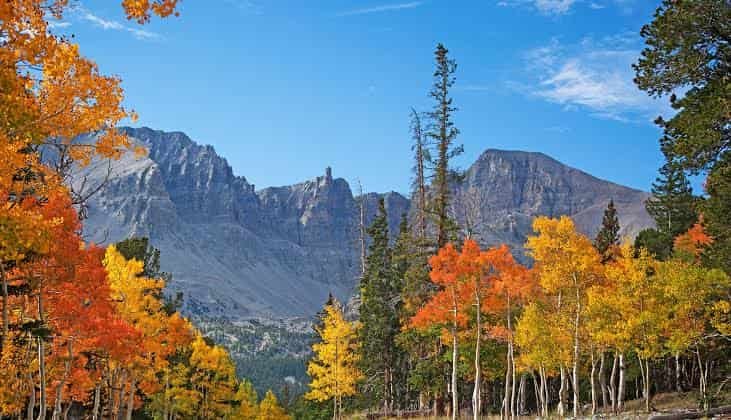
Wheeler Peak rises to 13,063 feet, the highest point located entirely within the state of Nevada, climbing dramatically from the surrounding desert basin floor and creating a compressed transect through multiple western ecosystems within a relatively short hiking distance. The park’s bristlecone pine groves hold some of the oldest known living non-clonal organisms on Earth, with individual trees surviving 4,000 years or more in harsh, high-elevation conditions that would kill most other vegetation.
Beneath the mountains, Lehman Caves offers a marble cave system featuring more than 300 rare shield formations, a geological feature uncommon even among cave systems generally considered spectacular. Aboveground, Great Basin’s designation as an International Dark Sky Park reflects genuinely minimal light pollution, drawing visitors specifically for stargazing that’s become increasingly rare to find anywhere in the country.
The History Behind Great Basin National Park
The Fremont people inhabited this region from roughly 1000 to 1300 AD, leaving behind rock art still visible today. Modern protection efforts trace back to 1885, when local rancher Absalom Lehman explored and began guiding tours into the cave system that now bears his name. President Warren G. Harding designated Lehman Caves National Monument on January 24, 1922, protecting the cave system decades before the surrounding mountain wilderness gained similar status.
Advocacy for a broader national park incorporating Wheeler Peak and the South Snake Range spanned decades afterward, gaining unexpected momentum following a 1964 incident in which a researcher’s tree-ring study inadvertently destroyed what was later determined to be one of the oldest living trees on Earth. That controversy strengthened public support for full protection, and through the sustained advocacy of Nevada Congressman Harry Reid, Congress established Great Basin National Park on October 27, 1986, formally abolishing Lehman Caves National Monument and incorporating its land into the new park’s roughly 77,100 acres.
Frequently Asked Questions
Q1. Does Death Valley count as a Nevada national park since part of it crosses the border?
A portion of Death Valley National Park does extend into Nevada, though the majority of the park and its most visited areas, including Badwater Basin and Furnace Creek, sit in California. Most references to “Nevada’s national park” mean Great Basin specifically.
Q2. Do I need to book Lehman Caves tours in advance, or can I show up same-day?
Advance reservations are strongly recommended, especially during summer, and same-day bookings aren’t accepted. Book through Recreation.gov as early as possible, since tours can fill up during peak visitation periods.
Q3. Is Great Basin worth visiting if I’m just passing through on Highway 50?
Yes, and many visitors treat it exactly that way. Even a few hours allows time for a short cave tour and a look at the bristlecone pine groves, though a full day lets you add a hike toward Wheeler Peak or one of the park’s alpine lakes.
Q4. What’s the best time of year to visit for stargazing?
New moon periods during summer and early fall typically offer the clearest, darkest skies for stargazing, combined with more comfortable overnight camping temperatures than winter, when nighttime temperatures at higher elevations can drop well below freezing.