Florida holds three national parks, and none of them look like a typical national park. There are no mountains, no towering trees, no dramatic canyons. Instead, Florida’s parks protect a “River of Grass” floodplain forest, a park that’s 95% underwater, and a cluster of remote islands reachable only by boat or seaplane. Together they represent some of the most ecologically unusual landscapes in the entire National Park System.
Here’s the practical guide to all three: where they sit, what they cost, the numbers that define them, and the very different conservation battles that led to each one’s protection.
Florida’s National Parks Overview
| Park | Location | Established | Entrance Fee | Signature Feature |
| Everglades | Southern Florida, near Homestead | 1947 | $35 per vehicle/vessel (7 days) | Subtropical wetland, largest wilderness east of the Mississippi |
| Biscayne | Miami-Dade County, south of Miami | 1980 | Free | 95% underwater, part of the Florida Reef |
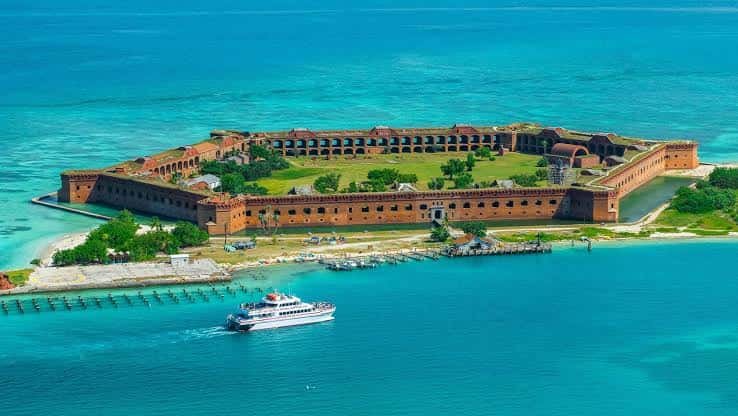
| Dry Tortugas | Gulf of Mexico, 70 miles west of Key West | 1992 | $15 per person (built into ferry/seaplane tickets) | Fort Jefferson, remote coral reef |
Where Florida’s National Parks Are Located
Everglades National Park sits at the southern tip of Florida, spanning Miami-Dade, Monroe, and Collier counties, with its main entrance near Homestead about an hour south of Miami International Airport. Biscayne National Park sits just south of Miami itself, easily reached by car, though most of the park’s 172,000 acres requires a boat to actually explore. Dry Tortugas is the outlier of the three, sitting roughly 70 miles west of Key West in the Gulf of Mexico, accessible only by ferry, seaplane, or private boat, with no road connection whatsoever.
Because all three parks sit within a few hours of each other in South Florida, combining two or even all three into a single trip is genuinely feasible, especially for visitors already planning a Miami or Florida Keys vacation.
What Florida’s National Parks Cost to Visit
Everglades charges $35 per vehicle or vessel for a seven-day pass, one of the higher standard rates in the system, with $30 for motorcycles and $20 per person for those arriving on foot, bicycle, or paddle-craft. As of January 1, 2026, Everglades also charges an additional $100 surcharge for non-U.S. residents, one of eleven parks nationwide with that policy.
Biscayne National Park charges no entrance fee at all, though experiencing most of the park requires a paid boat tour or private vessel, since the park is roughly 95% water. Dry Tortugas charges a $15 per-person entrance fee, but nearly every visitor pays it automatically as part of a ferry or seaplane ticket rather than separately, since there’s no independent way to reach the park otherwise.
For anyone visiting all three or combining them with parks elsewhere in the country, the $80 America the Beautiful Annual Pass covers Everglades and Dry Tortugas entrance fees and has no functional use at fee-free Biscayne.
Facts That Distinguish Florida’s Three Parks
Everglades protects roughly 1.5 million acres of subtropical wilderness, the largest such wilderness area in the country, spanning nine distinct habitat types from sawgrass marsh to mangrove forest. It’s the only place on Earth where American alligators and American crocodiles share the same habitat, and it was the first national park in the system created specifically to protect an ecosystem rather than scenic landmarks.
Biscayne protects part of the Florida Reef, the third-largest barrier reef system in the world, along with the longest continuous stretch of mangrove shoreline on the U.S. East Coast. Of its roughly 173,000 total acres, only about 9,075 sit on dry land. Dry Tortugas centers on Fort Jefferson, the largest all-masonry fort in the United States, built from more than 16 million bricks and never fully completed despite roughly 30 years of construction. The park’s remote location also makes it one of the best snorkeling destinations in the Florida park system.
The History Behind Florida’s National Parks
Everglades has the longest and most complicated history of the three. Plans to drain the wetlands for development emerged as early as 1882, and it took a sustained advocacy campaign, along with Marjory Stoneman Douglas’s influential 1947 book “The Everglades: River of Grass,” to shift public opinion toward conservation. President Harry Truman dedicated the park later that same year, and its boundaries have expanded multiple times since, most recently through the ongoing Comprehensive Everglades Restoration Plan authorized in 2000.
Biscayne emerged from a very different fight in the 1960s, when proposals threatened to develop the bay into a Miami Beach-style resort corridor complete with oil refineries and a deepwater seaport. Conservation advocates won that battle, and President Lyndon Johnson established Biscayne National Monument in 1968, upgraded to full national park status in 1980. Dry Tortugas traces back to Spanish explorer Ponce de León naming the islands in 1513, though federal protection didn’t arrive until President Franklin Roosevelt designated Fort Jefferson National Monument in 1935, elevated to full national park status in 1992.
Frequently Asked Questions
Q1. Can I visit all three Florida national parks in one trip?
Yes, it’s genuinely feasible given their proximity to South Florida and each other, though Dry Tortugas requires a full day commitment due to the ferry or seaplane crossing, while Everglades and Biscayne can each be visited in a half-day if time is limited.
Q2. Which Florida national park is best for snorkeling?
Dry Tortugas generally offers the clearest water and most striking reef scenery, especially around Fort Jefferson’s moat area, though Biscayne’s boat tours also provide strong snorkeling access to the Florida Reef closer to the mainland.
Q3. Do I need a boat to see anything at Biscayne National Park?
For most of the park’s highlights, yes. Since 95% of Biscayne is water, reaching the reefs and islands requires either a guided boat tour through a park concessionaire or your own private vessel; only the visitor center and shoreline area near Convoy Point are accessible without a boat.
Q4. What’s the best time of year to visit Everglades to avoid mosquitoes and see the most wildlife?
The dry season, roughly December through April, offers the best combination of lower mosquito activity and concentrated wildlife around shrinking water sources, making animal sightings far more reliable than during the wetter summer months.