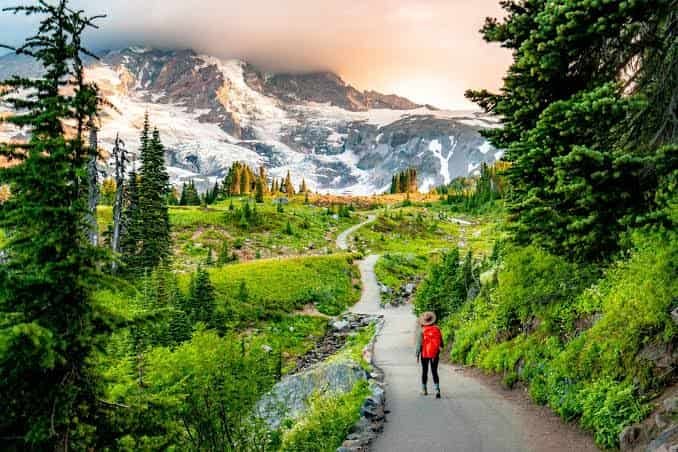
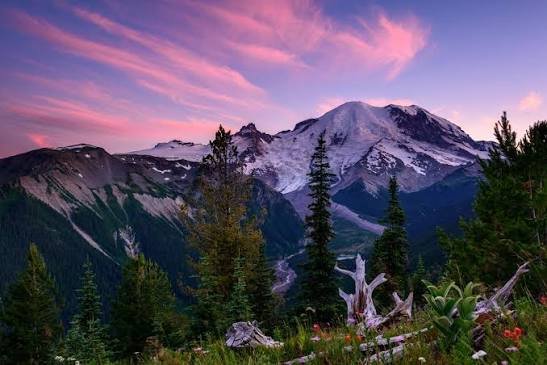
Seattle residents can see it from nearly 100 miles away on a clear day, a solitary white peak rising so far above the surrounding landscape that locals just call it “the Mountain,” as if there were no other. Mount Rainier is an active volcano, the most heavily glaciated peak in the contiguous United States, and tall enough that its presence dominates the horizon for an entire metropolitan region. It’s also been a national park since 1899, making it one of the oldest protected landscapes in the entire system.
Here’s the practical guide for planning a visit: where the park sits, what it costs, the numbers behind its record-setting glaciers, and the surprisingly hard-fought legislative battle it took to get the mountain protected in the first place.
Mount Rainier National Park Overview
| Category | Details |
| Location | West-central Washington, Cascade Range |
| Distance from Seattle | About 65–68 miles southeast |
| Nearest airport | Seattle-Tacoma International (SEA) |
| Established | March 2, 1899 — the fifth U.S. national park |
| Total area | About 236,000 acres (roughly 369 square miles) |
| Vehicle entrance fee | $30, valid 7 consecutive days (May–September peak rate) |
| Motorcycle fee | $25 |
| Per-person fee (foot/bicycle) | $15 |
| America the Beautiful Annual Pass | $80 (all U.S. national parks) |
| Timed entry reservation (2026) | Not required anywhere in the park this season |
| Summit elevation | 14,410 feet — tallest peak in the Cascade Range |
| Named glaciers | 25, the most of any peak in the contiguous U.S. |
| Highest point accessible by car | Sunrise, about 6,400 feet |
| Annual visitation | Around 2 million visitors |
Where Mount Rainier National Park Is Located
Mount Rainier sits roughly 65 to 68 miles southeast of Seattle in Washington’s Cascade Range, close enough to the metro area that many visitors treat it as a day trip, though the park rewards a longer stay. Seattle-Tacoma International Airport is the natural arrival point for most travelers, with driving time to the park’s entrances ranging from about an hour and a half to two hours depending on which side you’re heading toward.
The park has several distinct entrances and destination areas that function almost like separate experiences: Paradise, accessible via the Nisqually Entrance, offers the most developed visitor facilities and the classic postcard views of the mountain. Sunrise, in the northeast corner, sits at a higher elevation and offers a quieter alternative with views of the Emmons and Winthrop Glaciers, though it’s only accessible seasonally from roughly early July through mid-September due to snow.
Elevation swings dramatically across the park, from around 1,600 feet in the Carbon River area up to 6,400 feet at Sunrise, the highest point reachable by car, creating distinct ecological zones from dense old-growth forest to alpine meadow within a relatively compact area.
What It Costs to Visit
A standard vehicle pass costs $30 during the peak season from May through September, covering everyone inside for seven consecutive days. Motorcycles pay $25, and visitors on foot or bicycle pay $15 per person. Travelers planning to visit multiple national parks during the year typically prefer the $80 America the Beautiful Pass, which covers admission to every federal recreation site nationwide.
An important update for 2026: after running a timed entry reservation pilot at the Sunrise and Paradise corridors in 2024 and 2025, the park announced it will not require timed entry reservations anywhere in 2026. Visitors can drive in and pay the standard entrance fee without booking an advance time slot, a genuine simplification compared to the prior two seasons. The park says it’s shifting instead to active parking management strategies, including better lot staffing and real-time signage, to handle crowding without a reservation requirement.
That doesn’t mean congestion disappears entirely. Paradise and Sunrise remain the park’s two busiest destinations, and their parking lots can still fill completely on peak summer weekends, particularly in July, the single busiest month. Arriving early in the morning remains the most reliable strategy for a smooth visit to either area.
Facts That Make Mount Rainier Extraordinary
At 14,410 feet, Mount Rainier is the tallest peak in the Cascade Range and the most heavily glaciated mountain in the contiguous United States, carrying 25 named glaciers across roughly 100 square miles of its upper slopes. The largest of these, Emmons Glacier, sits along the northeast face and ranks among the largest single glaciers in the lower 48 states.
Meltwater from those glaciers feeds five major river systems across the Pacific Northwest, making the mountain a critical water source well beyond the park’s own boundaries. The mountain also holds a place in snowfall history: during the winter of 1971-1972, Mount Rainier’s Paradise area recorded 1,122 inches of snow, a national snowfall record that stood until Mount Baker unofficially surpassed it decades later.
Nearly three-fifths of the park remains forested with dense coniferous stands, transitioning at higher elevations into subalpine and alpine meadows known for vivid wildflower blooms during the short summer season. Wildlife here includes black-tailed deer, Roosevelt elk, black bears, and a wide range of bird species adapted to the park’s dramatic elevation range.
The History Behind Mount Rainier National Park
Indigenous peoples, including the Nisqually, Puyallup, Cowlitz, and Yakama, have called this region home for approximately 9,000 years, referring to the mountain by names including Tahoma or Takhoma, long before British explorer George Vancouver renamed it in 1792 after his friend Admiral Peter Rainier, a man who never actually set foot in North America.
Efforts to establish federal protection began gathering momentum in the 1890s, when scientists, mountaineers, and local business interests, including the naturalist John Muir, banded together to lobby Congress. That advocacy faced real resistance; lawmakers introduced bills across six separate congressional sessions before succeeding, hampered by broader skepticism at the time about the federal government’s role in managing parkland. What ultimately broke the legislative logjam were assurances that the mountain’s terrain held no meaningful agricultural or mining value, and that protecting it wouldn’t require significant federal spending.
President William McKinley signed the legislation establishing Mount Rainier National Park on March 2, 1899, making it the fifth national park in the country, following Yellowstone and three California parks created just years earlier. Development accelerated through the following decades as automobile tourism grew; by the 1920s, the park had built the National Park Inn at Longmire and carved the dramatic Sunrise Road through solid rock and steep cliffs to reach the 6,400-foot elevation, an engineering feat that remains one of the park’s defining infrastructure projects. Much of that early rustic log-and-stone architecture survives today, protected as part of a National Historic Landmark District spanning the park’s developed areas.
Frequently Asked Questions
Q1. Do I need a timed entry reservation to visit Paradise or Sunrise in 2026?
No. Unlike the 2024 and 2025 seasons, Mount Rainier is not requiring timed entry reservations anywhere in the park for 2026. You can drive in and pay the standard entrance fee without booking an advance time slot.
Q2. When does Sunrise Road actually open each year?
Typically from early July through mid-September, depending on snowpack, since it sits at a much higher elevation than Paradise and takes longer to clear each spring. Check current road status before planning a trip specifically around Sunrise.
Q3. Is it safe to hike near the summit given that Rainier is an active volcano?
Climbing to the summit requires serious mountaineering experience, proper permits, and awareness of volcanic hazard zones, which the park’s visitor centers at Paradise and Sunrise explain in detail. Casual visitors sticking to established lower-elevation trails face no unusual volcanic risk during a typical day visit.
Q4. What’s the best strategy for avoiding crowds at Paradise during peak summer?
Arrive before 9 a.m. or visit on a weekday rather than a weekend, since parking lots at both Paradise and Sunrise fill quickly during July and August. Early morning visits also tend to offer clearer mountain views before afternoon cloud buildup rolls in.W