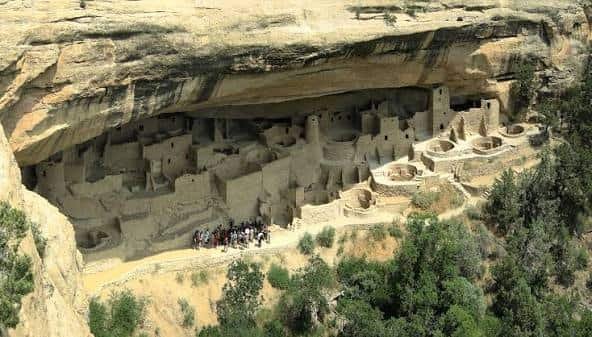
In December 1888, two cattle ranchers searching for lost steer spotted something extraordinary through a winter snowstorm: a massive stone structure tucked into a canyon alcove, later named Cliff Palace, the largest cliff dwelling in North America. It had sat there for over 600 years, built by the Ancestral Puebloan people and left behind decades before any American ever laid eyes on it. That discovery, and the looting that followed it, eventually led Congress to create the first national park in the entire system dedicated specifically to protecting human history rather than natural scenery.
Here’s the practical guide for anyone planning a visit: where the park sits, what it costs, the numbers behind its remarkable concentration of ancient sites, and the activist campaign that saved these dwellings from continued destruction.
Mesa Verde National Park Overview
| Category | Details |
| Location | Montezuma County, southwestern Colorado, near the Four Corners |
| Nearest cities | Cortez and Durango, CO |
| Nearest airport | Durango-La Plata County Airport (DRO) |
| Established | June 29, 1906 — first national park created for cultural preservation |
| Total area | About 52,485 acres |
| Summer vehicle entrance fee (May 1–Oct 22) | $30, valid 7 consecutive days |
| Winter vehicle entrance fee (Oct 23–Apr 30) | $20 |
| Annual Pass | $55 |
| America the Beautiful Annual Pass | $80 (all U.S. national parks) |
| Cliff dwelling tours | Separately ticketed, reservations open 14 days in advance via Recreation.gov |
| Archaeological sites protected | Nearly 5,000, including about 600 cliff dwellings |
| UNESCO status | World Heritage Site since 1978 — Colorado’s only one |
| Annual visitation | Around 500,000 to 600,000 visitors |
Where Mesa Verde National Park Is Located
Mesa Verde sits in Montezuma County, in the far southwestern corner of Colorado near the Four Corners region, where Colorado, Utah, Arizona, and New Mexico all meet. The nearest cities offering lodging and services are Cortez, just a short drive from the park entrance, and Durango, roughly an hour and a half away with its own regional airport.
Once inside the park, distances stretch out considerably. It’s roughly a 45-minute, 21-mile drive from the entrance up to Chapin Mesa, where most of the famous cliff dwellings and the archaeological museum are located, and cell service throughout the park remains limited, so printing or saving passes and tour tickets before arrival is genuinely important.
The park sits atop a high sandstone tableland rising more than 8,500 feet above sea level, sloping gently southward, terrain that both sheltered the ancient dwellings for centuries and now shapes how modern visitors move through the park.
What It Costs to Visit
Mesa Verde uses a seasonal entrance fee structure. During summer, from May 1 through October 22, a vehicle pass costs $30, valid for seven consecutive days. During winter, from October 23 through April 30, that drops to $20. Frequent visitors can pick up the $55 Annual Pass, while anyone planning a broader national park trip typically prefers the $80 America the Beautiful Pass.
Here’s the detail that catches many first-time visitors: the entrance fee gets you into the park, but visiting the most famous cliff dwellings, Cliff Palace, Balcony House, Long House, Square Tower House, and Mug House, requires a separate ranger-led tour ticket, purchased through Recreation.gov. These reservations open exactly 14 days before the scheduled tour date, starting at 8 a.m. Mountain Time, and popular time slots fill quickly. Some tickets do become available if others cancel, purchasable up to two hours before a tour starts. Spruce Tree House and the Mesa Top Loop Road remain accessible year-round without a separate tour reservation, weather permitting.
Entrance fees are paid by credit, debit, or contactless payment only, though cash still works for food and gift purchases inside the park.
Facts That Make Mesa Verde Extraordinary
Mesa Verde protects nearly 5,000 documented archaeological sites, including roughly 600 cliff dwellings, an unmatched concentration of preserved ancient architecture anywhere in the United States. Cliff Palace, the largest of these dwellings, contained 217 rooms and 23 kivas, housing an estimated 100 to 250 people at its peak, built between approximately 1190 and 1280 CE.
The Ancestral Puebloan occupation of this plateau spanned roughly 700 years, beginning with simple pit houses in the 500s CE, progressing through compact mesa-top villages by the mid-700s, and culminating in the elaborate cliff dwellings constructed during the Classic Pueblo Period from about 1100 to 1300. By around 1300, the population, estimated at up to 20,000 people at its height, had largely migrated away from Mesa Verde entirely, likely driven by a severe, sustained drought.
Today, park staff regularly consult with representatives from 26 culturally affiliated Native American tribes and pueblos who consider Mesa Verde their ancestral homeland, a collaborative relationship that shapes ongoing preservation, research, and interpretation throughout the park.
The History Behind Mesa Verde National Park
Journalist Virginia McClurg first visited the region in the 1880s searching for evidence of ancient settlements, and her expeditions helped document sites including Balcony House. The most famous discovery came on December 18, 1888, when rancher Richard Wetherill and cowboy Charlie Mason, guided partly by information shared by a Ute tribal member named Acowitz, spotted Cliff Palace from atop the mesa during a snowstorm while searching for stray cattle.
Word of the discovery spread quickly, and in the following years, amateur treasure hunters and pot hunters descended on the site, looting artifacts and destabilizing ancient walls in the process. Alarmed by the ongoing destruction, McClurg and fellow activist Lucy Peabody launched a sustained, multi-decade lobbying campaign, eventually gathering support from hundreds of thousands of Americans and pressuring Congress to act. That effort succeeded on June 29, 1906, when President Theodore Roosevelt signed legislation establishing Mesa Verde National Park, the first park in the entire system created specifically to protect archaeological and cultural heritage rather than natural scenery.
Professional stabilization and excavation work continued for decades afterward, including efforts by archaeologist Jesse Walter Fewkes in the early 20th century and Civilian Conservation Corps projects during the 1930s and 1940s. The major Wetherill Mesa Archaeological Project, running from 1958 to 1965, further expanded scientific understanding of the park’s sites. UNESCO designated Mesa Verde a World Heritage Site in 1978, recognizing it as Colorado’s only such designation and cementing its global archaeological significance.
Frequently Asked Questions
Q1. Do I need a separate ticket to see Cliff Palace, or does the entrance fee cover it?
You need a separate ranger-led tour ticket, purchased through Recreation.gov, in addition to the park entrance fee. These reservations open 14 days before the tour date and fill quickly, so book as early as that window allows.
Q2. Which sites can I visit without booking a separate tour ticket?
Spruce Tree House and the Mesa Top Loop Road are accessible year-round without a ranger-led tour reservation, weather permitting, making them a solid option if you didn’t manage to book the popular tour slots.
Q3. How much driving time should I budget once inside the park?
Plan for roughly 45 minutes and 21 miles from the entrance to reach Chapin Mesa, where most cliff dwellings and the museum are located. If booking multiple tours in one day, allow at least 2 hours between tour start times to account for drive time between sites.
Q4. Is it worth staying overnight, or can I see the highlights in a single day?
Most visitors benefit from at least one overnight stay, since a single day rarely allows time to see both the Chapin Mesa and Wetherill Mesa areas along with a hiking trail. A two-day visit with an overnight in or near the park is generally recommended for a fuller experience.