A game reserve half the size of Belgium, home to Africa’s Big Five, and named after a Boer president who initially proposed protecting it as a way to stop unchecked hunting from wiping out the region’s wildlife entirely. Kruger National Park has grown from a modest, war-interrupted reserve into one of the most visited safari destinations on Earth, drawing close to 2 million visitors a year to a landscape stretching 220 miles from north to south along South Africa’s border with Mozambique.
Here’s the practical guide for anyone planning a trip from the U.S.: where the park sits, what it costs in dollars you can actually budget around, the numbers behind its massive wildlife population, and the century-plus history behind Africa’s oldest national park.
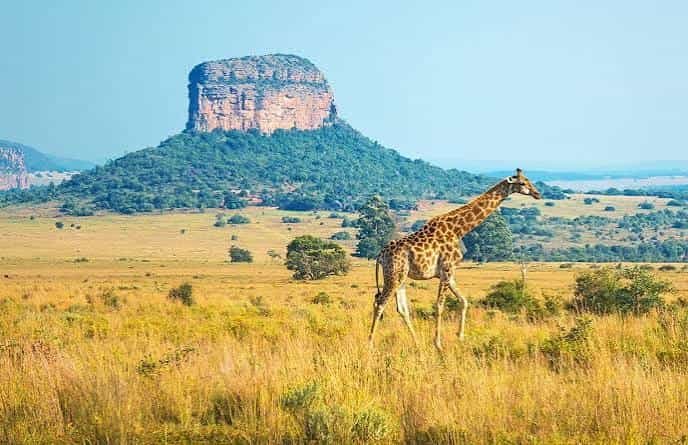
Kruger National Park Overview
| Category | Details |
| Location | Limpopo and Mpumalanga provinces, northeastern South Africa |
| Nearest cities | Mbombela (Nelspruit) south; Phalaborwa central |
| Nearest airports | Kruger Mpumalanga International (MQP); Skukuza Airport (inside the park) |
| Established | Sabie Game Reserve in 1898; national park in 1926 |
| Total area | About 7,576 square miles (19,485 km²) — roughly the size of Israel or Wales |
| International visitor daily fee (2025/26 rate) | R602/day (roughly $33–$35 USD), ages 12+ |
| SADC nationals | R275/day (roughly $15 USD) |
| South African residents | R134/day (roughly $7.50 USD) |
| Vehicle fee | R47 per vehicle, per day (roughly $2.60 USD) |
| Payment | Cashless — card only at all gates |
| Big Five present | Lion, leopard, elephant, buffalo, rhino |
| Headquarters | Skukuza |
Where Kruger National Park Is Located
Kruger National Park sits in South Africa’s far northeast, spanning Limpopo and Mpumalanga provinces along the country’s border with Mozambique, with Zimbabwe just to the north. The park stretches roughly 220 miles from north to south and 25 to 50 miles wide, making it genuinely vast, comparable in size to the entire country of Israel or Wales.
For U.S. travelers, the most convenient arrival point is Kruger Mpumalanga International Airport, which sits close to the park’s southern entrances near Nelspruit (officially Mbombela). Several airstrips also operate directly within the park itself, including one at Skukuza, the park’s administrative headquarters, useful for visitors flying in from Johannesburg on connecting flights rather than driving the roughly four to five hours from South Africa’s main international gateway.
What It Costs to Visit
Kruger uses a tiered daily conservation fee system rather than a flat rate, differentiating between South African residents, citizens of neighboring SADC countries, and international visitors. For the 2025/26 tariff year, running November 1, 2025 through October 31, 2026, international adult visitors pay R602 per day, roughly $33 to $35 USD depending on the exchange rate, while children ages 2 to 11 pay R300, or about $16 to $17 USD. Infants under 2 enter free.
This fee is charged per person, per day, not per vehicle, so a family of four should budget that daily rate for each member rather than assuming one flat vehicle charge covers everyone. A separate, much smaller vehicle fee of R47 (roughly $2.60 USD) per day applies on top of the personal conservation fee. All Kruger gates are cashless, so a credit or debit card is required, and day visitors booking online in advance should expect a small non-refundable admin or booking fee, typically around R59 per adult, on top of the standard conservation rate.
Frequent visitors or those planning an extended South African trip might consider a Wild Card membership, which provides a full year of unlimited entry to more than 80 national parks, reserves, and resorts across southern Africa, often working out cheaper than paying daily fees across a multi-week or repeat-visit itinerary.
Facts That Make Kruger Extraordinary
Kruger protects all five of Africa’s legendary “Big Five” species, lion, leopard, elephant, African buffalo, and black rhinoceros, alongside hundreds of other mammal species, more than 500 recorded bird species, and over 2,000 documented plant species across its savanna, woodland, and riverine habitats. The park holds a genuinely significant share of global rhino populations, though ongoing poaching pressure remains a serious conservation challenge across the region.
Nearly 5,000 miles of paved and gravel roads wind through the park, connecting a network of rest camps and lodges that range from budget-friendly public camping to high-end private concessions. Since 2002, Kruger has formed the core of the Great Limpopo Transfrontier Park, a cross-border conservation initiative linking it with Zimbabwe’s Gonarezhou National Park and Mozambique’s Limpopo National Park, creating one of the largest connected conservation areas in the world.
Archaeological evidence within the park traces human presence back to the 8th century, and Kruger holds the distinction of being South Africa’s oldest national park, often affectionately nicknamed “the People’s Park” for its long history of accessible, budget-friendly public accommodation alongside its luxury lodge offerings.
The History Behind Kruger National Park
Gold discoveries in the region during the 1870s and 1880s drew fortune-seekers into the lowveld in large numbers, triggering a dramatic decline in wildlife as hunting and the trade in animal skins and horns intensified. In 1895, Transvaal parliamentarian Jakob Louis van Wyk introduced a motion to establish a protected game reserve, which passed by a single vote. On March 26, 1898, Paul Kruger, president of the South African Republic (Transvaal), proclaimed the land between the Sabie and Crocodile Rivers a restricted hunting zone, creating what became known as the Sabie Game Reserve.
Progress stalled almost immediately when the Second Boer War broke out the following year, leaving the fledgling reserve vulnerable to unchecked poaching for years. James Stevenson-Hamilton became the reserve’s first warden on July 1, 1902, earning the nickname “Skukuza,” meaning roughly “he who sweeps clean,” for his aggressive efforts evicting settlers and poachers from the protected land. A railway line built through the reserve in 1912 unexpectedly became a tourism asset, as Stevenson-Hamilton arranged for passing trains to stop for lunch, giving early travelers a taste of the reserve’s wildlife.
On May 31, 1926, South Africa’s National Parks Act merged the Sabie and Shingwedzi Game Reserves into a single protected area, officially renamed Kruger National Park as an act of reconciliation honoring its founder. The first tourist groups visited in 1923 ahead of the official merger, and by 1927, motorists were permitted to drive through for a fee of one pound, sparking rapid growth in visitor numbers within just a few years.
Frequently Asked Questions
Q1. Do I pay the entrance fee per person or per vehicle if I’m traveling with family?
Per person. The daily conservation fee applies individually to every visitor aged 2 and older, regardless of how many people share a single vehicle, with a separate, much smaller vehicle fee charged on top.
Q2. Can I pay in cash at the park gates?
No. All Kruger National Park gates are fully cashless, so you’ll need a credit or debit card for both the conservation fee and any vehicle charges. International visitors should bring a card that works internationally rather than relying on South African Rand cash.
Q3. Is it worth buying a Wild Card if I’m only visiting South Africa once?
Generally, it’s most valuable for visitors staying multiple days or planning to visit several South African national parks within a year. For a single short trip to Kruger alone, paying the standard daily international rate is usually simpler and comparably priced.
Q4. What documentation do I need to make sure I’m not overcharged at the gate?
International visitors should carry a valid passport, since South African residents and SADC nationals receive discounted rates but must prove their status with an ID, driver’s license, or passport. Without proper documentation, visitors risk being charged the higher international rate regardless of actual citizenship.