Less than 40 miles from downtown Chicago, sand dunes rise along the shore of Lake Michigan, home to over 1,100 plant species packed into one of the most industrialized corners of the Midwest. Indiana Dunes became the 61st national park in the country in 2019, a genuinely surprising promotion for a landscape most people driving I-90 have passed without a second glance, tucked between steel mills and power plants along the lake’s southern edge.
Here’s the practical guide for anyone planning a visit: where the park sits, what it costs, the numbers behind its unlikely biodiversity, and the decades-long conservation fight it took to save this stretch of shoreline from industrial development in the first place.
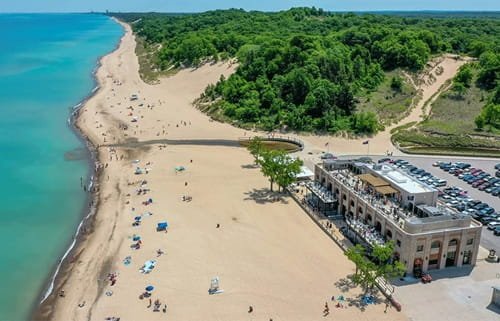
Indiana Dunes National Park Overview
| Category | Details |
| Location | Northwestern Indiana, along the southern shore of Lake Michigan |
| Counties | Porter, Lake, and LaPorte |
| Nearest city | Chicago, IL (under 40 miles) |
| Nearest airport | Chicago Midway (MDW) or O’Hare International (ORD) |
| Established | National Lakeshore on November 5, 1966; national park on February 15, 2019 |
| Total area | About 15,349 acres |
| Vehicle entrance fee | $25, valid 1–7 days |
| Motorcycle fee | $20 |
| Per-person fee | $15 (up to $25 per family) |
| Annual Pass | $45 |
| America the Beautiful Annual Pass | $80 (all U.S. national parks) |
| Important note | Fees are separate from the adjacent Indiana Dunes State Park ($7 in-state / $12 out-of-state) |
| Plant species protected | Over 1,100, including rare orchids and prickly pear cactus |
| Annual visitation | Around 2.8 to 3 million visitors |
Where Indiana Dunes National Park Is Located
Indiana Dunes sits along the southern shore of Lake Michigan in northwestern Indiana, spread across Porter, Lake, and LaPorte counties and woven through 15 different cities and towns rather than existing as one continuous block of land. It’s the closest national park to Chicago, and also closer to Detroit than Michigan’s Sleeping Bear Dunes National Lakeshore, putting it within a three-hour drive of more than 30 million people.
Chicago’s two major airports, Midway and O’Hare, both offer convenient access, and the park is unusually well connected by public transit for a national park: the South Shore Commuter Railroad stops directly within park boundaries at Miller, Ogden Dunes, Dune Park, and Beverly Shores. Major interstates, including I-65, I-80, I-90, and I-94, all run close by as well.
One layout detail worth understanding before visiting: the national park’s land is interrupted in places by Indiana Dunes State Park, a separately managed and separately funded state park with its own entrance fee, sitting geographically inside the boundaries of the larger national park.
What It Costs to Visit
A standard vehicle pass costs $25, valid for one to seven days depending on purchase, motorcycles pay $20, and visitors on foot, bicycle, or as part of a non-commercial group pay $15 per person, capped at $25 total per family. Frequent visitors can pick up the $45 Annual Pass, while anyone visiting multiple national parks throughout the year typically prefers the $80 America the Beautiful Pass.
The park didn’t always charge for entry; fee collection began March 31, 2022, introduced specifically to help fund infrastructure and conservation programs as visitation climbed sharply, from roughly 1.7 million to around 3 million annual visitors following the park’s 2019 upgrade in status.
Here’s the detail that trips up nearly every visitor: national park passes and fees do not cover entry to the adjacent Indiana Dunes State Park, and vice versa. The state park charges its own separate daily fee, $7 for vehicles with Indiana plates and $12 for out-of-state plates, collected independently regardless of what national park pass you’re carrying.
Facts That Make Indiana Dunes Ecologically Unique
Indiana Dunes protects an unusually diverse mix of habitats packed into a relatively small footprint, supporting over 1,100 plant species, including rare orchids and prickly pear cactus, an unexpected desert plant thriving alongside Great Lakes wetlands and forest. That biodiversity exists as a genuine ecological island surrounded by heavy industry, functioning as a critical refuge for migratory birds and endangered species like the karner blue butterfly.
The dunes themselves formed over thousands of years through glacial action and lake current deposition, creating a “succession” landscape where plant communities shift dramatically as you move inland from the beach through progressively older, more stabilized dune formations. This dynamic process made the park a foundational site for the scientific study of plant succession, research that helped establish ecology as a formal academic discipline.
The park’s unusual patchwork geography, woven through 15 municipalities rather than existing as one solid block, reflects the piecemeal way land was assembled here over decades, purchased and protected parcel by parcel amid surrounding industrial and residential development.
The History Behind Indiana Dunes National Park
Scientific interest in the dunes dates back to pioneering ecologist Henry Cowles, whose late-19th and early-20th-century studies of plant succession along the Lake Michigan shoreline earned him recognition as a foundational figure in modern ecology and helped build the scientific case for protecting the area.
Conservation advocacy accelerated through the mid-20th century as steel mills and industrial development increasingly encroached on the remaining dune landscape. Illinois Senator Paul H. Douglas led the congressional push to save what remained, and that effort succeeded on November 5, 1966, when Congress authorized the Indiana Dunes National Lakeshore, protecting an initial acreage from further industrial expansion. Four subsequent expansion bills, in 1976, 1980, 1986, and 1992, gradually grew the park to its current roughly 15,000 acres.
Full national park status arrived decades later. Representative Pete Visclosky, along with Senators Todd Young and Mike Braun, sponsored legislation to reclassify the site, building on earlier efforts by Senator Joe Donnelly aimed at bringing the area greater national recognition. That provision was included in the Consolidated Appropriations Act of 2019, and on February 15, 2019, Indiana Dunes officially became the nation’s 61st national park, a status upgrade that significantly boosted both its visibility and its visitation numbers in the years since.
Frequently Asked Questions
Q1. Does my national park pass also cover Indiana Dunes State Park?
No. The two parks charge entirely separate fees and honor separate passes. If your visit includes stops in both, budget for both entrance fees independently, since neither pass substitutes for the other.
Q2. What’s the easiest way to visit without driving, given how close this is to Chicago?
The South Shore Commuter Railroad stops directly within the park at several stations, including Dune Park and Beverly Shores, making it genuinely feasible to visit by train from Chicago without a car.
Q3. Is Kemil Beach really open 24 hours, and why?
Yes, Kemil Beach stays open around the clock specifically to allow stargazing, unlike most of the park’s other beaches and facilities, which follow set daily hours.
Q4. What time of year is best to see the widest range of plant life, including the rare orchids?
Late spring through early summer typically offers the best wildflower and orchid displays, as the succession habitats move through their most active growing period before summer heat sets in.