Forty years before Yellowstone became the world’s first national park, President Andrew Jackson had already set aside a stretch of Arkansas mountainside to protect a resource nobody wanted to see privatized: hot mineral water bubbling out of the ground at 143°F. Hot Springs is technically the oldest federally protected land in the entire National Park System, even though it didn’t officially become a “national park” in name until decades later. It’s also the smallest, the most urban, and the only one with a working brewery inside its boundaries.
Here’s the practical guide for anyone planning a visit: where the park sits, what it actually costs (spoiler again: almost nothing), the details that make it unlike any other park in the system, and the century of legal battles that shaped how it exists today.
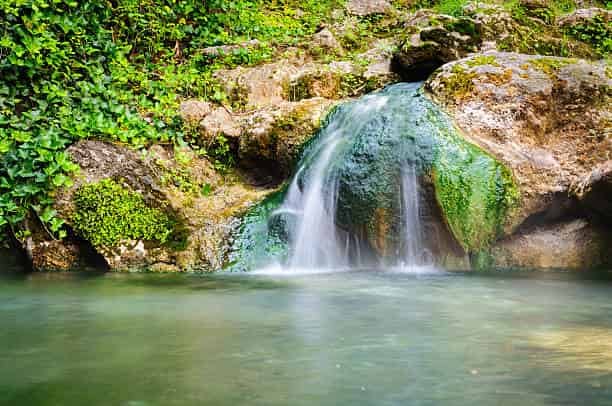
Hot Springs National Park Overview
| Category | Details |
| Location | Garland County, central Arkansas, adjacent to downtown Hot Springs |
| Nearest city | Hot Springs, AR (the park sits within the city) |
| Nearest airport | Bill and Hillary Clinton National Airport (LIT), Little Rock, about an hour away |
| Established | April 20, 1832 (as Hot Springs Reservation); March 4, 1921 (as a national park) |
| Total area | About 5,550 acres — the smallest national park in the system |
| Entrance fee | None — one of 16 fee-free national parks |
| Bathhouse soak cost | Roughly $30 per person at operating bathhouses |
| Gulpha Gorge Campground | About $34 per night |
| Hiking trails | Over 25 miles |
| Spring water temperature | 143°F, cooled before bathing |
| Daily spring flow | About 700,000 gallons |
| Annual visitation | Around 2.2 to 2.6 million visitors |
Where Hot Springs National Park Is Located
Hot Springs National Park sits directly within the city of Hot Springs, Arkansas, roughly an hour southwest of Little Rock. It’s genuinely unusual among national parks for being woven into an active downtown rather than sitting apart from civilization; Bathhouse Row, the park’s central attraction, runs along Central Avenue with restaurants, shops, and city traffic just steps away.
Bill and Hillary Clinton National Airport in Little Rock is the most convenient arrival point for most visitors, with a straightforward drive southwest along I-30 to reach the park. Because the park is urban, parking works more like a city visit than a typical national park trip; metered street parking and a nearby parking garage on Exchange Street serve most visitors, and towing enforcement is active, so checking posted signage matters here more than at almost any other park.
What It Costs to Visit
Hot Springs charges no entrance fee at all, one of just 16 national parks in the entire system with completely free admission. There’s no gate, no entrance station, and no vehicle pass required simply to walk Bathhouse Row, hike the trails, or fill a bottle at the public spring-water fountains.
That said, several specific experiences within the park do charge separately. Soaking at one of the two currently operating bathhouses, Buckstaff and Quapaw, typically runs around $30 per person. Camping at Gulpha Gorge, the park’s only campground, costs roughly $34 per night and requires an advance reservation. The Hot Springs Mountain Tower, offering panoramic views from 216 feet above the mountain summit, also charges its own separate admission.
Because the park itself charges nothing, America the Beautiful passes have limited direct use here, though the Fordyce Bathhouse does distribute a handful of specific federal passes, including the Access, 4th Grade, and Military passes, useful if your trip includes other fee-charging parks.
Facts That Make Hot Springs Unlike Any Other National Park
At just 5,550 acres, Hot Springs is the smallest national park in the entire system, a scale that reflects its origin as a protected spring rather than a wilderness area. The park’s 47 hot springs are the only federally controlled hot springs in the country, releasing roughly 700,000 gallons of water daily at a consistent 143°F, far too hot for direct bathing without cooling first.
The water’s journey is remarkable in its own right: rainfall on the surrounding Ouachita Mountains slowly seeps underground, travels roughly 6,000 feet deep, and takes an estimated 4,400 years before resurfacing through the springs, a genuinely ancient water cycle hidden beneath a modern American city.
Bathhouse Row itself, a collection of eight historic bathhouses along Central Avenue, showcases early 20th-century architecture and now serves a mix of purposes: some buildings function as museums, one still operates as a working bathhouse, and the Superior Bathhouse now houses a working brewery, making Hot Springs the only national park in the country with an on-site brewery using the park’s own spring water in its beer.
The History Behind Hot Springs National Park
Native American tribes considered the springs sacred and medicinal for centuries before European contact, with the Quapaw people ceding the surrounding land to the United States through an 1818 treaty, following which they were forcibly relocated to a reservation south of the site and later removed entirely to Indian Territory during the 1830s.
Following the Louisiana Purchase in 1803, interest in the springs grew steadily as settlers recognized their commercial and medicinal potential. Competing efforts to privatize the site as a health resort ran up against public advocacy pushing for federal protection instead, and the latter side won. On April 20, 1832, President Andrew Jackson signed legislation establishing Hot Springs Reservation, setting aside roughly 2,500 acres and prohibiting private settlement of the springs, four decades before Yellowstone became the first officially designated national park.
Because Congress never spelled out exactly how the reservation should be administered, private individuals repeatedly attempted to claim the springs for their own development over the following decades, leading to years of legal disputes and occasional violence before the U.S. Supreme Court ultimately affirmed federal ownership. The area developed into a thriving spa town through the late 1800s and early 1900s, drawing visitors under doctor’s orders to soak in and even drink the mineral water for a wide range of ailments.
Full national park designation finally arrived on March 4, 1921, when Congress formally renamed the reservation Hot Springs National Park and expanded its boundaries by roughly 900 acres, cementing its place as both the newest name and the oldest protected federal land in the entire National Park System.
Frequently Asked Questions
Q1. Can I actually soak in the natural hot springs directly outside?
No. The springs emerge at 143°F, far too hot for safe direct bathing. Two display springs let you touch the water as it surfaces, but for an actual soak, you’ll need to visit Buckstaff or Quapaw Bathhouse, where the water is cooled to safe temperatures first.
Q2. Do I need a reservation to soak at one of the bathhouses?
It’s strongly recommended, especially for Quapaw or Buckstaff during weekends and peak tourist season. Calling ahead avoids showing up to find appointment slots already booked for the day.
Q3. Is parking really as difficult as reviews suggest?
It can be, particularly on weekends. There’s no dedicated visitor center parking lot, so most visitors use the free parking garage on Exchange Street, a block from Bathhouse Row, or metered street spots, watching signage carefully since towing enforcement is active.
Q4. Are dogs allowed throughout the park, including on trails and the Grand Promenade?
Yes, Hot Springs is notably pet-friendly. Leashed dogs are permitted on all 26 miles of hiking trails and on the Grand Promenade, making it one of the more dog-accessible national parks in the system.