Every summer evening at Carlsbad Caverns, hundreds of thousands of Brazilian free-tailed bats spiral out of the cave’s natural entrance in a single continuous funnel, a spectacle so consistent that rangers still host a formal Bat Flight Program to watch it happen. It’s a striking reminder that this park protects something genuinely alive and active underground, not just static rock formations. Below the surface sits the Big Room, the largest accessible underground chamber in North America, part of an ancient Permian-era fossil reef that’s been drawing explorers, researchers, and tourists for more than a century.
Here’s the practical guide for anyone planning a visit: where the park sits, what it costs, the numbers behind its record-setting cave chamber, and the guano-mining operation that first drew serious attention to Carlsbad Cavern’s scale.
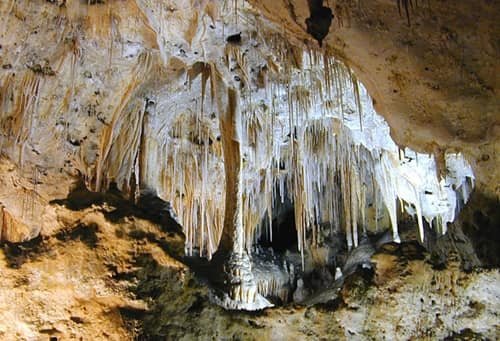
Carlsbad Caverns National Park Overview
| Category | Details |
| Location | Guadalupe Mountains, southeastern New Mexico |
| County | Eddy County |
| Nearest city | Carlsbad, NM (about 18–20 miles away) |
| Nearest airport | El Paso International (ELP) or Midland-Odessa, TX |
| Established | National monument October 25, 1923; national park May 14, 1930 |
| Total area | About 46,766 acres |
| Entrance fee | $15 per person, ages 16 and older (free for 15 and under) |
| Timed entry reservation | Required to enter Carlsbad Cavern, purchased separately from the entrance fee |
| America the Beautiful Annual Pass | $80 (all U.S. national parks); free access with pass |
| Big Room size | Almost 4,000 feet long, 625 feet wide, 255 feet high |
| Documented caves | 117 known caves within the park |
| UNESCO status | World Heritage Site since 1995 |
| Annual visitation | Around 410,000 visitors |
Where Carlsbad Caverns National Park Is Located
Carlsbad Caverns National Park sits in the Guadalupe Mountains of southeastern New Mexico, with the park entrance located on U.S. Highway 62/180 roughly 18 to 20 miles southwest of the town of Carlsbad, where most visitors find lodging. El Paso International Airport and the Midland-Odessa area in Texas both offer reasonable air access, with a drive of a couple hours needed to reach the park from either.
This corner of New Mexico functions as a genuine multi-park destination: Guadalupe Mountains National Park sits only about 30 minutes away across the Texas border, and White Sands National Park lies a bit further west, making it common for visitors to combine two or three parks into a single Southwest trip.
What It Costs to Visit
Entry costs $15 per person for anyone 16 and older, with visitors 15 and under admitted free. The America the Beautiful Pass also covers admission entirely, making it a strong option for anyone planning a broader national park trip through the region.
The detail that catches many visitors off guard: getting into Carlsbad Cavern itself requires a separate timed entry reservation, purchased in advance online or by phone, distinct from the entrance fee itself. Reservations are strongly recommended and only reserve your entry time slot; the actual entrance ticket still needs to be purchased at the visitor center upon arrival. That entrance fee grants access to explore the majority of Carlsbad Cavern independently along the Big Room and Natural Entrance trails, reachable either by elevator or by hiking in through the natural entrance yourself. Audio guides are available to rent separately at the visitor center gift shop for those wanting more context during a self-guided visit.
Pets are not allowed anywhere in the cavern, on unpaved surface trails, during the Bat Flight Program, or inside the visitor center, though a kennel is available on-site for visitors traveling with animals.
Facts That Make Carlsbad Caverns Extraordinary
The Big Room stands as the largest single underground chamber accessible to the public in North America, stretching almost 4,000 feet long, 625 feet wide, and rising 255 feet high, covering roughly 8.2 acres of cave floor. Carlsbad Cavern is just one of 117 known caves documented within the park, part of a Permian-age fossil reef laid down by an inland sea roughly 265 million years ago.
Nearby Lechuguilla Cave, made famous through nature documentaries like Planet Earth, ranks as the nation’s deepest and third-longest limestone cave at 1,604 feet, though it remains closed to the general public and accessible only for specialized scientific research. Temperatures throughout the accessible caves stay remarkably consistent year-round, holding steady around 56°F with high humidity regardless of the desert heat outside.
Beyond the caves themselves, the park protects more than 50 miles of aboveground desert trails, and archaeological evidence shows American Indians inhabited the surrounding Guadalupe Mountains as far back as 12,000 to 14,000 years ago, leaving behind cooking ring sites and pictographs still found within the park’s present-day boundaries.
The History Behind Carlsbad Caverns National Park
Long before tourism arrived, this cave system attracted commercial interest for a very different reason: massive deposits of bat guano, valuable at the time as agricultural fertilizer. Mining operations extracted guano from the cave beginning in the early 20th century, and it was during this extraction work that the true scale of the cavern system began to draw broader attention.
Jim White, a young cowboy working in the area, is widely credited with extensively exploring and popularizing the cave in the early 1900s, eventually leading tours himself and helping build public awareness of its significance. That growing recognition led President Calvin Coolidge to designate the site Carlsbad Cave National Monument on October 25, 1923, protecting the cavern under federal oversight for the first time.
Continued exploration and mounting scientific interest eventually pushed for stronger protection, and Congress upgraded the site to full national park status on May 14, 1930. UNESCO later recognized the park’s global significance, designating it a World Heritage Site on December 6, 1995, citing both its exceptional cave formations and its role as a well-preserved example of Permian-era reef geology. Roughly two-thirds of the park’s total acreage has since been set aside as designated wilderness, ensuring the surrounding desert habitat remains permanently protected alongside the cave system itself.
Frequently Asked Questions
Q1. Do I need to book a timed entry reservation even for a self-guided cave visit?
Yes. Timed entry reservations are required to enter Carlsbad Cavern regardless of whether you’re joining a ranger-led tour or exploring independently along the Big Room and Natural Entrance trails. Book online in advance, since same-day availability isn’t guaranteed.
Q2. Can I watch the bat flight without paying a separate fee?
The Bat Flight Program, typically held seasonally at the natural entrance amphitheater, is included with your standard park entrance and doesn’t require an additional ticket, though pets are not permitted at this specific event.
Q3. Is hiking into the cave through the natural entrance harder than taking the elevator?
Yes, the natural entrance route involves a steep, roughly 750-foot descent on a paved but demanding trail, taking about an hour. The elevator offers a much easier alternative for visitors with mobility concerns or limited time, though the elevator serves as the exit route for all visitors regardless of entry method.
Q4. How far in advance should I book if visiting during peak summer season?
Book your timed entry reservation as early as possible, ideally several weeks ahead, since June, July, and August along with weekends near Memorial Day and the Fourth of July represent the park’s busiest periods and slots can fill accordingly.