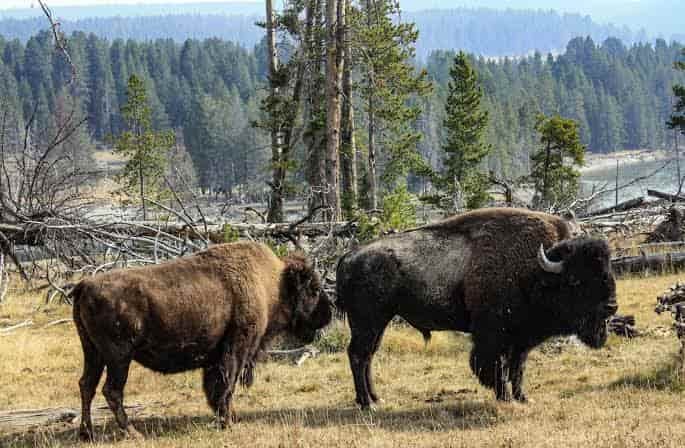
There’s a moment every first-time visitor to Yellowstone has, usually somewhere along the Grand Loop Road, when the landscape just stops making sense. Steam rises out of the ground for no visible reason. A river runs bright blue-green next to one that’s rust orange. A bison the size of a small car walks past your windshield like it owns the place — which, honestly, it kind of does. That’s Yellowstone. It doesn’t ease you in.
Whether you’re planning a summer road trip, researching for a school project, or just curious why this park keeps showing up on every “must-see in America” list, here’s what actually matters: where it is, what it costs to get in, and why it earned the title of the world’s first national park.
Here’s an overview table for the article — built to actually help a reader planning a visit, not just filler stats:
| Category | Details |
| Location | Northwest Wyoming, extending into Montana and Idaho (96% WY / 3% MT / 1% ID) |
| Nearest towns | West Yellowstone, MT; Gardiner, MT; Cody, WY; Jackson, WY |
| Nearest airports | Bozeman Yellowstone International (BZN), Jackson Hole Airport (JAC) |
| Established | March 1, 1872 — world’s first national park |
| Total area | ~2.2 million acres (3,472 sq. miles) |
| Entrances | North, Northeast, East, South, West (5 total) |
| Vehicle entrance fee (2026) | $35, valid 7 consecutive days |
| Motorcycle/snowmobile fee | $30 |
| Per-person fee (foot/bicycle) | $20 |
| Yellowstone Annual Pass | $70 (park-specific, U.S. residents) |
| America the Beautiful Annual Pass | $80 (covers all U.S. national parks, 12 months) |
| International visitor surcharge (2026) | $100 additional per person (waived with an annual/interagency pass) |
| Children under 16 | Free entry, no pass required |
| Highest elevation | 11,372 ft (Eagle Peak) |
| Lowest elevation | 5,282 ft (Reese Creek) |
| Active geysers | 500+ |
| Hydrothermal features | 10,000+ |
| Waterfalls | 290+ |
| 2024 visitation | ~4.75 million recreational visits |
| UNESCO status | Biosphere Reserve (1976), World Heritage Site (1978) |
| Best time to visit (fewer crowds) | Late September–early October |
| Governing body | U.S. National Park Service |
Where Is Yellowstone National Park Located
Yellowstone sits mostly in the northwest corner of Wyoming, though it spills over into Montana and Idaho too. The park spans roughly 63 miles from north to south and 54 miles east to west, with about 96% of its land in Wyoming, 3% in Montana, and the remaining 1% in Idaho.
That three-state spread is part of why access varies so much depending on where you’re coming from. There are five entrances — North, Northeast, East, South, and West — and each one funnels you in through a different kind of scenery. The West Entrance, near the town of West Yellowstone, Montana, is the busiest by far. The Northeast Entrance, which winds through the Lamar Valley, tends to reward patient drivers with the best wildlife sightings.
If you’re flying in, Bozeman Yellowstone International Airport and Jackson Hole Airport are the two most convenient options, though both still leave you with a couple of hours of driving. That’s by design. Yellowstone was never meant to be a quick stop.
Yellowstone Entrance Fees and Ticket Prices for 2026
Here’s where a lot of trip planning goes sideways, because fee structures aren’t as simple as “one price fits all.” For U.S. visitors, 2026 entry costs $35 for a private, non-commercial vehicle, $30 for motorcycles or snowmobiles, and $20 per person for those arriving on foot or by bicycle. That pass covers seven consecutive days, so if you’re splitting your trip across Yellowstone and nearby Grand Teton, you get real value out of a single vehicle pass.
If you plan on visiting more than once a year, or you’re bouncing between several national parks, the math changes in your favor pretty quickly. The America the Beautiful Annual Pass runs $80 and covers unlimited visits to every National Park Service site nationwide for twelve months. For visitors who only care about Yellowstone specifically, there’s also an annual pass limited to just this park, which makes sense if you’ve got family nearby or you’re the type who comes back every summer.
One thing worth flagging for anyone reading this from outside the U.S.: the Interior Department introduced a new $100 surcharge on international visitors starting January 1, 2026, added on top of the standard entrance fee. It applies at Yellowstone and ten other heavily visited parks. That surcharge doesn’t apply to visitors holding an Annual or America the Beautiful Pass, so if you’re planning multiple park visits during a longer U.S. trip, it’s worth buying one before you arrive.
A quick note on kids: entry for children under 16 has traditionally been free at most national parks, so families shouldn’t expect to pay per-child on top of the vehicle fee.
Yellowstone National Park: Facts Worth Knowing
Numbers alone don’t capture what makes this place strange and wonderful, but they help set the scale.
- Size: Yellowstone covers about 3,472 square miles, or roughly 2.2 million acres — bigger than Rhode Island and Delaware combined.
- Geothermal features: the park holds more than 10,000 hydrothermal features and over 500 active geysers, more than anywhere else on Earth.
- Elevation extremes: the highest point sits at 11,372 feet, while the lowest, Reese Creek, sits at 5,282 feet.
- Wildlife: the park is home to one of the densest concentrations of large mammals in the lower 48 states, including free-ranging bison herds, elk, grizzly bears, and reintroduced gray wolves.
- Waterfalls: Yellowstone has more than 290 waterfalls scattered across its river canyons.
- Recent visitation: the park welcomed nearly 4.75 million recreational visits in 2024, its second-busiest year on record.
None of this is trivia for trivia’s sake. If you’re planning a trip, that geyser density means Old Faithful is far from the only show in town, and that wildlife density means dawn and dusk drives through Lamar Valley are worth rearranging your schedule for.
The History Behind America’s First National Park
Long before Yellowstone had a name recognized worldwide, Native American peoples had lived on, hunted, fished, and used this land for more than 10,000 years, gathering plants and quarrying obsidian, treating the geothermal waters as sacred ground rather than a tourist curiosity.
By the mid-1800s, reports from mountain men describing boiling rivers and steaming earth sounded so far-fetched that most people back East assumed they were exaggerating. It took formal expeditions, complete with photographs and geological surveys, to convince Congress the place was real and worth protecting. On March 1, 1872, President Ulysses S. Grant signed the act establishing Yellowstone, and with no real precedent to follow, the early park was a bit of a mess: no funding, no ranger salary, and no enforcement mechanism to speak of. Poachers and squatters moved in fast, and it eventually took the U.S. Cavalry stepping in to bring order until the National Park Service was formally created decades later.
The park’s global stature grew over the twentieth century. UNESCO designated it a Biosphere Reserve in 1976 and a World Heritage Site in 1978, cementing what visitors already sensed just by standing at the rim of the Grand Canyon of the Yellowstone: this landscape belongs to more than just one country’s history.
Frequently Asked Questions
Q1. Do I need a timed-entry reservation to visit Yellowstone?
No. Unlike some parks such as Zion or Arches, Yellowstone doesn’t currently require timed-entry permits for general access. You do need reservations for lodging and campgrounds well in advance, especially for summer visits.
Q2. What’s the best time of year to avoid crowds but still see the geysers and wildlife?
Late September through early October offers a solid middle ground. Roads and most facilities are still open, crowds thin out noticeably after Labor Day, and wildlife tends to be more active as animals prepare for winter.
Q3. Can I see Yellowstone in a single day?
You can hit the highlights — Old Faithful, Grand Prismatic Spring, and maybe the Upper Falls — but it’ll be a long, tightly scheduled day of driving. Most seasoned visitors recommend at least three days to see the park’s five distinct regions without constant rushing.
Q4. Are pets allowed on Yellowstone’s trails?
Pets are permitted in developed areas, parking lots, and campgrounds, but they’re not allowed on boardwalks, trails, or backcountry areas. This is largely for safety, given the wildlife and unstable thermal ground.