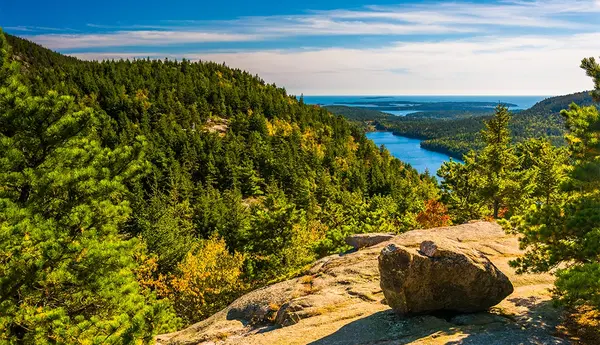
For much of the year, the first rays of sunlight to touch the continental United States land on top of Cadillac Mountain, inside Acadia National Park. That single fact tells you something about this place: it’s a park built around edges — where granite meets ocean, where forest gives way to fog, where the eastern United States runs out of land entirely. Unlike the sprawling wilderness of the western parks, Acadia packs its drama into a comparatively small footprint of coastal Maine, and somehow that makes it feel more intimate rather than less impressive.
Here’s what to know if you’re planning a trip: where the park sits, what it costs, the numbers that define it, and how a wealthy conservationist’s stubborn land purchases turned into the first national park east of the Mississippi.
Acadia National Park Overview
|
Category |
Details |
|
Location |
Coastal Maine, primarily on Mount Desert Island |
|
Counties |
Hancock and Knox |
|
Nearest town |
Bar Harbor |
|
Nearest airport |
Hancock County–Bar Harbor Airport (BHB), ~10 miles away; Bangor International (BGR), about an hour away |
|
Established |
July 8, 1916 (as Sieur de Monts National Monument); renamed Acadia in 1929 |
|
Total area |
About 49,000 acres across Mount Desert Island, Schoodic Peninsula, and Isle au Haut |
|
Vehicle entrance fee |
$35, valid 7 consecutive days |
|
Motorcycle fee |
$30 |
|
Per-person fee (foot/bicycle) |
$20 |
|
Acadia Annual Pass |
$70 |
|
America the Beautiful Annual Pass |
$80 (all U.S. national parks) |
|
International visitor surcharge (2026) |
$100 per person, age 16+ (waived with a qualifying annual pass) |
|
Coastline protected |
Over 64 miles |
|
Highest point |
Cadillac Mountain, 1,530 feet |
|
Island Explorer shuttle |
Free, seasonal, connects the park with Bar Harbor and surrounding towns |
|
2025 visitation |
Just over 4 million visitors |
|
First national park |
East of the Mississippi River |
Where Acadia National Park Is Located
Acadia sits along the mid-coast of Maine, roughly three hours north of Portland and about an hour from Bangor. The bulk of the park — around 30,000 acres — covers Mount Desert Island, a chunk of granite and forest connected to the mainland by a short causeway near the town of Trenton. From there, the park also stretches to the quieter Schoodic Peninsula on the mainland and to Isle au Haut, a remote island accessible mainly by mailboat.
Most visitors base themselves in Bar Harbor, a small town that sits right at the park’s edge and fills up fast during summer and peak fall foliage season. If you’re flying in, Bar Harbor’s own small airport is the closest option, though Bangor International offers more flight choices for a slightly longer drive.
What makes Acadia’s geography unusual among national parks is how fragmented it is. Rather than one continuous protected wilderness, it’s a patchwork of donated and purchased parcels, stitched together over more than a century — a detail that shapes both its layout and its history.
What a Ticket to Acadia Costs
Entry follows the same structure used across most national parks. A private vehicle pass runs $35 and covers everyone inside for seven consecutive days. Motorcycles pay $30, and visitors arriving without a vehicle pay $20 per person.
Regular visitors, especially those who live nearby or return every season, typically buy the $70 Acadia Annual Pass. Anyone planning to visit several national parks during the year tends to go with the $80 America the Beautiful Pass instead, which covers admission to every federal recreation site in the country for twelve months.
As of January 1, 2026, Acadia joined ten other high-traffic parks in charging non-U.S. residents an additional $100 surcharge per person, on top of the standard entrance fee. For a family of four visiting from overseas, that can mean paying $435 just to drive through the entrance station in a rental car. The alternative is a $250 non-resident annual pass, which waives the per-person surcharge and covers everyone traveling in the same vehicle — often the better deal for groups or families planning more than a single visit.
One cost-saving detail worth knowing: the Island Explorer shuttle system that runs throughout the park and into Bar Harbor is completely free, funded in large part by entrance fee revenue, making it easy to skip parking headaches during the busiest summer weeks.
Facts Worth Knowing About Acadia
Acadia protects more than 64 miles of Maine’s rugged coastline, along with granite peaks, glacially carved ponds, and a mix of temperate and boreal forest that shifts noticeably depending on elevation and exposure to the Atlantic. Cadillac Mountain, the park’s highest point at 1,530 feet, is famous for being one of the first places in the country to catch the sunrise for part of the year, a detail that draws crowds well before dawn during peak season.
The park’s carriage roads are another signature feature — 45 miles of crushed-stone paths built for horse-drawn travel in the early 20th century, funded almost entirely by John D. Rockefeller Jr., who spent years and a personal fortune shaping the park’s early infrastructure.
Acadia has also weathered disaster. In the fall of 1947, wildfires tore through more than 10,000 acres of the park during what Mainers still call “the year Maine burned.” The fire reshaped parts of the landscape permanently, though restoration efforts, heavily supported by the Rockefeller family, brought the park back within a matter of years.
The History Behind Acadia National Park
Long before European contact, the Wabanaki people used Mount Desert Island seasonally for fishing and gathering, a relationship with the land that stretches back thousands of years. European history arrived with Samuel de Champlain in 1604, who damaged his ship’s hull near the island and gave it the name Isle des Monts Déserts, or “island of bare mountains,” for the peaks he saw rising above the treeline.
The push toward federal protection began with George B. Dorr, a wealthy conservationist troubled by the rapid development creeping into Bar Harbor in the early 1900s. Dorr spent over four decades of his life and much of his family’s fortune acquiring land for public preservation, eventually offering thousands of acres to the federal government. President Woodrow Wilson accepted, creating Sieur de Monts National Monument on July 8, 1916.
The designation changed twice in the years that followed. In 1919, the monument became Lafayette National Park, honoring the Marquis de Lafayette and making it the first national park established east of the Mississippi River. A decade later, in 1929, following the addition of land on the Schoodic Peninsula, the park took its current name: Acadia, a nod to the historic French name for the region.
Much of what visitors experience today — the carriage roads, stone bridges, and layout of the Park Loop Road — traces directly back to Rockefeller’s involvement during the 1920s and 30s, work later supplemented by Civilian Conservation Corps labor during the Depression era.
Frequently Asked Questions
Do I need a reservation to drive up Cadillac Mountain for sunrise?
Yes, during the peak season (typically May through October), the National Park Service requires a separate vehicle reservation for driving up Cadillac Summit Road, especially for sunrise viewing. This is separate from your park entrance fee and should be booked well in advance.
Is the Island Explorer shuttle really free, and does it run year-round?
It’s free, but seasonal — typically running late spring through Columbus Day. Outside that window, you’ll need your own vehicle to get around the park and connect between Bar Harbor and the various trailheads.
What’s the best time to see fall foliage in Acadia?
Late September through mid-October usually offers the best color, though exact timing shifts year to year depending on weather. This is also one of the busiest periods, so lodging in Bar Harbor books up early.
Can I visit Acadia’s other sections, like Isle au Haut, without a boat of my own?
Yes. A passenger mailboat runs from Stonington to Isle au Haut seasonally, and it’s the primary way visitors without private boats reach that quieter, less-developed section of the park.